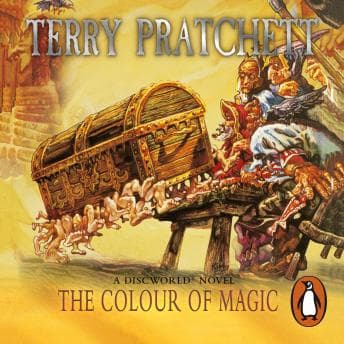

So here's the thing about The Colour of Magic that nobody warns you about: it's not actually Pratchett's best work. There. I said it. Every Discworld fan knows this. It's the rough draft of a genius finding his voice, the blueprint before the mansion. And yet—there's something genuinely magical about listening to where it all began.
I went into this expecting the sharp satirical wit that made me fall in love with later Discworld novels. What I got instead was something looser, weirder, more overtly fantasy-parody than the philosophical comedy Pratchett would eventually perfect. Rincewind stumbling through set pieces. Twoflower being aggressively optimistic in the face of certain death. The Luggage doing Luggage things. It's chaotic in a way that feels almost experimental.
Tony Robinson Gets It (Mostly)
Look, Tony Robinson clearly loves this material. His passion bleeds through every sentence, and when he's on, he's really on. The way he voices Death—that dry, cosmic inevitability—works beautifully. His Rincewind captures that perfect blend of cowardice and reluctant heroism. And his pronunciation of Discworld's absurd place names? Flawless. The man did his homework.
But—and this is a significant but—there are moments where his enthusiasm outpaces the material. He rushes through some passages like he's trying to catch a train, and certain character voices blur together in ways that made me rewind more than once. The female characters especially suffer; some of their dialogue comes through so quietly I had to crank my volume up, only to get blasted when we cut back to the main action. (My cat Shirley was not impressed. She's heard enough audiobook jump-scares for one lifetime.)
The bigger issue? This is the abridged version. Three hours for a Pratchett novel should've been my first red flag. You can feel the missing pieces—transitions that don't quite land, jokes that seem to be missing their setups. It's like watching a movie where someone cut every other scene. The story still works, technically, but you're constantly aware something's been taken from you.
The Disc Before It Was Perfect
Here's what's fascinating about listening to this now, after consuming most of the Discworld series: you can hear Pratchett figuring it out in real time. The satire is broader here, less subtle. The worldbuilding is more concerned with being clever than being true. Later books would make the Disc feel like a real place with real problems wearing absurdist masks. This one? It's still a theme park.
And honestly? That's fine. Not every book needs to be the peak of a series. The Colour of Magic is a portal, not a destination. It's the invitation to spend the next forty-odd books watching a writer become one of the greats.
The fantasy parody elements hit differently now than they would have in 1983. Rise of Nine tries for that same self-aware energy, though it never quite reaches Pratchett's level of chaos. We've had decades of Pratchett imitators, decades of self-aware fantasy comedy. Some of the jokes feel almost quaint. But there's a freshness to the chaos, a sense of "what if we just did whatever we wanted?" that later, more polished Discworld novels traded for depth.
The Abridged Elephant in the Room
I can't review this without addressing the obvious: if you're serious about Discworld, you probably want the unabridged version narrated by Nigel Planer. Robinson brings heart, but Planer brings completeness. And with Pratchett, every digression, every footnote, every seemingly throwaway observation is doing work. Cutting them isn't just trimming fat—it's removing muscle.
That said, if you're commuting and want a taste of where Discworld began? This works. It's three hours of mostly charming chaos with a narrator who genuinely cares. Just know you're getting the highlight reel, not the full experience.
Who's This For (And Who Should Run Away Like Rincewind)
For Discworld completionists who've already read the book? Sure, throw it on during a drive. Robinson's enthusiasm is infectious, and hearing Death's dialogue performed aloud adds something the page can't quite capture. For newcomers? Honestly, start with Guards! Guards! or Mort. Come back to this one later, when you love the Disc enough to appreciate its awkward teenage phase. Skip this version entirely if you're an audiobook purist who can't stand knowing chunks are missing—it'll drive you mad.
The Foundation, Not the Mansion
This is the foundation of something extraordinary. It's just not extraordinary yet. And that's okay. Even Shirley Jackson had to start somewhere. (My cat remains indifferent to this observation.)









