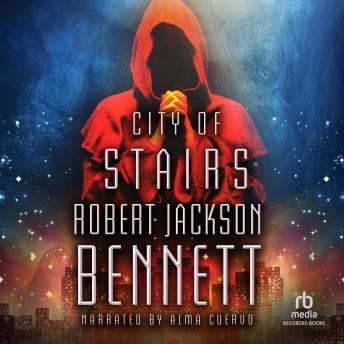

Robert Jackson Bennett built a world where dead gods left scars on reality itself, and I'm sitting here wondering why I spent three years on procedural generation when this is what world-building looks like.
City of Stairs is the kind of fantasy novel that makes you want to redesign your entire D&D campaign from scratch. I was supposed to be debugging my thesis code on a Saturday afternoon. Instead I had my headphones in, staring at a terminal I hadn't touched in two hours, completely lost in Bulikov.
The Gods Died But Their Miracles Didn't Get The Memo
Here's the premise that hooked me: gods literally shaped the city of Bulikov with thousands of miracles - warping architecture, bending physics, creating impossible spaces. Then someone killed the gods. But the city didn't fully snap back. So you've got staircases that lead to rooms that shouldn't exist, walls that open onto streets in the wrong part of town, and an entire population trying to pretend this isn't deeply, cosmically weird.
This is Sanderson-level world-building, but with a post-colonial political framework that adds real weight. The Continent (Bulikov's homeland) used to enslave Saypur using divine power. Now Saypur rules the Continent, and there's this raw tension between oppressor-turned-oppressed and the uncomfortable question of whether the formerly colonized people are now just doing the same thing back. Bennett doesn't hand you easy answers. The magic system is chef's kiss - it's not about fireballs and enchantments, it's about the residual physics-breaking effects of divine will, and the political implications of miracles being illegal.
Shara Thivani is a spy who's basically an academic with a license to cause problems. She's obsessed with history in a world where history has literally been outlawed - the Saypuri government banned the study of the Continent's divine past. So she's navigating this murder investigation while secretly being the world's foremost expert on things she's not supposed to know about. And her bodyguard Sigrud is this massive, terrifying Dreyling man who speaks in short sentences and commits acts of incredible violence with minimal commentary. My D&D group would love this - Shara's the wizard who dumped STR and maxed INT, Sigrud's the barbarian with a tragic backstory who lets his axe do the talking. The same "brilliant mind paired with unstoppable muscle" dynamic actually shows up in Black Powder War, though that one leans harder into the action and lighter on the political chess.
The progression is satisfying in a way that rewards patience. The first few hours are dense - Bennett is laying political groundwork, establishing the power dynamics between Saypur and the Continent, introducing you to a naming system that takes some getting used to. If you don't like info-dumps, this isn't for you (but you're wrong). By about hour five, though, the murder mystery starts pulling threads that unravel the entire theological and political foundation of the world, and suddenly all that setup pays off hard.
Alma Cuervo and the Shatner Problem
Okay, so. The narration. This is where it gets complicated.
Alma Cuervo is expressive and animated with female characters. She's consistent, she's got good energy, and her reading of Shara specifically works well - you can hear the intelligence and the careful diplomatic restraint. But her male voices have this... thing. People call them "Shatner pauses" and honestly that's accurate. There are these unnatural gaps between words when she's voicing male characters - especially Sigrud - where it sounds like she's reading each word individually instead of in flowing speech. "I... will... handle... this." That kind of cadence.
It's not a dealbreaker, but it is noticeable. Especially because Sigrud is supposed to be this laconic, dangerous presence, and instead he sometimes sounds like a GPS recalculating. Steven Pacey walked so other narrators could run, and I kept thinking about what someone like him would do with Sigrud's quiet menace versus what we actually got. The editing also feels rough in spots - occasional audio quality shifts that suggest takes were stitched together without enough smoothing.
I bumped the speed to 1.25x and honestly it helped with the pacing issues in the male dialogue. Made the pauses feel more like deliberate brevity instead of technical difficulty.
Who Gets The Keys To Bulikov
This is for you if: you love secondary-world fantasy that takes its politics as seriously as its magic, you've ever wished your epic fantasy addressed colonialism with actual complexity instead of just putting elves in charge, or you're the kind of person who reads worldbuilding wikis for fun. Yes, it's nearly 18 hours. Yes, it's worth it.
Skip it if: you need a fast start, you're purely audio-dependent and can't tolerate narrator inconsistency in male voices, or you want your fantasy to stay away from political philosophy.
I read this instead of writing my thesis, and I regret nothing. Bennett built something special here - a city that feels like a character, a magic system rooted in theology and loss, and a spy story that's actually about what happens when you try to bury history. Now I need to start the sequel before Dr. Patel's next check-in email.