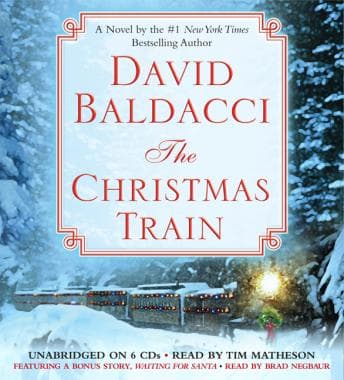

Look, I need to get something off my chest: David Baldacci writing a Christmas romance is like finding out your neighbor who builds AR-15s in his garage also makes delicate French pastries on weekends. The man has sold 150 million copies of thrillers. Political conspiracies. Government assassins. And then he sits down and writes a book about a guy finding love on a train during the holidays. I respect the audacity even when the execution makes me want to argue with nobody in particular at midnight.
I finished this one during a faculty holiday party - earbuds in, standing by the punch bowl, nodding along to conversations I wasn't having while Tom Langdon rode Amtrak across America. Denise caught me smiling at one point and assumed I was being social. I wasn't. Tim Matheson had just done something genuinely funny with a Southern accent.
Baldacci Takes Off the Body Armor
Here's what caught me off guard. This isn't a thriller writer trying on a holiday sweater and failing. Baldacci actually commits to the sentimentality. Tom Langdon is a journalist - disillusioned, divorced from the idea of flying after a career covering war zones - forced onto a cross-country train from D.C. to L.A. right before Christmas. The setup is pure Hallmark (literally - they made it into a Hallmark movie), and Baldacci leans into that without much shame.
The problem is Tom himself. He's supposed to be this charming, world-weary reporter rediscovering the goodness in people, but Baldacci keeps interrupting his own story with information dumps about train history and Amtrak logistics that read like someone copy-pasted from a Wikipedia article about American rail travel. By hour two, I knew more about sleeper car configurations than I ever wanted to. My students complain when I spend ten minutes on historical context before we read a poem. I get it now. I owe them an apology.
And Tom's character? He shifts from cynical to sentimental so fast you'd think he was two different people sharing a berth. One scene he's dismissive and self-absorbed, the next he's having these warm epiphanies about strangers. The transitions don't earn themselves. If you loved the slow emotional unraveling of a character like Stevens in The Remains of the Day, this is... not that. This is more like someone flipping a light switch labeled "FEELINGS" every other chapter.
But - and I want to be fair here - the ensemble of train passengers works. Baldacci populates that locomotive with eccentrics and misfits who feel like they wandered in from a screwball comedy. There's genuine warmth in those interactions, even when the plot telegraphs its punches from three states away.
Tim Matheson Earns His Ticket
Here's where this audiobook surprised me. Tim Matheson - and yes, that's the Tim Matheson, Otter from Animal House, which is a sentence I never expected to write in a book review - has this silky, unhurried delivery that suits the material perfectly. The narrator understands that pause is punctuation. He doesn't rush through the quieter moments, and his comic timing with the dialogue is better than the writing probably deserves.
His character work leans broad. We're talking thick accents for the colorful passengers - Southern drawls, gruff conductors, the works. It's not subtle. But subtlety would be wrong here. This is a book where a screenwriter and a film director are secretly plotting a movie on the train. Broad is the correct key to play in. The French Gardener pulled off a similar trick — broad strokes, predictable warmth, and somehow it worked better than it had any right to.
Now, the production. They added sound effects - train whistles, bells, conductor announcements, the rhythmic clatter of wheels on track. And I'll be honest: at 1.0x, sitting still with good headphones, it's immersive. It genuinely creates atmosphere. But I can absolutely see how this would be maddening in a car. You're driving, a train whistle blasts in your ear, and suddenly you're checking your mirrors for a locomotive. Fair warning.
Who Should Board and Who Should Stay on the Platform
If you want literary fiction that rewards close reading, skip this. My students would hate this. Actually no - my students would probably love this. I'm the one who wants more from the prose. The writing is functional, sometimes charming, but it's not the kind you pause to admire.
But if you want something warm and undemanding for a holiday drive (with the caveat about those train sounds), or if you're decorating the tree and want company that won't ask too much of you, Matheson's narration elevates this into pleasant territory. It's eggnog in audiobook form - sweet, a little rich, and you probably don't want too much of it.
At seven hours, it doesn't overstay its welcome. The predictability is a feature if you're in the right mood. You know where this train is going. You know Tom's going to find love and meaning. The question is whether you enjoy the scenery along the way.
The Red Pen, One Last Time
This reminds me of what Hemingway said about prose being architecture, not interior decoration. Baldacci built a solid enough structure here - the train framework, the ensemble cast, the ticking clock of Christmas Eve. But he decorated it with information dumps and character inconsistencies that a good editor should've flagged. Matheson papers over the cracks with genuine skill. The prose doesn't always deserve to be savored, but Matheson makes you savor it anyway.
Worth pausing the faculty meeting for? Honestly, only during the slow parts of the budget presentation. Which is most of it.