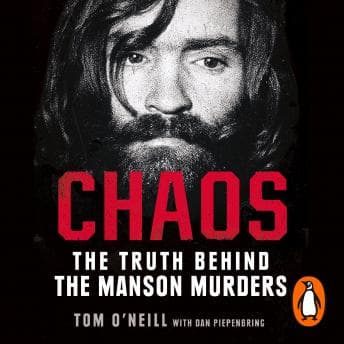

I was three hours into this audiobook, sitting in the hospital break room at 4 AM eating cold lumpia my mom packed me, when I realized I'd forgotten to chart on two patients because I was so deep into Tom O'Neill's rabbit hole about the Manson murders. That's either a recommendation or a safety violation. Maybe both.
Here's the thing - I picked this up thinking it'd be a solid true crime listen for my commute home. Something dark enough to match the 6 AM desert light, gritty enough to keep me awake on the I-10. What I got instead was a sixteen-hour investigative journalism odyssey that genuinely made me question things I thought were settled history. And I am not someone who questions settled history. I'm a nurse. I believe in evidence. I chart everything.
When the "Official Record" Starts Looking Like Bad Charting
O'Neill starts this book as a magazine journalist assigned a simple anniversary piece on the Manson murders. Thirty years later, nothing new to say, right? Wrong. What begins as routine reporting turns into a twenty-year obsession as he starts pulling threads in prosecutor Vincent Bugliosi's famous narrative from Helter Skelter - and those threads just keep coming. The motive doesn't hold up. The timeline has gaps. Law enforcement had multiple opportunities to stop Manson and didn't. Why?
As someone who's actually worked a code, I know what it looks like when documentation doesn't match reality. When the chart says one thing but the patient's body tells a different story. That's essentially what O'Neill found - the official story of the Manson murders reads clean on paper, but the deeper he digs, the more inconsistencies bleed through. Connections to the CIA's MK-Ultra program. Manson's free clinic visits at a facility with ties to government mind-control research. An informant relationship that nobody wanted to acknowledge. Each revelation builds on the last until you're sitting in your car in the hospital parking lot, engine off, staring at nothing, thinking what the hell.
And O'Neill is careful. Frustratingly careful, actually. He doesn't make claims he can't support. He lays out hundreds of new interviews, declassified documents from the LAPD, FBI, and CIA, and lets you sit with the discomfort of not having a neat answer. This is not some late-night YouTube conspiracy rant. This is a journalist who destroyed his own career and relationships chasing a story because the evidence wouldn't let him stop.
Kevin Stillwell Reads Like a Man Who Knows He's Carrying Dynamite
Stillwell's narration is steady. Calm. Almost clinical. And honestly? That's exactly right for this material. You don't want someone breathlessly dramatizing government conspiracies and cult murders - you want a voice that sounds like it's presenting evidence to a grand jury. Matter-of-fact. Let the content do the screaming.
He doesn't do distinct character voices, which normally I'd ding, but this isn't a character-driven novel. It's investigative nonfiction with so many names, dates, and institutional connections that what you really need is clarity. Stillwell delivers that. He keeps the throughline audible even when O'Neill is zigzagging between Hollywood parties, CIA black sites, and Haight-Ashbury free clinics. At sixteen-plus hours, that's no small feat.
My one caveat: this is dense. Like, ICU-charting-on-a-multi-system-failure dense. There were stretches during my commute where I'd zone out for thirty seconds and miss a crucial connection between some FBI handler and a Manson associate. I had to rewind more than once. This is not background listening. This is not a housework audiobook. You need to be present.
The Part That Made Me Yell at My Dashboard
I yelled at my dashboard during this one, but not because O'Neill got something wrong. I yelled because the implications of what he found are genuinely disturbing. The idea that Manson may have been - knowingly or not - connected to government experiments in social control and psychedelic manipulation? That law enforcement let him operate because he was useful? That Bugliosi, America's hero prosecutor, may have been building a narrative that served institutional interests more than truth?
O'Neill never fully lands on a single alternative theory, and I respect that even as it frustrated me. He's honest about what he can prove and what remains in shadow. The book ends without a neat bow, which - okay, it's maddening. But it's also honest. Real investigations don't wrap up clean. I see that every shift.
Who Needs This in Their Ears
If you're into deep investigative nonfiction - the kind where a journalist burns twenty years of his life chasing something everyone told him to drop - this is your book. True crime fans who've only read Helter Skelter absolutely need this counterweight. History buffs who want to understand the darker machinery of 1960s America, same. That same appetite for the buried, uncomfortable version of American history is what drew me to Miracles and Massacres, though I'll warn you upfront that one left me considerably less unsettled than this did.
Skip it if you need fast resolution or can't handle ambiguity. Skip it if you only have ten-minute listening windows - you'll lose the thread. And maybe skip it if you're already prone to conspiracy thinking, because this book will not help. (I mean that kindly.)
Night Shift Discharge Orders
Carlos asked why I was sitting in the driveway for an extra twenty minutes three days in a row. I told him I was on the phone with my mom. I was not on the phone with my mom. I was listening to a journalist explain how Charles Manson might have been a government asset, and I needed to hear how it ended before I could go make pancakes and pretend the world made sense. Night shift approved - but only if you're ready to have your understanding of a famous case dismantled, brick by brick, with no promise that someone's going to rebuild it for you.