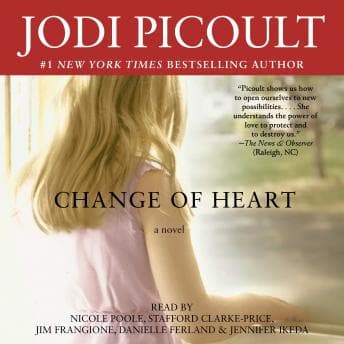

What would you actually do if the only person who could save your child's life was the person who destroyed your family?
I've read a handful of Jodi Picoult books over the years - the woman has a talent for finding the exact moral dilemma that will keep you up at night arguing with yourself. But Change of Heart hit different for me, probably because I listened to most of it during Sophie's nap times and those sacred 45 minutes in the car, and something about sitting alone in a quiet garage while a mother wrestles with whether to accept a heart transplant from her daughter's killer... yeah. That'll get you.
The Question That Won't Leave You Alone
So here's the setup: June Nealon lost her husband and stepdaughter to Shay Bourne, who's now on death row. Her surviving daughter Claire needs a heart transplant. And Shay - who may or may not be performing actual miracles in prison - wants to donate his heart to Claire before he's executed. Which means June has to decide whether to let the man she hates most in the world literally become part of her child.
Picoult doesn't let you sit comfortably with any easy answer. Every time I thought I knew where I stood, she'd shift to another character's perspective and yank the rug out. The book weaves in questions about religion, the death penalty, what constitutes a miracle, and whether forgiveness is even possible when the wound is that deep. It's a LOT. Compared to something like My Sister's Keeper, which stuck closer to one central ethical question, this one casts a wider net - sometimes almost too wide. There are sections about different religious traditions and legal proceedings that felt more like research than story, and I'll be honest, during a few of those courtroom stretches I zoned out and had to rewind after realizing I'd been mentally meal-planning instead of listening.
But the core of it - June's impossible choice - that's the stuff that grabbed me by the throat and wouldn't let go.
Five Narrators and I Could Actually Keep Track
This is where the audiobook earns its keep. Five narrators - Danielle Ferland, Jennifer Ikeda, Jim Frangione, Nicole Poole, and Stafford Clark-Price - and each one owns their character so completely that even after pausing to break up a fight over who gets the blue cup (it's always the blue cup), I could jump back in and immediately know whose head I was in. Jim Frangione's Shay has this quiet, broken quality that makes you forget for stretches that this character did something monstrous. And Nicole Poole's June carries so much exhaustion and fury that when she finally cracks - you feel it in your chest.
The production is clean, the transitions between narrators are smooth, and nobody sounds like they're performing at you. They sound like people telling you what happened to them. That's a big difference and it matters when you're listening in stolen fifteen-minute chunks between snack requests.
If I'm comparing to other multi-narrator Picoult audiobooks, this one's up there with the best. Way easier to follow than books that try this format and end up confusing you about who's talking.
The Part Where I Have to Be Honest
At 15 hours, this is on the longer side for me. Could it have been tighter? Absolutely. Some of the religious and philosophical detours - while interesting in a "oh that's a cool factoid" way - slowed the emotional momentum. And the ending... look, I won't spoil it, but there's a twist that asks you to take a pretty big leap of faith (pun intended). Some people will roll with it. I almost did. I wanted to. But part of me felt like the book earned a more grounded resolution than the one it chose.
Did I cry at school pickup? Yes. Was it the ugly kind? Not quite - more of a sustained watery-eye situation that I had to blink away before Emma's teacher saw me and asked if I was okay. So. Semi-ugly cry. That counts.
Who This Is For (And Who Should Maybe Not)
If you like books that make you argue with your spouse at dinner about what you would've done - this is your book. If you enjoy Picoult's signature move of showing every side of an impossible situation until you're not sure what you believe anymore - you'll eat this up. Survived 47 pauses and still made sense, which at 15 hours is genuinely impressive.
But if you're looking for something light, something that won't leave a bruise - skip this one. There's violence, there's a child in medical danger, there's death row. It's heavy. Macbeth scratches a similar itch if you want that same darkness without a single comfortable exit ramp — though fair warning, Shakespeare in audiobook form is its own kind of commitment. And if you need your endings tied up in a neat, fully satisfying bow, this might frustrate you.
Car Time Verdict: Worth the Emotional Damage
Not a perfect book. But a powerful one. The kind that made me sit in my garage for an extra ten minutes after Sophie woke up from her nap, just staring at the steering wheel thinking about what it means to forgive someone who took everything from you. My book club will love this - if I ever have time for book club again.