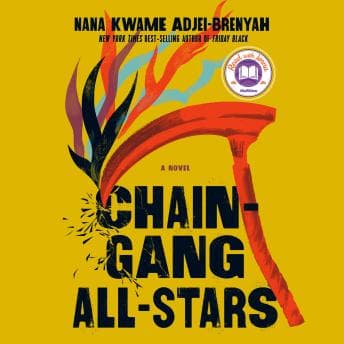

Everyone keeps comparing this book to 1984 and The Handmaid's Tale, and I get it - I do - but I think those comparisons actually undersell what Adjei-Brenyah is doing here. Orwell and Atwood built their dystopias from scratch. Adjei-Brenyah barely had to build anything. He just turned the volume up on what already exists. And that's what made this so much harder to listen to than either of those classics.
I started this one on a Saturday morning walk along the lakefront with Denise. Beautiful day. Sun on the water, joggers passing, the whole postcard version of Chicago. And here I am, earbuds in, listening to prisoners fight to the death for an entertainment-drunk public while corporations count the revenue. Denise asked me why I looked like I'd swallowed something wrong. I told her I was fine. I was not fine.
The Footnotes That Hit Like a Freight Train
Let's talk about what the author is really saying - because Adjei-Brenyah doesn't trust you to just absorb the allegory passively. He interrupts his own narrative with footnotes. Real statistics. Actual data about incarceration rates, about the prison-industrial complex, about who gets locked up and why. In an audiobook, these land differently than they would on the page. You're deep in the story, invested in Thurwar and Staxxx, and then suddenly the narration pulls back to give you a cold fact about private prisons in America, and you realize - oh. He's not exaggerating as much as I wanted to believe.
This is why we still read the classics, and why we need new ones. Because sometimes you need someone to hold up the mirror at an angle you haven't seen before.
The love story between Thurwar and Staxxx carries the emotional weight of the whole thing. These two women who are teammates, lovers, and fellow survivors of a system designed to consume them - their tenderness in the middle of all that violence is what keeps the book from being pure polemic. Adjei-Brenyah earns his brutality because he earns the quiet moments first.
Four Narrators, Zero Weak Links
The full cast here is doing something special. Shayna Small carries the heaviest load - she's voicing prisoners, she's voicing the sensationalizing commentator with that performative excitement, she's doing the chanting protesters outside the arenas. The range is staggering, and she never once lets one character bleed into another. But the performance that stopped me cold was Michael Crouch as Craft. There's this tortured quality to his voice, this broken-mind cadence where you can hear the character's sanity fraying in real time. The narrator understands that pause is punctuation, and Crouch uses silence like a weapon.
And then there's Aaron Goodson, who - I'm not kidding - sings as Hendrix. Actually sings. Tender, aching singing in the middle of a novel about prison gladiators. It shouldn't work. It absolutely works. It's the kind of choice that reminds you audiobooks aren't just delivery systems for text. They're performances.
Lee Osorio rounds things out with Gunny Puddles, complete with a Southern accent that carries just enough menace underneath the drawl. Each narrator owns their territory completely. My students would hate this - too long, too heavy, too many voices asking them to sit with discomfort. I love it. The last time I felt this kind of sustained narrative demand from an audiobook was with Cities of the Plain - McCarthy also refuses to let you breathe, and the weight accumulates in the same slow, crushing way.
The Book That Doesn't Let You Look Away
Here's my one caveat, and I want to be straight about it: this book is a lot. The violence is graphic and intentional. Adjei-Brenyah isn't being gratuitous for shock value - every death match serves the larger argument about what we're willing to watch, what we're willing to permit. But at thirteen and a half hours, the relentlessness can wear on you. I had to take breaks. Not because the quality dipped, but because my stomach needed a minute.
The kaleidoscopic structure - jumping between the Links, the protestors, the CAPE employees, the fans - keeps you off-balance in a productive way. You never get to settle into one comfortable perspective. Just when you're sympathizing with the fighters, you're inside the head of someone who enjoys watching. And that's the crux of it, isn't it? Adjei-Brenyah is asking you to examine your own spectatorship. You're consuming this violence too. The book knows it.
This reminds me of what Toni Morrison said about writing being an act of confrontation. Adjei-Brenyah has written a confrontation dressed as a genre novel, and the four narrators refuse to let you flinch.
Worth Pausing the Faculty Meeting For
If you loved The Handmaid's Tale or Octavia Butler's Parable of the Sower, this is their spiritual successor - angrier, Blacker, and aimed squarely at the America we're living in right now. If you need your dystopias comfortable and distant, skip this one. If you want fiction that grabs you by the collar and makes you reckon with something real, spend the credit. The prose deserves to be savored, and these four narrators deliver it at exactly the intensity it demands.
Principal Martinez, if you're reading this - this is the book I was listening to during last Tuesday's curriculum meeting. And honestly? It was more educational than anything on the agenda.









