
Let me be honest about something that might disqualify me from reviewing this book fairly: I'm an English teacher who spent twenty years training teenagers to analyze texts, and I have a complicated relationship with books that tell me what to do. I bristle at prescriptive literature. I've argued in faculty meetings - the ones I was actually paying attention to - that the best books open questions rather than close them.
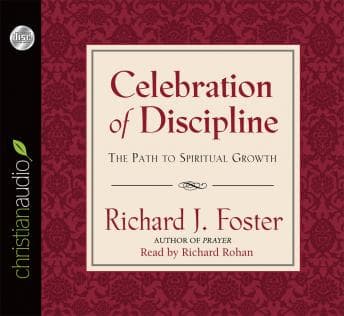
So when Denise handed me Celebration of Discipline and said, with that particular look she has, 'Marcus, maybe just listen,' I wasn't exactly enthusiastic. I loaded it up on a long lakefront walk in late October, the kind of gray Chicago morning where the lake looks like hammered pewter and you can't tell where the water ends and the sky begins. Felt appropriate, somehow, for a book about spiritual practice. Austere. A little demanding.
Foster won me over in the first chapter and lost me slightly by the last. That's the honest arc of this thing.
What Foster Actually Argues (And Why It's Sharper Than You'd Expect)
The premise sounds simple: twelve classical Christian disciplines - things like meditation, fasting, solitude, simplicity, service - practiced intentionally lead to genuine spiritual transformation. But Foster's real argument, the one underneath the practical instruction, is that spiritual growth isn't a matter of willpower. He's explicitly pushing back against the idea that trying harder is the answer. The disciplines, he insists, are not the goal. They're the field where grace does its work.
That's a more interesting theological claim than the book's self-help-adjacent title suggests. This reminds me of what Eliot was doing in Middlemarch - the structure looks like a social novel about marriage and reform, but the real argument is about what happens to human souls over time, quietly, under the surface of visible action. Foster's structure looks like a spiritual how-to guide. The real argument is about surrendering the illusion of control.
He's a Quaker writing for a broadly Christian audience, and that background shows - there's a contemplative quality to his best passages on solitude and prayer that feels genuinely earned rather than performed. The chapter on meditation, in particular, has a stillness to it that I noticed even while walking, which is either a compliment to the prose or an indictment of my attention span. Probably both.
Where Richard Rohan Fits In (Or Doesn't Quite)
I want to be fair here because the research I have on Rohan is thin - no specific strengths flagged, no significant weaknesses either. What I can tell you is that for a book this interior, this reliant on pace and weight, a narrator is either a guide or an obstacle.
Rowan is mostly a guide. His delivery is measured, unhurried - appropriate for content that explicitly asks you to slow down. He doesn't editorialize. There's no interpretive flourish when Foster makes a bold claim; Rohan just reads it and lets it land. For the early chapters, where Foster's writing has genuine momentum and clarity, that restraint works well.
The problem - and this matches what other listeners noticed - is that the later chapters do get drier. Foster moves into disciplines like submission and celebration that are harder to make concrete, and the prose becomes more abstract. Rohan's even-keeled delivery, which felt like wisdom in chapter three, starts to feel like flatness by chapter eleven. The narrator understands that pause is punctuation, but he doesn't seem to know what to do when the text itself loses its grip.
Seven hours is the right length for this material. It doesn't overstay its welcome. But the last ninety minutes could've used a narrator who knew how to carry weight when the words aren't doing it alone.
My Students Would Hate This. I Mostly Loved It.
Here's what I keep coming back to: Foster wrote this book in 1978 and it's sold over a million copies. That's not an accident. There's a reason it's still assigned in seminaries and handed between friends and placed on nightstands. I had a similar feeling reading God's Smuggler - that particular quality a book has when it's clearly been living in people's hands for decades, passed along because something in it refuses to stay quiet. The prose deserves to be savored in the early going, and the central argument - that discipline without grace is just performance - is one that lands differently at fifty-three than it would've at twenty-five.
If you're not Christian, or if you're suspicious of mysticism (some listeners are, and Foster does lean into experiential spiritual language that can feel unmoored from anything verifiable), you'll hit walls. He's not writing for skeptics. He's writing for people who already believe and feel like something is missing.
I'm not sure I'm his intended audience. But I'm glad I walked six miles listening to him anyway.
Borrow this one. It's worth the time. Just don't expect the ending to match the beginning.