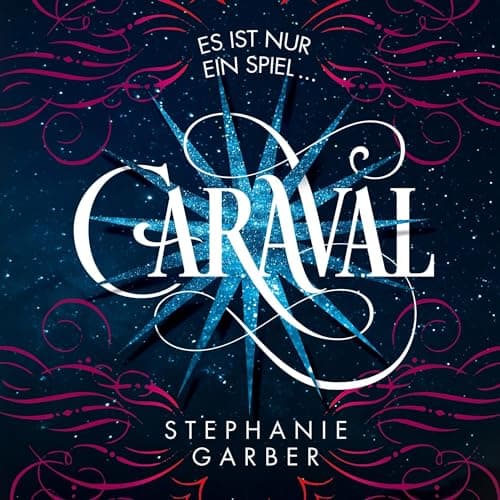

Everyone kept telling me Caraval was this enchanting, whimsical ride - the kind of fantasy you sink into like a warm bath. So I queued it up last Tuesday night, sitting cross-legged on my apartment floor recalibrating a client's caption timing software, hearing aids in, expecting to be swept away. And for about the first two hours, I was. Then the narrator's tone started gnawing at me like a splinter I couldn't reach.
Let me back up.
The Carnival Looks Gorgeous - But Who's Guiding You Through It?
Marie Bierstedt does something genuinely impressive with the atmospheric texture of this audiobook. The German translation already leans into the fairy-tale register, and Bierstedt commits to that dreamlike quality. When Scarlett first enters Caraval and the world shifts from her bleak island existence into this kaleidoscope of magic and danger, you can hear the wonder in Bierstedt's voice. The shift is palpable. She understands atmosphere.
But here's where it falls apart for me as a hard-of-hearing listener: character differentiation is basically nonexistent. Scarlett, Tella, Julian, Legend's agents - they all live in the same vocal register with the same emotional coloring. When I'm relying heavily on tonal cues to distinguish speakers (because I sync text and audio simultaneously, and text alone doesn't always tell me who's feeling what), this is a real problem. I kept losing track of who was speaking in dialogue-heavy scenes. No accent work, no rhythmic shifts between characters. Just... one voice wearing slightly different emotional hats that all look the same from a distance.
And then there's the weinerlich thing.
Scarlett Deserved Better Than a Permanent Whimper
So German listeners have been calling Bierstedt's Scarlett "weinerlich" - whiny - and I've been going back and forth on whether that's fair. Here's where I landed: it IS the right instinct for early Scarlett. This is a girl trapped under an abusive father, desperate and afraid. A certain trembling vulnerability makes sense. But Bierstedt never graduates from that register. Even as Scarlett grows bolder, makes risky choices, defies the game's logic - the vocal performance stays rooted in that same wounded, slightly pleading tone. It flattens her arc.
As a hard-of-hearing listener, this hit different. I need vocal performance to carry emotional progression because I miss subtle shifts that hearing listeners might pick up from context alone. When the narrator stays emotionally static, I lose the character's journey. Scarlett's supposed to transform through Caraval - from caged bird to someone who can play the game on her own terms. But Bierstedt's voice tells me she's still the same scared girl at hour ten that she was at hour one. That's a major missed opportunity for tone shift.
I will say - some German listeners apparently came around on Bierstedt by the end, finding her voice ultimately fitting. I respect that read. But I think the story's momentum carried them past the narration's limitations, not that the narration itself evolved.
The Game Itself: Beautiful Cage, Thin Locks
Garber's Caraval world is genuinely inventive in spots - the dress that changes color based on Scarlett's emotions is a clever externalization device, and the ticking-clock structure of the game gives the 11.5-hour runtime a natural pulse. But the rules of the game stay frustratingly vague. "It's just a game" gets repeated so often it starts feeling like the book is trying to convince itself. The mystery of what's real and what's performance within Caraval should create delicious tension. Instead it creates a kind of narrative fog where stakes feel slippery. I kept wanting the book to commit - is Tella actually in danger? Are the consequences real? - and it kept dodging.
For a single-narrator fantasy, 11 hours and 28 minutes is a significant ask, and the pacing sags in the middle third. I bumped to 1.25x around hour five and honestly wish I'd done it sooner.
Caption sync was decent on my end, though I noticed a few spots where the German text and audio diverged slightly in phrasing - translation artifacts, probably, not a production issue.
Who Gets the Golden Ticket (And Who Walks Past)
If you love atmospheric YA fantasy and don't mind a passive protagonist finding her footing slowly, this will scratch that itch. If you need distinct character voices, listen while multitasking, or rely on vocal cues for accessibility, you'll lose the thread fast - the vocal sameness between characters demands your full attention just to track conversations. Skip this one if you're a hard-of-hearing listener who depends on voice differentiation to follow multi-character scenes. I ran into a milder version of this same problem with Dark Wolf — genre fantasy that leans hard on atmosphere but doesn't always give hard-of-hearing listeners enough vocal distinction to keep up.
The comparison everyone makes is to The Night Circus, and I get it - same carnival-of-wonders DNA. But The Night Circus trusts its readers more. City of Golden Shadow: Otherland Book 1 is another sprawling immersive-world fantasy that actually trusts you to piece together its reality-bending rules — and the narrator differentiates characters in ways Bierstedt never attempts here. Caraval keeps explaining its own magic, and the narration doesn't add the layers of mystery that could've compensated.
My Hearing Aids Wanted More
Bierstedt isn't bad. She's capable and atmospheric and she clearly cares about the material. But this narrator reads when she should perform. The emotional layers that I need - that disabled listeners need - to fully access a character's inner transformation? They're not here. The performance stays on one level when the story demands three. Accessibility done right means vocal performance that carries meaning independently of text. This one gets you halfway there and asks you to fill in the rest yourself.
I'll probably try Once Upon a Broken Heart to see if Garber's world-building sharpens in the connected series. But I'll be checking the narrator situation first.









