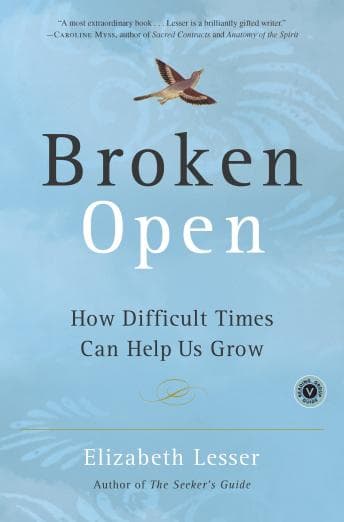

"Will we be broken down and defeated, or broken open and transformed?"
That line hit me somewhere around hour two, while I was stirring a pot of dal that was absolutely not going to turn out like my mother's. (It never does. She'd want me to note that.) And I had to pause — not the audiobook, the stirring — because Elizabeth Lesser had just articulated something I've been circling in my own research for years: the idea that suffering isn't just something that happens to us, it's raw material. It's data. And what we do with that data determines who we become.
The Psychology of Falling Apart (On Purpose)
Here's what grabbed me about Broken Open: Lesser isn't doing the standard self-help thing where she hands you five steps and a gratitude journal and sends you on your way. She's doing something more ambitious and, honestly, more psychologically honest. She's weaving together personal memoir — her own divorce, her struggles with identity as a woman who built Omega Institute while her personal life was fracturing — with stories of people she's encountered over twenty-five years of working in the wellness space.
The protagonist of this book, if we're treating it like a case study (and I always am), is Lesser herself. And she exhibits a classic pattern I see in narrative psychology: the person who helps everyone else heal while running from their own unprocessed grief. She actually names this. She talks about being the spiritual leader at Omega while privately falling apart, and there's a raw honesty there that a lot of self-help authors wouldn't dare. Most would polish the story until they're the wise sage who figured it out. Lesser lets you see her stumbling.
What makes this book compelling is that she draws from Rumi, from Joseph Campbell's hero's journey, from Jungian shadow work, from Buddhist teachings — and she does it in a way that doesn't feel like a Wikipedia survey of world traditions. She uses these frameworks the way a good therapist uses them: as lenses, not prescriptions. There's a section where she compares the process of personal breakdown to the Phoenix myth, and normally I'd roll my eyes (the Phoenix metaphor is so overused), but she grounds it in a specific story about a woman navigating cancer treatment who kept a journal of her rage — not her hope, her rage — and that specificity saved it for me.
The research actually shows that post-traumatic growth is real but messy, and Lesser seems to intuitively understand this. She doesn't promise transformation will be beautiful. She promises it will be useful. Big difference.
Susan Denaker and the Voice Question
Okay. The narration. I have thoughts.
Susan Denaker is an Earphones Award winner, and you can hear why — her pacing is deliberate, her emotional register lands in the right places, especially during Lesser's more vulnerable personal stories. When Lesser describes the moment her marriage ended, Denaker's delivery is quiet and measured in a way that lets the weight of the words do the work.
But — and this is a real but — there's a quality to her reading that I can only describe as... performatively gentle? Like she's narrating a guided meditation even during the more intellectually rigorous sections. Some listeners have called it "airy-fairy" and "sing-songy," and I get it. When Lesser is making a sharp psychological point about ego dissolution or quoting Rumi, the delivery sometimes softens the edges in a way that undercuts the content. I found myself wishing Denaker would occasionally push — let some grit into her voice, match the intensity of what's actually being said.
At 13 hours, this is not a short listen. And the narration style means certain stretches — particularly the more meditative, tradition-heavy middle sections — can start to blur together. I'd recommend 1.25x speed, honestly. It tightens the rhythm without losing the emotional texture.
Who This Is Really For (And Who Should Walk Away)
If you're someone who's in the middle of something hard — a divorce, a loss, a career implosion, a quiet existential crisis you can't quite name — this book will feel like someone handing you a flashlight in a dark room. Not pointing the way out, just helping you see where you are. That's valuable.
If you're skeptical of spiritual frameworks, you'll hit friction. Lesser draws heavily from Eastern philosophy and New Age-adjacent traditions, and while she's more grounded than most writers in this space, if the mention of chakras or Sufi poetry makes you check out, this isn't your book. (My therapist would have thoughts about why that resistance exists, but that's a different conversation.)
I found myself asking: why does this book, published over twenty years ago, still feel relevant? And I think it's because Lesser understood something the current wellness industry often misses — that growth isn't an optimization problem. It's a grief process. You have to lose the old self before the new one shows up. That's not inspirational fluff. That's developmental psychology. I'd put Tools: Transform Your Problems into Courage, Confidence, and Creativity in conversation with this idea — it operates on similar terrain but takes a more clinical, almost combative stance toward inner resistance, which is a useful counterweight if Lesser's warmth starts feeling too soft.
My Clinical Impression
This is a fascinating case study in how one woman turned personal breakdown into a philosophy of living, and mostly — mostly — avoided the trap of making it too neat. The narration won't work for everyone, and the 13-hour length demands patience. But the core insight is sound, and Lesser's willingness to be the flawed subject of her own research is what separates this from the stack of self-help books I've abandoned on my Audible shelf. Worth the time. Maybe especially if you're not sure you're ready for it.