
"I want to change. I need to change. I'm gradually losing touch with myself."
That's Linda, our protagonist, early in the book. And honestly? By hour four, walking the lakefront on a grey Sunday morning with Denise off visiting her sister, I was feeling the same way — about the novel itself.
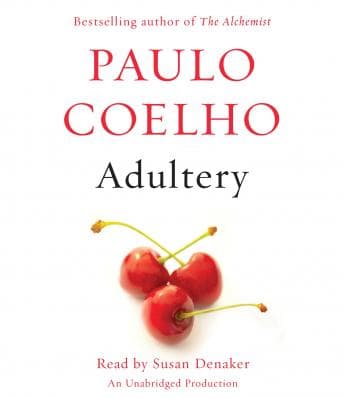
Paulo Coelho promised to explore the space between contentment and desire. This is territory that great writers have mined for centuries — Tolstoy, Flaubert, Updike. Anna Karenina. Madame Bovary. The stuff I teach. The stuff that makes my students groan but eventually — sometimes — understand something about themselves. So I came to this ready to be generous.
Here's the problem. Coelho writes about adultery the way someone writes a fortune cookie about heartbreak. Linda is a journalist in Geneva. She has a husband, kids, money, a career. She's bored. She reconnects with an ex-boyfriend who's now a politician. An affair begins. And then... philosophy happens. Relentlessly. The kind of observations about love and freedom and desire that sound profound if you've never read anything else on the subject, but land flat if you've spent twenty years teaching Gatsby to teenagers who ask better questions about moral compromise than this novel bothers to answer.
When the Fortune Cookie Is 300 Pages Long
This reminds me of what Hemingway said about writing — that the dignity of movement of an iceberg is due to only one-eighth of it being above water. Coelho gives us the whole iceberg, above water, labeled, with arrows pointing to the important parts. There's no subtext here. Linda tells us exactly what she's feeling at every moment. She tells us what it means. She tells us what she's learned. My sophomore students would call this "telling, not showing," and they'd be right, and I'd be proud, and then I'd feel slightly guilty about using Paulo Coelho as a punching bag.
The thing is — Coelho can write a sentence. The Alchemist works because it's a fable, and fables are supposed to be simple. That simplicity is a feature. But when you stretch that same aphoristic style across a realistic novel about a Swiss journalist's extramarital affair, the cracks show fast. Every few pages, Linda stops the narrative to deliver reflections like she's curating an inspirational Instagram feed. Paragraphs of meditation on desire, freedom, emptiness — and these aren't Dostoevsky-level examinations of the soul. They're surface-level observations circling the same ideas without ever digging a shovel into the dirt.
The story needed more mess. More contradiction. More of the ugly, confused, irrational behavior that makes adultery in fiction worth reading about. Madame Bovary doesn't explain herself to you. She destroys herself, and you have to figure out why. Linda explains everything, and somehow you understand less.
Susan Denaker vs. a Character Who Won't Sit Still
Susan Denaker has a calm, steady voice that should work for introspective fiction. And in the quieter moments — Linda reflecting on her marriage, her daily routines in Geneva — the narration finds a groove. But there's a disconnect I couldn't shake. Denaker's voice carries the weight and warmth of someone older, more settled, than a thirty-something woman supposedly vibrating with restless, dangerous energy. Linda's supposed to be coming apart. The delivery sounds like someone reading from a comfortable armchair.
I shouldn't be too hard on Denaker—her voice work on Penderwicks on Gardam Street is a delight, full of playful nuance. Here, she's just not vibing with the material.The bigger issue: when the text goes dramatic — and it does, often, because Coelho writes internal crises like thunderstorms — Denaker matches that energy with an overdramatic push that tips into melodrama. Non-dramatic observations about work meetings or grocery lists get the same breathless intensity as confessions of desire. Everything lands at the same emotional volume. Which means nothing feels urgent.
The love scenes land especially flat. I'm not asking for anything scandalous — I was passing joggers and dog walkers, for heaven's sake — but these scenes needed heat, tension, something that made you understand why Linda was torching her life. Instead they feel clinical. Detached. Like reading the terms and conditions on a dating app.
Start With The Alchemist. Maybe Stop There.
If you're new to Coelho, read The Alchemist. It's four hours. It's a fable. The simplicity works because the form matches the ambition. If you've already read everything he's written and need to complete the collection, fine — you'll get through this in a day and forget it in a week.
I had similar feelings about Brida, which shares the same penchant for weighty pronouncements without the narrative muscle to back them up.But if you want a real novel about adultery? About the gap between the life you have and the life you think you want? Pick up Madame Bovary. Listen to Anna Karenina. Find Richard Yates' Revolutionary Road. Books where the characters breathe and bleed and make terrible decisions that feel inevitable. Books where the prose deserves to be savored.
My students would hate this. And for once, I'd agree with them.
The Grade I'd Write in Red Ink
Eight hours I won't get back, though I've lost more to worse faculty meetings. (Sorry, Principal Martinez.) Coelho is capable of better, Denaker is capable of better, and the subject matter — the restless ache of a life that looks perfect from the outside — deserves so much better than what either of them gave it here. This is philosophy without depth, fiction without texture, and an audiobook that never figures out what temperature to run at.
If you loved The Alchemist, this is not its spiritual successor. It's its overextended cousin who talks too much at Thanksgiving.