
Look, I need to lodge a formal complaint with Marian Keyes. I started this audiobook on a Sunday evening walk along the lakefront with Denise, and by Tuesday I was so emotionally wrecked that I snapped at a sophomore for asking if Gatsby was "the green light guy." (He is, technically, but that's not the point.) Nineteen hours is a commitment. And Keyes makes you feel every single one of them — not because it drags, but because she won't let you look away from the slow, excruciating unraveling of a marriage you desperately want to survive.
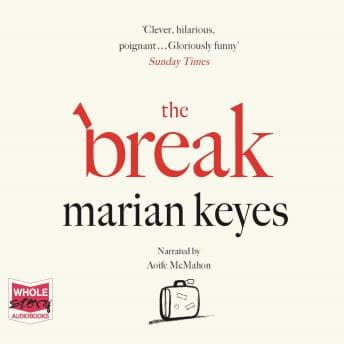
The premise sounds almost absurd when you say it out loud: Hugh, a seemingly decent husband and father, announces he needs "a break" — not a divorce, not a separation, a break — to go traveling in Southeast Asia and "find himself." He's in his fifties. Amy, his wife, is left holding together a sprawling Irish family that includes a mother with dementia, adult stepdaughters with their own chaos, and a social circle that doesn't know whether to pity her or envy her sudden freedom. It sounds like the setup for a comedy. And it is funny — Keyes is genuinely, laugh-out-loud funny in ways that most "literary" writers wouldn't dare attempt. But underneath every joke is a bruise.
That bruise-under-the-joke quality is exactly what she brought to Again, Rachel, and I fell for it there first.
The Slow Knife of a Polite Abandonment
What Keyes does so well here — and what the audiobook format amplifies — is the grinding dailiness of heartbreak. This isn't a dramatic betrayal with a clear villain. Hugh isn't cruel. He's just... gone. And Amy has to keep functioning. She has to feed people and manage her mother's care and go to work and pretend she's okay at dinner parties. The book lives in those moments, the ones where you're smiling at someone while your chest is caving in. My students would hate this. They want plot. They want action. I love it precisely because Keyes understands that real devastation is usually quiet and polite and happens over months.
The first few hours are admittedly slow — Keyes is building a world of relationships, and there are a LOT of characters. The Walsh family alone could populate a small village. I'd be lying if I said I didn't lose track of who was who early on. But by hour five or six, when you've settled into the rhythm of Amy's life, those characters stop being names and start being people you're worried about. That's when the book gets its hooks in.
Aoife McMahon's Irish Lilt Carries the Weight
Aoife McMahon narrates at exactly the right temperature. Her natural Irish lilt gives Amy's internal monologue a warmth that keeps the darker stretches from becoming unbearable — there's always a wry edge, a half-laugh hiding behind the grief. Her comedic timing is sharp; she knows when to let a Keyes punchline land with a beat of silence rather than rushing past it. The narrator understands that pause is punctuation.
Her character differentiation is solid — she gives each of the Walsh sisters a slightly different energy, and Amy's mother gets this fragile, confused quality that made me think of my own grandmother in ways I wasn't ready for on a Tuesday night. She does equally delicate work with family members in Guest List: A Novel, which is how I first noticed her.
. Where McMahon stumbles a bit is the male voices. Hugh sounds... fine, but some of the other men come across a little forced. It's not deal-breaking, but there were moments — particularly with younger male characters — where I winced slightly. Fair warning.Here's the thing, though: some listeners swear Keyes herself is the better narrator for her own work, and I understand that impulse. There's an intimacy to an author reading their own sentences. But McMahon brings something different — a performance layer that treats this like the serious emotional work it is, not just a chat with a friend. I think both approaches are valid. I think McMahon earns her place.
What Keyes Is Really Saying About Middle Age
Let's talk about what the author is really saying. This isn't just a book about a marriage falling apart. It's about what happens when the narrative you've built your life around — steady partner, stable home, knowable future — gets yanked away, and you have to figure out who you are without it. Amy at fifty is not Amy at thirty, and the book is honest about that in ways that stung. Keyes threads in dementia, grief, the messy reality of blended families, even some genuinely surprising turns I won't spoil, and she does it all without ever feeling like she's checking boxes. It's life. Messy, contradictory, sometimes hilarious life.
This is why we still read the classics — or in this case, why Keyes deserves to be mentioned alongside writers we take more "seriously." She's doing what George Eliot did in Middlemarch: examining how ordinary people navigate impossible emotional terrain. It's the same trick Rooney pulls off in Beautiful World, Where Are You — big ideas hiding inside ordinary days. (Yes, I just compared Marian Keyes to George Eliot. Principal Martinez, if you're reading this — I stand by it.)
Who Gets the Most Out of This
If you loved Anne Enright or Liane Moriarty but wish they'd let the knife twist a little longer, this is your book. If you're in a long-term relationship and want to feel both terrified and oddly hopeful, this is your book. If you need nonstop plot momentum and hate large family dynamics — skip it, honestly. You'll be frustrated by hour three.
Nineteen hours at 1.0x. The prose deserves to be savored. Worth every minute I should've spent grading.