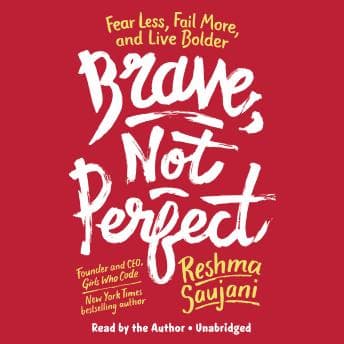

This book made me late for my morning jog three days in a row.
I'd be standing in my kitchen in Cambridge, sneakers on, earbuds in, and instead of heading out the door, I'd find myself frozen by the counter, stirring cold coffee, completely absorbed in Saujani's breakdown of why I spent my entire academic career apologizing before asking questions in seminars. The protagonist exhibits classic perfectionism-as-survival-strategy patterns, and the protagonist is... well, all of us who were praised for being "such good girls."
The Conditioning We Never Questioned
Saujani's central thesis isn't revolutionary if you've spent any time in developmental psychology literature. But here's what makes this different: she's not writing from the ivory tower. She's writing as someone who ran for Congress, lost publicly, and then built Girls Who Code from that failure. The research actually shows that women apologize more frequently than men not because we're inherently more polite, but because we have a lower threshold for what constitutes offensive behavior. Saujani takes that academic finding and makes it visceral through her own stories—bombing interviews, second-guessing every email, the exhausting mental gymnastics of trying to be impressive while also being likeable while also being competent while also not being threatening.
What makes this character—and yes, I'm treating Saujani as a character here, because memoir is still narrative—compelling is her willingness to sound petty. She admits to jealousy. To comparing herself to other women. To the specific flavor of self-sabotage that comes from being the daughter of immigrants who sacrificed everything for your success. (My mother would have thoughts about this chapter. Many thoughts.)
When the Author IS the Narrator
Saujani reading her own work creates an intimacy that a professional narrator couldn't replicate. Her voice has this quality—not polished, not radio-smooth—that sounds like she's telling you this over chai at her kitchen table. When she describes the moment she decided to run for office despite being terrified, you can hear the residual disbelief in her delivery. She still can't quite believe she did it.
No vocal gymnastics here. No character voices to differentiate. This is a woman talking directly to you about her own psychological excavation, and the directness works. At 5 hours and 26 minutes, it's the perfect length for processing without becoming repetitive.
But—and my therapist would have thoughts about this—the book does lean into a fairly specific experience. Western, cisnormative, and heavily focused on professional achievement as the arena where bravery matters most. If your perfectionism manifests in different contexts, if your cultural background taught you different lessons about girlhood, some of this will feel like it's speaking past you rather than to you.
The Psychology That Actually Tracks
I kept asking myself: why does Saujani's framework land when so many self-help books feel like empty affirmations?
It's because she grounds everything in observable behavioral patterns. She doesn't just say "be brave"—she identifies the specific micro-moments where we choose safety over growth. The email we don't send. The idea we don't pitch. The relationship we don't leave. She names the internal monologue with enough specificity that you recognize your own voice in it.
The practical exercises are genuinely useful. Not revolutionary, but actionable. Small acts of bravery, building tolerance for discomfort, reframing failure as data rather than verdict. It's a solid case study in translating behavioral psychology principles into accessible language without dumbing them down.
What it doesn't do—and this is worth noting—is address the structural barriers that make bravery more costly for some women than others. Saujani acknowledges privilege briefly, but the book fundamentally operates from a "lean in" framework that assumes the playing field is level enough that individual mindset shifts can overcome it. Psychologically, this doesn't track for everyone's reality.
Who This Is (and Isn't) For
Skip this if you're looking for rigorous research citations or academic depth. If you've already done significant work on perfectionism in therapy, you might find the insights familiar. And if the particular brand of Type-A professional woman striving isn't your experience, the book may feel alienating rather than validating.
But if you were a "good girl"? Who got praised for following rules and now can't stop? Who has a voice in your head that sounds like every teacher who ever said "you have such potential" and made it feel like a threat? You need this. You need permission—from someone who's been there—to be mediocre sometimes. To try things you might fail at. To stop apologizing for existing.
My Clinical Assessment
I've read dozens of books on perfectionism, imposter syndrome, and gendered socialization. Most of them I skim. This one I finished, and then I went for that jog, and I didn't apologize to anyone I passed on the path for taking up space. The Surrender Experiment approaches this same territory from the opposite angle—letting go of control rather than building courage—but both books left me examining the same behavioral patterns in myself. Small data point. But noted.