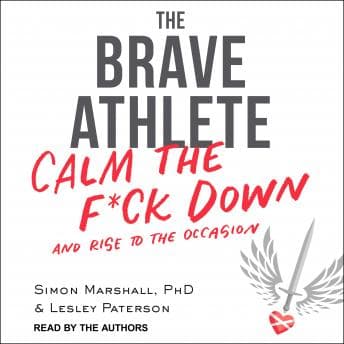

The Chimp won't shut up.
That's the thesis, really. Marshall and Paterson's central metaphor—that you've got three brains duking it out for control—landed while I was on my morning jog through Cambridge, trying to convince myself that the hill ahead wasn't actually that steep. My ancient Chimp brain was screaming "stop, you're dying," my Professor brain was calculating pace per mile, and somewhere in there my Computer brain was just... running the show on autopilot. The timing was almost too perfect.
When Scientists and Athletes Actually Talk to Each Other
Here's what makes this audiobook genuinely useful rather than another motivational pep talk: Marshall is the clinical researcher, Paterson is the three-time world champion triathlete, and they wrote this thing together. You can hear it in the narration—his explanations of neuroscience get grounded by her "yeah, but here's what that actually feels like when you're bonking at mile 20." The blend of English and Scottish accents with occasional American pronunciation thrown in shouldn't work, but it does. It's like eavesdropping on a very smart couple arguing about your brain at dinner.
Most sport psychology books fall into two camps: either too academic to be actionable or too woo-woo to be credible. How To Win Friends And Influence People leans heavily toward the actionable side, though it skips the neuroscience entirely. This one threads the needle. When they explain why you choke under pressure, you get the actual mechanism—not just "believe in yourself." When they tell you how to fix it, you get exercises that don't require a PhD to implement.
The F-Bomb Question
Let's address the elephant: yes, there's colorful language. The title kind of telegraphs this. Some listeners find it refreshing—one reviewer mentioned audibly laughing, which tracks. Others called it "an intellectual cop out," which... I found myself asking: why does profanity in self-help trigger such strong reactions?
Psychologically, this doesn't read as laziness to me. The swearing serves a function—it signals "we're not going to be precious about this." Athletes talk this way. Coaches talk this way. The book is written for people who want their mental training to sound like the locker room, not the therapy office. Whether that's your vibe is a different question entirely.
The Athlete as Case Study (Old Habits)
There IS a character study here, just not the kind I usually analyze. Marshall and Paterson understand that the person who signs up for an Ironman and the person who quits at mile 80 are the same person with different brain states. The protagonist exhibits classic self-sabotage patterns, except the protagonist is you, and the book hands you the clinical framework to understand why.
Nine hours and forty-one minutes is a commitment. This isn't background listening—the technical content requires actual attention. I tried it while cooking one of my elaborate solo dinners (lamb rogan josh, if you're curious) and had to rewind twice because I missed key concepts while managing spice levels. Save this for focused sessions. Maybe your own morning runs.
Who Should Bother (And Who Shouldn't)
If you're a competitive athlete—any level, any sport—who has ever:
- Panicked before a race for no rational reason
- Trained brilliantly and then fallen apart on game day
- Wondered why your brain seems determined to sabotage you
This is your book. The dual-narrator format keeps nearly ten hours from dragging, and the humor prevents it from feeling like homework.
Skip it if: profanity genuinely bothers you (no judgment, but you'll be annoyed), you want pure motivation without mechanism, or you're looking for something to half-listen to while doing other things. The content is too dense for that.
My Therapist Would Have Thoughts
She'd probably appreciate the Chimp/Professor/Computer framework, actually. It's a simplification of complex neuroscience, but it's a useful simplification—the kind that gives you language for experiences you couldn't articulate before. "My Chimp is being loud today" is more actionable than "I feel anxious for no reason."
The book doesn't pretend to replace actual clinical help when you need it. But for the specific problem of athletic performance anxiety? This is applied psychology that actually applies. Marshall and Paterson understand human nature—specifically, the nature of humans who voluntarily sign up to suffer for sport.
The Chimp still won't shut up. But now I know its name.