
"Eat more blueberries. Do crossword puzzles. Sleep eight hours."
That's roughly 40% of this book. I'm being generous with that estimate.
I was on a red-eye to Austin for a client pitch - couldn't sleep, didn't want to prep anymore, figured I'd do some "brain optimization" while stuck in 34C. Five hours and forty-six minutes of tips about brain health seemed like exactly the kind of low-stakes listen that might knock me out or actually teach me something. It did neither particularly well.
300 Tips, Maybe 30 Worth Remembering
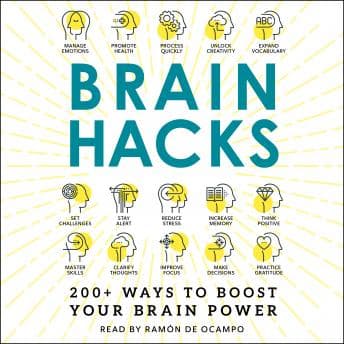
Here's the structural problem with Brain Hacks: it's a listicle in audiobook form. Adams Media - which is a publisher, not a person, worth noting - compiled 300+ tips about nutrition, supplements, stress management, and cognitive exercises. In print, this is a bathroom book. You flip to a random page, read a tip about how omega-3s support neural membrane integrity, go "huh, interesting," and move on with your life.
In audio? It's Ramón De Ocampo reading you a very long grocery list.
De Ocampo does fine work here - clear, professional, the kind of voice you'd want narrating a corporate training module. He keeps an even keel through what must have been a soul-crushing recording session. How do you bring energy to tip #187 about the benefits of turmeric? You don't. You just say it clearly and move on. He does that. I respect the professionalism even if I can't remember a single moment of vocal distinction.
The problem isn't him. The problem is that this format doesn't translate to audio. When I'm listening to "drink green tea for L-theanine" followed immediately by "try meditation for cortisol reduction" followed by "eat walnuts because they look like brains" (I'm paraphrasing but barely), there's no connective tissue. No narrative thread. No framework that makes tip #42 build on tip #41. It's just... the next tip.
My Parents' Dry Cleaning vs. Your Brain's Dry Cleaning
Here's what kills me about books like this. My parents ran a business on intuition, hard work, and community knowledge. My mom knew that ginseng tea helped her focus during 14-hour days - not because she read a hack book, but because her mother told her. My dad walked to work every morning, 2.3 miles, because he couldn't afford a second car. Turns out that's "Hack #89: Morning walks boost BDNF production." Cool.
This is what my parents did instinctively. Now it has a TED talk.
The book isn't wrong, exactly. The nutritional advice is broadly sound - eat whole foods, reduce sugar, get your B vitamins. The supplement section covers the usual suspects: fish oil, ginkgo biloba, magnesium. The exercise recommendations are fine. But "fine" and "broadly sound" don't justify a credit. You could get this information from a 10-minute conversation with a reasonably informed nutritionist, or honestly, from scrolling through three reputable health websites. The contrast with something like Untamed is instructive — that book also dispenses a lot of life advice, but Doyle earns each claim by anchoring it in a story you actually feel, which is the difference between wisdom and a grocery list.
What's missing is depth. When the book mentions that meditation reduces cortisol, I want to know: what kind of meditation? For how long? Based on what study? With what population? The tips just float there, unanchored. No citations I could track. No hierarchy telling me which hacks actually have strong evidence vs. which ones are folk wisdom dressed up in science-adjacent language.
Who Needs This (and Who Doesn't)
If you're someone who's never thought about brain health - never considered that sleep, nutrition, and exercise affect cognition - this is a decent primer. Genuinely. Not everyone grew up around health-conscious habits, and having 300 options means something in here will probably stick.
But if you've read even one serious book on neuroscience or cognitive health - Daniel Levitin, Matthew Walker, Andrew Huberman's stuff - this is going to feel like the CliffsNotes version of things you already know. And at 2.0x speed (which I absolutely used), it still felt padded. Five hours forty-six minutes for a tip compilation with no narrative arc. My 2.0x speed couldn't save this one.
The audiobook format specifically hurts here. You can't bookmark tip #203, skip to the supplement section, or quickly reference the stress management chapter. It's linear consumption of non-linear content. Get the print version if you're going to get it at all.
The Consulting Engagement Is Over
Bottom line: This is a reference book trapped in a medium that doesn't serve it. De Ocampo is a capable narrator handed an impossible assignment. The content is surface-level but not inaccurate. And I landed in Austin having retained maybe 12 of 300 tips - which, if we're being honest about ROI, means I paid roughly one credit for a dozen things I mostly already knew. Jenny would say I'm being harsh. Jenny is right. But she'd also say "just eat the blueberries and go to bed," and that's better advice than most of what's in here.