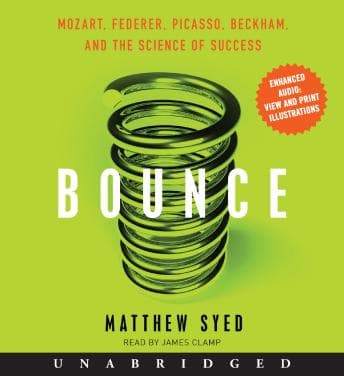

Everyone tells you to read Gladwell's Outliers when you want to understand success. And look, I've assigned excerpts from it to my juniors for years. But here's the thing—I finished Bounce during a particularly brutal stack of sophomore essays on The Great Gatsby, and Syed's version of the 10,000-hour argument hit different. Maybe because he's not just theorizing from the outside. The man was a Commonwealth table tennis champion. He lived this stuff.
I'll be honest upfront: if you've already consumed Outliers and Talent is Overrated, you're going to experience some déjà vu. The core thesis—that deliberate practice trumps innate talent—isn't new territory. Some listeners apparently checked out by the end, and I understand why. But here's what those critics miss: Syed brings receipts from his own life in ways Gladwell never could.
The Table Tennis Champion in the Room
Syed grew up on Silverdale Road in Reading, England, where an absurd number of top British table tennis players emerged from the same street. Same street. He traces this back to a 24-hour access table tennis club and one obsessive coach named Peter Charters. It's the kind of specific, granular detail that makes you actually believe the argument rather than just nodding along to clever anecdotes.
This is where Bounce earns its keep. When Syed talks about the thousands of hours he spent perfecting his backhand, about the psychological warfare of elite competition, about choking under pressure—he's not citing studies from a distance. He's confessing. There's a vulnerability to his examples that Gladwell, for all his brilliance, can't replicate.
The sports focus might turn off some listeners. Fair enough. But as someone who's spent two decades watching teenagers pretend they've done the reading, I found the athletic examples clarifying rather than limiting. Success in sports is measurable in ways that success in, say, literary criticism isn't. You either win Wimbledon or you don't. That clarity makes the argument harder to dismiss.
James Clamp Knows When to Step Back
Clamp's narration is workmanlike in the best sense. He won an AudioFile Earphones Award, and you can hear why—clean delivery, appropriate pacing, never tries to make himself the star. For nonfiction like this, that's exactly what you want. He's not performing Syed's words; he's transmitting them. The British accent feels natural given Syed's background, and there's a measured quality to his reading that matches the book's methodical argument-building.
I listened at my usual 1.0x because—and my students roll their eyes at this—I believe pacing is part of the author's intent. At just under eight hours, it's a reasonable commitment. Not so long that you forget the early chapters, not so short that it feels like a TED talk stretched thin.
Where the Argument Gets Wobbly
Around hour five or six, the book does start to feel like it's proving the same point in slightly different ways. Syed's chapters on race and IQ, on placebo effects, on the psychology of choking—they're interesting individually but don't always build toward something larger. It's less a sustained argument and more a series of related essays.
And yes, some of the examples feel borrowed. If you've read the deliberate practice literature, you'll recognize the stories about chess grandmasters and violinists. I had that same sense of recognition listening to Survivors' Tales of Famous Crimes—different subject matter, but a similar feeling of covering well-trodden ground. Syed acknowledges his intellectual debts, but the overlap can feel redundant if you're already familiar with the territory.
But here's what I kept thinking about during my lakefront walks with Denise: Syed isn't just recycling other people's research. He's testing it against his own experience and finding it true. There's something almost confessional about that. He's basically saying, "I was good at table tennis not because I was born special, but because circumstances aligned to give me 10,000 hours of practice before my competitors even started." That's a humbling admission from someone who could easily coast on his championship credentials.
Who Should Grab This (And Who Should Pass)
If you've never encountered the deliberate practice argument, Bounce is an excellent entry point. Syed writes with the clarity of a good journalist and the authority of someone who's actually competed at the highest levels. Coaches, teachers, parents of young athletes—there's practical wisdom here about how to structure practice, how to handle failure, how to cultivate what Carol Dweck calls a "growth mindset."
Skip it if you've already worked through Outliers, Talent is Overrated, Peak, and the rest of the genre. You'll find yourself on familiar ground. Not a waste of time, but maybe wait for a sale.
One for the Mental Syllabus
This reminds me of what Hemingway said about writing—that you have to learn the rules before you can break them. Syed's arguing something similar about excellence in any field. Talent is a story we tell ourselves to avoid the uncomfortable truth that greatness requires years of unglamorous work.
I'm keeping this one in my mental library for the next student who tells me they're "just not a reader." Nobody's born a reader. You become one through practice. Syed would approve of that message, I think. And so would my 47 podcast listeners. Maybe 48 now, if Principal Martinez ever actually reads my recommendations instead of just nodding politely.