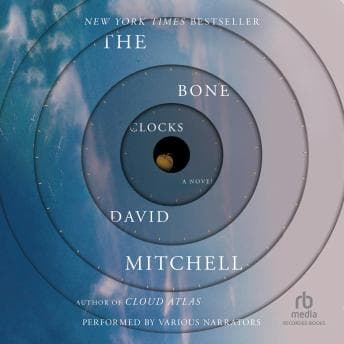

Everyone told me The Bone Clocks was David Mitchell's most accessible novel. The gateway drug for readers intimidated by Cloud Atlas. I'm here to tell you they're wrong. Or rather—they're right about accessibility, but wrong about what that means.
I finished this at 2 AM on a Tuesday, headphones in, red pen abandoned mid-essay. Denise had long since given up on me and gone to bed. Twenty-four hours and thirty-four minutes of my life, spread across three weeks of lakefront walks, faculty meetings (sorry again, Principal Martinez), and late-night grading sessions. And I'm still not sure I've processed half of it.
The Architecture of a Life (And Why Six Voices Matter)
Here's what Mitchell does that drives my AP Lit students crazy when I try to explain it: he builds novels like cathedrals. Not linear stories but structures. The Bone Clocks spans sixty years and multiple continents, following Holly Sykes from teenage runaway in 1984 to elderly woman watching civilization crumble in 2043. Each section is narrated by a different character—some connected to Holly, some orbiting her life like satellites.
The six-narrator approach isn't gimmick. It's architecture made audible.
Jessica Ball opens as fifteen-year-old Holly, and her performance sets something crucial: the emotional register. This isn't a fantasy epic pretending to be literary fiction. It's literary fiction with fantasy bleeding through the cracks. Ball captures that teenage certainty-mixed-with-terror that anyone who's taught high schoolers recognizes instantly. (My students would hate that I said that. They think they're mysterious. They're not.)
But Steven Crossley as Crispin Hershey? That's the section I kept rewinding. Hershey's a middle-aged novelist watching his career slide into irrelevance—pithy, self-pitying, desperately funny about his own desperation. Crossley delivers him with this plummy, wounded dignity that made me laugh out loud during a particularly tedious department meeting. The man's reading bad reviews of his own books and somehow you're rooting for him while also wanting to shake him. That same wounded self-awareness runs through Lolita, though Nabokov's unreliable narrator is far less sympathetic.
What Mitchell's Really Asking (And Why It Takes 24 Hours to Ask It)
Hemingway had his iceberg theory—show the surface, hide the depth. Mitchell shows you the whole iceberg, the ocean, the shipping lanes, and the fish underneath. The psychic war between immortals (the Horologists versus the Anchorites) sounds like genre nonsense when I describe it. In practice, it's Mitchell asking: what would you sacrifice for more time? What's a soul worth when you're watching everyone you love age while you don't?
The prose deserves to be savored. I listened at 1.0x because—well, you know my position on this—and there are sentences here that reward the patience. Mitchell writes dialogue that sounds like actual humans talking, which is rarer than it should be. The narrators understand this. They don't rush the pauses.
But here's the honest part: this audiobook requires your full attention. I tried listening while grading papers once and had to rewind twenty minutes. The story layers details that pay off hours later—a throwaway name in section two becomes crucial in section five. Background listening this is not.
The Cracks in the Cathedral
Look, I teach literature. I believe in difficulty. I believe some books should make you work.
But Mitchell's fantasy elements sometimes feel like they're from a different (lesser) novel. The immortal warfare sections veer into exposition dumps that even excellent narration can't entirely save. And the final section—Holly at sixty, watching climate collapse—feels rushed compared to the luxurious pacing of everything before it. Like Mitchell suddenly remembered he had a point to make about humanity's future and needed to make it fast.
The narrators do their best. Anna Bentinck and the others handle the tonal shifts with more grace than the text sometimes deserves. But I noticed the seams.
Who This Is For (And Who Should Run)
If you loved Cloud Atlas, this is its spiritual successor—more linear, less formally experimental, but wrestling with the same questions about connection across time. If you've never read Mitchell, this actually is a reasonable starting point, despite what I said earlier. Just... commit to it.
If you want something for background listening while cleaning or commuting through traffic? Skip this. Seriously. You'll be lost by hour three and frustrated by hour ten.
If you're a reader who thinks audiobooks are cheating? This might convert you. The full-cast approach adds dimension that the page can't replicate. Hearing Hershey's self-deprecation in Crossley's voice versus reading it in my own internal monotone—there's no comparison.
Worth Pausing the Faculty Meeting For
Twenty-four hours is a commitment. A relationship. I started this book in September warmth and finished it in October chill, and something about that felt right—watching Holly age across seasons while I walked the same lakefront path.
My students would hate this. Too long, too literary, too much work for a story about psychic immortals.
I loved it. Not perfectly—the fantasy war stuff still feels like Mitchell grafting genre onto literary fiction without fully committing to either. But Holly Sykes stayed with me. Her ordinary life, interrupted by the extraordinary, observed by six different voices across six decades.
This is why we still read the classics. And why, sometimes, the new stuff earns its place beside them.