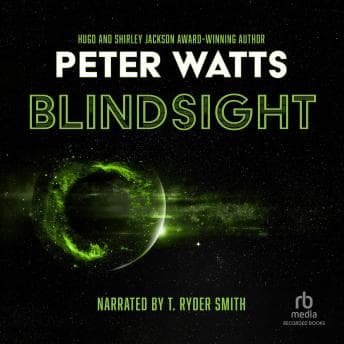

Blindsight is the book that broke my brain in the best possible way - and then made me question whether having a brain that can break is even an evolutionary advantage.
I need to say this upfront: this is not a commute book. I tried. I really, genuinely tried to get through this on my 6AM Caltrain, and by Mountain View I'd realized I'd absorbed maybe 40% of what T. Ryder Smith had been telling me. So I restarted. On a Saturday. Sitting on my couch. Coffee. No distractions. And that's when Blindsight clicked into place like a distributed lock finally acquiring consensus.
Your Brain Is a Bug, Not a Feature
The premise sounds like standard first-contact fare - aliens show up, humanity sends a ship to investigate. But Peter Watts is a marine biologist turned SF writer, and he's not interested in "take me to your leader" scenarios. He's interested in whether consciousness itself is a dead-end adaptation. The crew of the Theseus includes a linguist split into four distinct personalities, a biologist who's more machine than human, a military specialist with her own augmentations, and your narrator-protagonist Siri Keeton - a man who had half his brain removed as a child and now functions as a "Chinese Room" of human interaction. He can read people perfectly but feels nothing. He's basically a very sophisticated pattern-matching algorithm wearing a meat suit.
That last bit isn't me being clever. That's literally the thesis of the book. Watts is arguing - with real neuroscience citations in the appendix - that consciousness might be an expensive parlor trick that natural selection should've optimized away. The aliens the crew encounters? They're intelligent. Staggeringly so. But they might not be conscious at all. And that distinction, the gap between intelligence and awareness, is where this book lives and where it will mess you up.
T. Ryder Smith and the Art of Narrating Emptiness
Here's the thing about casting this audiobook: you need someone who can convincingly voice a protagonist defined by his inability to connect emotionally, without making 12 hours of listening feel like sitting through a quarterly performance review. Smith threads that needle. His Keeton is flat in a way that feels deliberate - clinical, observational, distant - but not monotone. There's a difference between a character who can't feel and a narrator who can't act, and Smith clearly knows which side he's on.
The structure is where audio gets tricky though. Watts intercuts the main mission timeline with Keeton's childhood memories and backstory fragments, and in print you've got visual cues - chapter breaks, formatting changes - that signal the switch. In audio, the transitions can hit you mid-sentence and suddenly you're in a completely different time period wondering if you accidentally skipped a chapter. Smith handles the shifts, but if your attention drifts even slightly (say, because someone on the train just spilled their oat milk latte), you're lost. I had to rewind probably a dozen times during my first attempted commute listen.
I'd compare the difficulty level to listening to Anathem by Stephenson or maybe Echopraxia (Watts' own sequel). The fantasy epics I've been rotating through lately — like Tower Lord — are genuinely good, but they're a completely different cognitive load; Blindsight is operating in its own weight class. If you survived either of those in audio, you'll be fine. If your hardest SF audiobook is The Martian, maybe read this one first and audio it on a re-listen.
Who This Is Actually For (And Who Should Run)
Perfect for: dedicated listening sessions, long flights, insomnia at 2AM when your brain is already in that weird philosophical mode anyway. (I finished the last three hours after a Thursday night deploy went sideways and I couldn't sleep. The existential dread of the book paired surprisingly well with the existential dread of wondering if my rollback worked.)
Skip for: commute, gym, anything where you can't give it 90%+ of your attention. This is not background listening. This is not multitask-compatible. If you put this on while cooking dinner, you will burn dinner and also understand nothing.
If you love hard SF that treats the reader like an adult - that doesn't slow down to explain the neuroscience or hand-hold you through the implications - the ROI on this audiobook is enormous. Watts packs more genuine ideas per hour than most trilogies manage across their entire run. But the cost is attention. Real, sustained, focused attention.
Debug Level: Worth the Stack Trace
I keep thinking about this book weeks later. The concept of a "Chinese Room" alien intelligence - something that can respond perfectly to inputs without any internal experience - keeps popping into my head during work meetings. (Draw your own conclusions about my coworkers.) At 11 hours 50 minutes, it's a serious commitment, and I genuinely think the audio format makes it 30% harder than it needs to be. But Smith's narration is strong enough that once you're locked in, you're locked in. Just don't try to do it at 1.75x. I dropped to 1.25x for this one and I'm not ashamed.