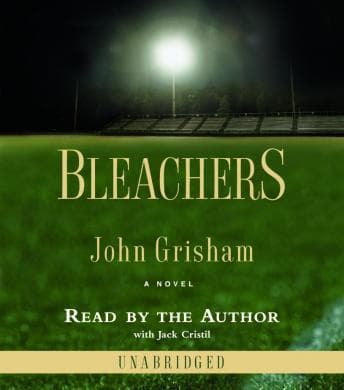

Authors narrating their own audiobooks is usually a vanity project I grade with a heavy red pen. For every Neil Gaiman who understands that reading aloud is a performance, there are ten writers who mutter into the microphone like they're dictating a grocery list. So when I saw John Grisham narrated Bleachers himself, I almost skipped it. I assumed it would be the audio equivalent of a student reading their essay while staring at their shoes.
But I was—mostly—wrong.
I listened to this over three afternoons while sitting in my own classroom after hours, grading a stack of mediocre papers on The Great Gatsby, looking out the window at our school's empty football field. The setting matters. This book is entirely about the ghosts that haunt those fields.
## When the Author's Voice Is the PointGrisham isn't an actor, and he doesn't try to be. He doesn't do voices. He doesn't pitch his voice up for the few female characters or growl menacingly for the legendary Coach Rake. He just reads.
And frankly, for this specific book, that flat, unvarnished delivery works. Grisham has a thick, authentic Mississippi drawl that you can't fake. When he describes the humidity or the sticky silence of a small town waiting for a legend to die, you believe him because he sounds like the guy sitting on the porch next door. It feels less like a performance and more like a testimony. If a professional actor from New York had tried this, they would've over-acted the "glory days" angst. Grisham plays it straight, and the melancholy lands harder because of it.
Grisham brings that same unadorned sincerity to Chamber, where the emotional weight also depends entirely on restraint rather than theatrics. ## Where I Take Points OffThe lack of variation can be hypnotic in the bad way. There were moments around the two-hour mark where Neely Crenshaw (the quarterback) and Paul Curry (the receiver) sounded exactly the same. If you zone out for thirty seconds, you lose track of who is speaking because everyone sounds like John Grisham. It requires more focus than your standard thriller, which is ironic given how simple the plot is.
The story itself is a chamber drama disguised as a sports book. It's short—only four hours—which is barely enough time for me to get through a faculty meeting. It's essentially a series of conversations in bleachers (shocking title, I know) while former players wait for the field lights to dim, signaling their coach has passed. It reminds me of what Hemingway might've written if he cared about passing yards instead of bullfighting. It's about the tragedy of peaking at eighteen, a tragedy I witness every year at graduation.
That specific ache—the weight of a life defined by one shining moment—is something The Widow circles around too, though from a very different angle. ## Who Gets an A, Who Should Drop the CourseIf you carry a bit of gray in your beard and understand that your best days might be in the rearview mirror, this hits a nerve. Skip it if you need action, courtroom drama, or distinct character voices—my students would call this "mid," mostly because nothing explodes and nobody sues a chemical company. But for a quiet four hours of small-town melancholy? Grisham earns a passing grade.
## Final Grade: B-Minus, With Notes in the MarginDon't expect a theatrical tour de force. Expect a man telling you a sad story about football, slowly. Sometimes that's exactly what the assignment calls for.