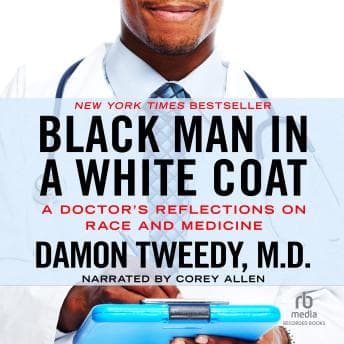

I was sitting in the waiting room of my dentist's office on South Lamar - the one where I'm always the only brown person in the room and the receptionist pronounces my last name differently every single time - when Damon Tweedy described a professor looking at him on his first day of medical school and essentially asking if he was in the right place. And I just... sat there. Phone in my lap. Staring at the fake orchid on the reception desk. Because I knew that feeling in my bones.
This book felt like someone finally writing down the thing you've been turning over in your head for years but couldn't quite articulate.
The Weight of "More Common in Blacks"
There's this recurring moment throughout Tweedy's medical education that wrecked me. Lecture after lecture, disease after disease, the same clinical phrase keeps showing up: "more common in blacks than in whites." And Tweedy is sitting there - one of the only Black students in the room - absorbing this information not as abstract medical data but as a personal forecast. That distinction is everything. He's not just learning medicine. He's learning that his body is statistically more vulnerable, and he's surrounded by future doctors who might only ever see his community as a set of risk factors.
What gets me is how Tweedy doesn't let anyone off the hook - not the medical system, not his patients, not himself. When he's eventually diagnosed with a chronic condition that fits neatly into those very statistics he spent years studying? My heart. MY HEART. The irony is so sharp it could cut, and he handles it with this quiet, almost stunned honesty that made me set down my stylus and just sit with it for a minute.
First-Gen Recognizes First-Gen
Okay, here's where I get personal, because I can't help it. Tweedy comes from a working-class, segregated background. He gets this scholarship meant to diversify medical school enrollment, and suddenly he's navigating a world that wasn't built for him, where people keep subtly (and not so subtly) signaling that he doesn't belong. And listen - I dropped out of art school, I'm not saving lives - but the architecture of that experience? The way you carry your family's pride and your own imposter syndrome in the same pocket? I know that. My abuela used to brag to her comadres about me going to college, and when I dropped out I felt like I'd stolen something from her.
Tweedy writes about his patients - their stories, their distrust of doctors, the economic and cultural walls between them and decent healthcare - with this empathy that never tips into pity. He's not performing allyship for his own community. He IS the community. And he's also the doctor. That dual identity runs through every chapter like a live wire.
Corey Allen Behind the Mic
Corey Allen has this rich, grounded voice that fits the material like it was custom-tailored. The pacing is deliberate without dragging - which matters in a memoir that deals with heavy systemic stuff. You need room to breathe between the hard parts, and Allen gives you that. There's a warmth underneath even the most clinical passages, this undercurrent of hope that keeps the book from feeling like a lecture or a polemic.
I will say the narration is pretty straightforward - no fireworks, no dramatic shifts between characters. For a single-narrator memoir that's more reflective than plot-driven, that works. But if you need a narrator who's going to give you theatrical range or wildly distinct voices, that's not what's happening here. Allen is doing something quieter: he's being a steady, trustworthy guide through difficult terrain. And honestly? For this book, that's exactly right.
Who Needs to Hear This
If you're a person of color who's ever sat in a professional space wondering if you were supposed to be there - yeah. This one's for you. If you work in healthcare and want to understand why Black patients might not trust you, read this and actually listen. If you're someone who thinks racism in medicine ended with desegregation, Tweedy will gently but firmly dismantle that for you over the course of about eight and a half hours.
It's not a fast book. It's not trying to be. Some sections on health policy get a little dense, and I'll admit my attention drifted once or twice during the more statistical passages (sorry, Damon, my brain is wired for feelings, not data tables). I found a similar emotional anchor in Brief Answers to the Big Questions—a book about the universe that somehow felt more intimate than cold equations. But every time I started to drift, he'd anchor it back to a real person, a real moment, and I'd be right back in.
Abuela would have listened to this and gotten very quiet, which was her version of being deeply moved. She spent her whole life going to doctors who didn't speak her language, literally and figuratively. Different community, same broken system. She would've understood every word.
The Book I Didn't Know I Needed at 2 PM on a Tuesday
I came into this expecting a straightforward medical memoir. What I got was something that crawled under my skin and stayed. I didn't ugly-cry (the spreadsheet remains untouched), but I felt that deep, slow ache that's almost worse - the kind where you're not sad about a fictional character, you're sad about the actual world. That's harder to shake off.
That same ache drove me to finally pick up History of the United States, Vol. IV, and while it's a denser listen, it filled in some of the historical architecture behind the hurt.Listen at 1.0x. Let it breathe. And maybe don't listen at the dentist's office unless you want to explain to the hygienist why you look like you've been through something.