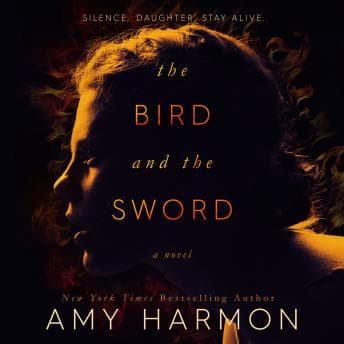

I was debugging a particularly nasty race condition at 11 PM, half-listening to this while staring at logs, when I realized I'd completely stopped working and was just... listening. That's either a sign of a really good book or a really bad bug. In this case, both.
Bottom Line: Worth your commute. Amy Harmon's first fantasy outing is basically a fairy tale retelling but for adults who want their romance with actual stakes and magic systems that make sense. The audiobook has some quirks, but the story carried me through five commutes plus that late-night debugging session.
A Protagonist Who Literally Cannot Speak—And It Works
Lark can't talk. Like, at all. Her mother's dying curse sealed her voice to protect her, and the entire narrative unfolds through her internal monologue and the words she writes. This could've been a gimmick that got old fast, but Harmon commits to it completely. Lark's power manifests through written words that literally come to life—she writes "bird" and birds appear. She writes something more dangerous and... well.
The magic system here is refreshingly logical for a fairy tale. Words have power, but only written ones, only from Lark, and there are costs. Golden Lion has a similarly grounded approach to power—magic isn't free, and the political costs are just as brutal. It's not just "wave wand, get result." The political intrigue around a kingdom that's been purging magic users while secretly depending on them felt uncomfortably relevant.
What surprised me was the slow burn romance. I usually get impatient with these (just TALK to each other, people), but when your protagonist physically cannot speak, the tension actually earns itself. King Tiras is the kind of morally gray love interest who could've been insufferable but lands on the right side of compelling. Wolf Hunters also does that dance with morally complex characters, though it skips the romance angle entirely. He's got his own curse situation going on, which creates this dynamic where two people who can't fully be themselves are trying to figure out if they can trust each other.
Nishimura's Performance: The Crying Problem
Okay, here's where I have to be honest. Trina Nishimura's narration is... polarizing. And I get why.
She nails the lyrical, almost poetic quality of Harmon's prose. There's a hushed reverence to her delivery that matches the fairy tale atmosphere perfectly. When the emotional scenes hit, she commits fully—sometimes too fully. About a third of the way through, I noticed that almost every character sounds like they're perpetually on the verge of tears. The king, the guards, the villains. Everyone's got that catch in their voice.
The child voices are rough. I won't sugarcoat it. When younger characters showed up, I found myself wincing. There's a shrillness that doesn't work.
BUT—and this is important—the book is mostly Lark's internal narration, and Nishimura absolutely owns that space. Since Lark can't speak out loud, we're in her head constantly, and that's where the performance shines. The limited range becomes less of an issue when you're spending 80% of your time with one character's thoughts.
The Booktrack edition adds a musical soundtrack that's surprisingly non-intrusive. Usually I hate that stuff (I'm here for the story, not a spa experience), but it actually worked here. The music swells during emotional peaks without drowning out the words.
The Pacing Hiccup
My one real complaint: the battle scenes feel rushed. Like Nishimura suddenly remembered she had somewhere to be. The emotional beats get the full dramatic treatment, but when swords come out, it's speed-reading time. I caught myself rewinding a couple times during action sequences because I'd missed what actually happened.
At 1.5x (my default), this was occasionally a problem. I actually dropped to 1.25x for the second half, which is rare for me. The prose is dense enough that it benefits from a slightly slower pace.
Best Use Case: Train, Gym. Not For: Falling Asleep
This is not a background listen. The plot requires attention—there are political machinations, multiple curse storylines, and a magic system that builds on itself. I tried listening while doing laundry and had to rewind twice.
But for a commute where you're awake enough to focus? Solid choice. The 11-hour runtime split nicely across my week. The romance builds slowly enough that you're not hitting major moments mid-conversation with your seatmate.
Content warning: there's violence, some abuse themes (Lark's father is genuinely terrible), and the romance gets steamy but not explicit. Nothing that made me rip out my earbuds on a crowded train.
Queue It or Skip It?
You'll love this if: you want fairy tale vibes with actual consequences, you enjoy slow burn romance where the obstacles are real, you can tolerate a narrator who leans dramatic.
Skip if: you need action-packed pacing, child character voices are a dealbreaker for you, or you want something light for background listening.
The ROI Calculation
The return on this audiobook is positive but not overwhelming. The story is genuinely good—Harmon's prose has a musicality that works beautifully in audio format. The narrator has real strengths that match the material, even if she's got some range limitations. The production quality with the Booktrack music is above average.
Is it perfect? No. But I finished it, I enjoyed it, and I'm considering picking up the sequel. For a random fantasy recommendation from a coworker, that's a win.
Now if you'll excuse me, I still have that race condition to debug.