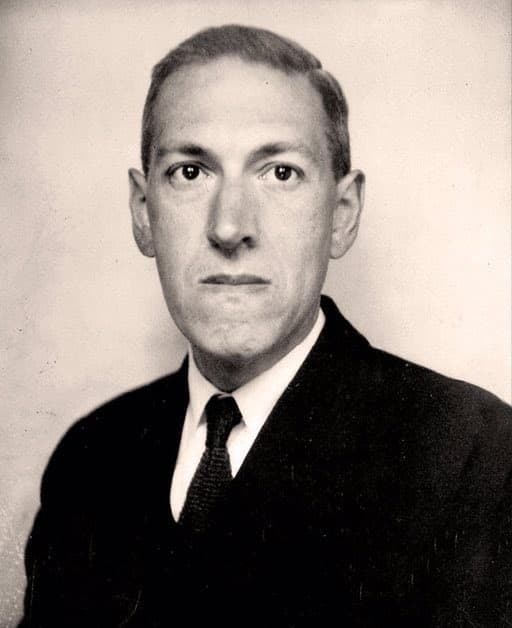
People love to throw Lovecraft into the "important but unlistenable" category. You know the take - influential writer, impossible prose, better read on a page where you can reread his sentences three times before your brain parses them. And honestly? For a lot of his work, I get it. But "Beyond the Wall of Sleep" is one of those early Lovecraft pieces that actually lands differently in audio, because the whole story is basically one man's feverish account of something he can barely comprehend, and hearing that confusion spoken aloud does something the page can't always replicate.
Let me set the scene: I was shelving returns at the library after close - alone, obviously, because my branch doesn't exactly have a night crew - and I had this queued up on my earbuds. Forty minutes. That's nothing. That's a commute. That's doing the dishes. But this particular forty minutes in a dim, empty library with Lovecraft whispering about the cosmic void behind a dying man's dreams? Different experience entirely.
The Dream Behind the Dreamer
So the story itself. If you haven't read it, "Beyond the Wall of Sleep" follows an intern at a psychiatric institution who becomes obsessed with a backwoods patient named Joe Slater - a man who has violent episodes and speaks of luminous beings and cosmic battles in his sleep, things far beyond what his uneducated waking mind could conceive. The narrator rigs up a telepathic device (this is early weird fiction, just go with it) to tap into Slater's dream-consciousness as the man dies, and what he finds is... Lovecraftian. In the truest sense. Not tentacles and elder gods, but the cold, beautiful terror of realizing human consciousness is a prison and something vast is pressing against the bars.
This understands that horror isn't about gore - it's about dread. Specifically, the dread of insignificance. Local Woman Missing works in a completely different register but taps that same nerve — the horror isn't what you see, it's what you slowly realize is true. Lovecraft wrote this in 1919 and the cosmic horror here is almost gentle compared to his later work, but that restraint is what makes it stick. The moment when the narrator makes contact with the entity speaking through Slater's dreams - that shift from clinical observation to existential awe - still hits. It's proto-cosmic horror at its most distilled.
Now, I need to be honest about the Lovecraft of it all. His description of Joe Slater leans hard into the classist, pseudo-scientific language Lovecraft used to describe anyone he considered "lesser," and it's uncomfortable in exactly the way you'd expect from a man with his well-documented prejudices. The story frames Slater's "degeneracy" as part of why his cosmic connection is so remarkable - the contrast between his crude exterior and the transcendent being within. It's doing something narratively interesting but it's wrapped in language that hasn't aged well. Content warning noted and earned.
Jesse P. Watson and the Art of Restraint
Here's where I have to work with what I've got, because Jesse P. Watson isn't a narrator with a huge body of work that I can compare this against. What I can tell you is this: at forty minutes, a single-narrator Lovecraft piece lives or dies on whether the reader understands the cadence. Lovecraft's sentences are long, nested, deliberately overwrought - that's the style, not a flaw. A narrator who fights against that or tries to modernize the rhythm kills the atmosphere. A narrator who leans into it, who treats each subordinate clause like another step down a dark staircase? That works.
Watson lands somewhere in the middle. The reading is competent and steady, which for Lovecraft is actually not a bad thing - there's no dramatic overselling, no trying to turn cosmic dread into a haunted house performance. But I wanted more variation in the emotional register, especially during the telepathic contact sequence where the narrator's clinical detachment is supposed to shatter. That moment needs a shift, a crack in the composure, and I'm not sure Watson quite gets there. The narrator commits in terms of consistency, but I wanted more risk.
For a forty-minute listen, the production is clean. No distracting edits, no weird ambient noise. Bare bones, which is fine - Lovecraft doesn't need sound effects. The text is the effect.
Who This Is Actually For
If you're a Lovecraft completist, you probably already own three versions of this. If you're Lovecraft-curious and want to dip a toe into cosmic horror without committing to a full novel, forty minutes is the perfect entry point. This is early-career Lovecraft before he fully developed his mythology, so it's more accessible than something like "The Call of Cthulhu" while still carrying the DNA of everything he'd become.
If you scare easily, skip. Not because it's viscerally frightening, but because the existential implications have a way of settling into your brain at 2 AM when you're trying to sleep. Ask me how I know.
If you're looking for a definitive audio performance of this story, though, I'd shop around. Watson is fine - genuinely fine - but at this price point and length, you might find a version with a narrator who brings more dynamic range to the cosmic reveal.
Shelve It Under: Starter Cosmic Horror
At forty minutes, this is barely a commitment. It's a palate cleanser between longer listens, a quick hit of existential dread for the drive home. Shirley Jackson walked so Lovecraft could crawl into the void, and this particular story is one of the more elegant crawls in his catalog. Not his best, not his scariest, but a clean distillation of what makes cosmic horror work - the awful, beautiful suspicion that we are not the point of the universe, and something behind our dreams knows it.
Shirley (my cat) was unimpressed. I was unsettled in that quiet way that doesn't fade when you turn the lights on. That's the Lovecraft sweet spot.