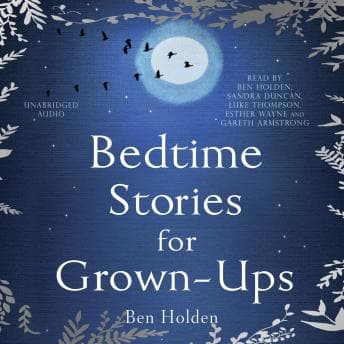

Look, I need to rant about something first. I am a person who optimizes everything. My morning alarm, my Caltrain seat selection, my audiobook queue - it's all a finely tuned pipeline. So when a book literally tells me to "fold away your laptop and shut down your mobile phone" and curl up in bed, I feel personally attacked. That is the opposite of my use case. I listen to audiobooks to make my 2+ hour daily commute productive, not to... fall asleep?
And yet here I am, writing a review of Bedtime Stories for Grown-ups because I made the questionable decision to start it during a bout of insomnia after a particularly gnarly on-call incident last Tuesday. Kevin was already passed out, I was staring at the ceiling replaying a cascading failure in my head, and I figured - fine, Ben Holden, you win. Let's see if your sleep anthology can do what melatonin couldn't.
The First Hour Is Basically a README Nobody Asked For
Holden's introduction is... a lot. He spends what feels like an eternity explaining the science of sleep and why bedtime stories matter for adults, and honestly? Could've been a blog post. A short one. Multiple listeners have called it "relentless dribble about sleep and bedtime ritual" and I can't disagree - it reads like a TED talk that didn't get workshopped enough. The thesis is fine (sleep is important, stories help, we abandoned a good ritual), but the delivery front-loads all the justification before giving you the actual goods. It's like a function with 200 lines of comments before a 10-line implementation.
If you're coming to this specifically to wind down, that first hour of meta-commentary about why you should wind down is counterproductive. Skip ahead. Seriously.
Where It Actually Works: The Anthology as Sleep Architecture
Once you get past the preamble, the structure is genuinely clever. Holden organized the selections to mirror the stages of a single night's sleep - from the drowsy pre-sleep drift through deeper stages and eventually into dream territory. You've got Shakespeare next to Murakami, Dickens alongside Roald Dahl, Tagore sitting with Nora Ephron. It's a wild range, and the tonal shifts between pieces actually work because the five narrators handle different moods well.
The dark humor selections hit surprisingly hard. There's a quality to how the cast handles the weirder, more adult retellings of familiar stories - Gareth Armstrong and Luke Thompson especially bring this dry, almost conspiratorial tone to the darker material. Sandra Duncan and Esther Wane handle the more lyrical, dreamlike pieces. And Holden himself narrates his connective tissue sections, which - for better or worse - means you always know when you're back in "here's why this matters" mode vs. actually experiencing a story.
The Neil Gaiman and Roald Dahl selections are standouts. The contemporary writer picks (Margaret Drabble, Patrick Ness, etc. choosing their ideal grown-up bedtime story) add a fun curation-within-curation layer that I genuinely appreciated as someone who treats book recommendations like pull requests - I want to see the reasoning. That same oddball-literary energy — where you're never quite sure if the next page is going to be whimsical or quietly devastating — is exactly what made 100-Year-Old Man Who Climbed Out the Window and Disappeared such a weirdly satisfying listen for me, even if that one I could actually run at 1.5x on the train.
The Commute-Worthiness Problem
Here's where I have to be honest: this is a terrible commute book. Poetry requires attention. Short story collections mean you're constantly context-switching between authors and styles. At 6AM on a packed Caltrain, surrounded by other half-conscious engineers, I need narrative momentum - something that pulls me forward. This is the opposite. It's designed to let you drift, to lose the thread, to surrender focus. That's the whole point.
And at 13 hours, it's a significant commitment for something that works best consumed in 20-30 minute chunks before bed. The ROI on this audiobook is weird - it's high if you use it as intended (a nightly ritual you return to), but terrible if you're trying to get through it linearly like I do with everything else.
I ended up splitting the difference: listened to the stories and poems at bedtime over about two weeks, skipped or 1.5x'd Holden's interstitial commentary. That worked. The insomnia Tuesday? I was out cold somewhere around a Tagore poem. Point to Holden.
Who Gets Value Here (And Who Doesn't)
Perfect for: bedtime, specifically. People who miss being read to. Anyone who wants a curated tour of short-form literature without having to build their own reading list. If you're the kind of person who falls asleep to podcasts but wants something more intentional, this is your thing.
Skip for: commute, gym, deep work, anyone who wants a single continuous narrative. Also skip if you're allergic to being told why something is good before being allowed to experience it.
The Debug Report
TL;DR: Worth your bedtime, not your commute. A genuinely smart anthology hampered by an overlong introduction and a format that fights against how most of us consume audiobooks. The multi-narrator cast handles the tonal range well, and the sleep-stage structure is more than a gimmick - it actually works when you surrender to it. But you have to meet it on its terms, not yours. I knocked out faster on this than on any white noise app, and I mean that as a compliment.