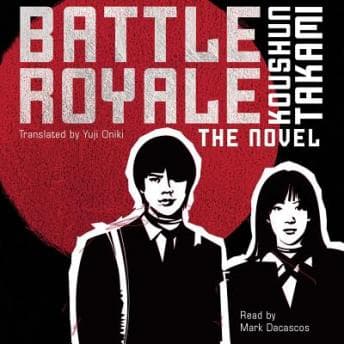

Twenty-one and a half hours of teenagers killing each other. That's what I signed up for.
I picked this up during a stretch of four night shifts in a row - the kind where your circadian rhythm just gives up and files for divorce. I figured Battle Royale's reputation for relentless violence would keep me alert during charting. And honestly? For the first ten hours, it worked. But this book and I have a complicated relationship.
Forty-Two Kids, One Island, and a Collar That'll Blow Your Head Off
Here's the setup: a class of Japanese junior high students gets dumped on an island by their authoritarian government and told to murder each other until one kid is left. They're given random weapons - some get machine guns, some get binoculars, one poor kid gets a fork - and tracked by explosive collars. Every few hours, zones become forbidden. Stay in one and your collar detonates. The premise is savage and Takami commits to it fully. No flinching, no softening. Every single one of those 42 students gets a name, a backstory, a reason you should care before the narrative decides whether they live or die.
And that's both the book's greatest strength and its most exhausting quality. When you're invested in a character - when Takami spends pages building out their childhood crush or their relationship with their parents - and then they're gone in a paragraph of graphic violence, it hits. The trust dynamics are genuinely interesting. Who do you team up with? Who do you believe? Some kids snap immediately, some try to organize resistance, some just hide and pray. That slow unraveling of who you thought people were under pressure is something I'm Thinking of Ending Things does in a completely different register - no weapons, no collars, just dread - and it stuck with me in a similar way. As someone who's actually worked a code, I can tell you that people in crisis don't behave predictably, and Takami gets that right. The panic, the bad decisions, the desperate loyalty - it rings true.
But around hour fourteen? I started feeling the fatigue. The structure is repetitive by design - introduce student, provide backstory, describe confrontation, describe death. Rinse. Repeat. Forty-two times. By the time I was on my third night shift with this book, I was starting to blur the characters together, and not just because of sleep deprivation.
Mark Dacascos Sounds Young Enough - But That's About It
Some listeners love Dacascos's narration. He does capture something youthful in his voice - there's a quality that sells these characters as actual kids rather than miniature action heroes, and that matters because the horror of this story depends on you remembering these are fourteen-year-olds. His readings of the more emotional moments - the fear, the disbelief, the grief - land with real weight.
But here's where I have to be honest. By the two-thirds mark, I was struggling with his performance. With 42 characters to differentiate and a translation that's already working against natural English rhythm, the narration starts to flatten. Characters I should've been able to tell apart started sounding similar. The relentless pacing of the text doesn't give Dacascos many places to shift gears, so you get this sustained intensity that eventually stops feeling intense and starts feeling monotonous. I caught myself rewinding more than once because I'd zoned out during a death scene - and when you're zoning out during someone's death, something's not clicking.
I yelled at my dashboard during this one, but not about medical inaccuracies for once. More like "Wait, who just died? Was that the girl with the sickle or the one with the crossbow?" Not ideal.
The Medical Details Are... Well, Creative
Look, I wasn't expecting clinical accuracy from a pulp thriller about government-mandated teen death matches. But some of the wound descriptions and survival scenarios made me do that thing where I tilt my head at the steering wheel like a confused golden retriever. Kids surviving injuries that would've had my trauma team calling time of death. Adrenaline apparently functioning as a cure-all. The usual thriller stuff. I've made my peace with it. This isn't trying to be realistic - it's trying to be mythic, and on those terms, it mostly works.
Who Needs This in Their Ears
If you read The Hunger Games and thought "this could be darker, longer, and Japanese" - this is your origin story. Literally. Takami wrote this years before Collins, and the DNA is unmistakable. If you can handle extreme violence (and I mean extreme - content warnings for days), the underlying questions about authoritarianism, adolescent trust, and survival morality are genuinely worth sitting with.
But at 21.5 hours with this narration? It's a commitment. I'd honestly recommend bumping the speed to 1.25x, especially through the middle third where the pattern gets predictable. And maybe don't do what I did and pair it with consecutive night shifts. Carlos asked why I looked haunted at breakfast. I told him it was just the usual trauma center stuff. Easier than explaining I'd been emotionally invested in fictional teenagers for four straight nights.
Shift Change
Battle Royale is brutal, bloated, and kind of brilliant in spots. The premise still slaps 25 years later. The execution (pun intended) gets repetitive, and the audiobook performance doesn't quite have the range to carry you through all 21 hours without fatigue. But when it works - when Takami locks you into one kid's perspective and makes you feel the weight of their impossible choices - it's the kind of story that stays in your car with you after you've parked and turned off the engine.
Night shift approved, but bring caffeine. Lots of it.