
"There is no us and them. There's just us."
That line hit me around hour three, grading papers at my kitchen table while Denise slept. I had to stop the audiobook. Set my red pen down. Just sit with it for a minute.
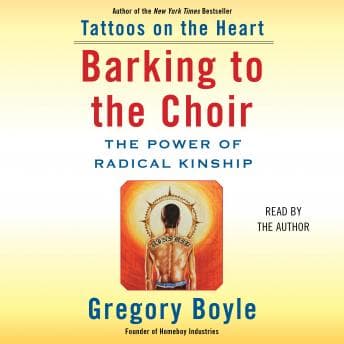
This reminds me of what Hemingway said about writing—that the truest sentences are the ones that make you stop. Father Gregory Boyle writes sentences like that. Speaks them, actually, since he narrates this himself. And that gravelly voice—the one some listeners apparently find distracting—becomes part of the message. This isn't a polished TED talk. This is a man who's spent thirty years in the trenches of East LA, and you can hear every one of those years.
A Voice Worn Smooth by Use
Let's talk about that narration. Yes, Boyle sounds like he's smoked a pack a day. (He probably hasn't, but decades of gang funerals will age a voice.) Some folks wanted a professional narrator, someone with radio-smooth delivery. Those folks missed the point entirely.
When Boyle tells you about Sergio—arrested at nine, gang member by twelve—there's a pause before he says the kid now works on the substance-abuse team at Homeboy. That pause isn't theatrical. It's a man remembering. When he shares how Jamal, abandoned at seven for trying to go to school, eventually forgave his schizophrenic mother—the crack in Boyle's voice is real. You can't hire that.
The humor surprised me most. Boyle is genuinely funny, in that self-deprecating Jesuit way that reminds me of my old theology professors. He'll tell you something devastating, then pivot to something absurd, and you're laughing before you realize you're still crying from the previous paragraph. My students would call this emotional whiplash. I call it expert pacing.
Less Story, More Sermon—And That's the Point
Here's where I'll agree with the critics: if you loved Tattoos on the Heart for its narrative arc, this one's different. Barking to the Choir reads more like a collection of homilies. Quotes and snippets. Moments strung together by theme rather than chronology.
At first, I wanted more. More of Sergio's journey. More about Cuco taking his four-year-old on daily adventures because he never knew his own father. I wanted the full stories.
But around hour five—walking the lakefront, Denise pointing at something I completely missed because I was lost in Boyle's words—I realized this structure is intentional. These aren't case studies. These are people. And people don't come with neat narrative arcs. They come in glimpses. In moments of grace you almost miss if you're not paying attention.
What Boyle's Really Saying
This is why we still read the classics, even when they're uncomfortable. Even when they challenge our categories.
Boyle isn't writing about gang members. He's writing about us—all of us—and how the boundaries we draw between "good people" and "those people" are lies we tell ourselves to feel safe. That same tension—where to draw lines, when to hold them—runs through Boundaries with Teens, though from a different angle. Every story in this book is a mirror. Jamal's mother wasn't evil; she was sick. Sergio wasn't born criminal; he was born into circumstances most of us can't imagine.
"Compassion isn't a relationship between the healer and the wounded," Boyle says at one point. "It's a relationship between equals."
I've been teaching To Kill a Mockingbird for fifteen years. Atticus Finch's whole thing is about standing in someone else's shoes. Boyle does Atticus one better. He doesn't just stand in their shoes—he gives them jobs. He calls them his sons. He buries them when the streets take them back.
Who This Is (And Isn't) For
If you want escapism, look elsewhere. If you need tight plotting and clear resolution, this isn't it. If a gravelly voice genuinely bothers you—fair enough, but you're missing something.
But if you teach. If you work with young people. If you've ever looked at a kid making terrible choices and wondered how they got there—this is essential listening. If you're exhausted by a world that seems to have forgotten kindness is an option, Boyle will remind you.
My students would hate this. Too slow. Too churchy. Not enough plot.
I love it. Worth pausing the faculty meeting for. Worth staying up past midnight for. Worth the tears I blamed on allergies when Denise asked why I looked wrecked the next morning.
Class Dismissed
I started this audiobook expecting spiritual comfort food. What I got was a challenge. Boyle doesn't let you off easy. He doesn't want you to feel good about donating to charity and moving on. He wants kinship. Real, uncomfortable, inconvenient kinship with people you'd normally cross the street to avoid.
Seven hours and fifty-six minutes. That's how long it takes to crack open your assumptions about who deserves compassion.
The prose deserves to be savored. At 1.0x, obviously. Anyone who speeds through this is cheating themselves.