
I was about four hours into this one, driving through evening traffic with nowhere to be, when Kuang's premise finally clicked into place. Robin is watching his professor inscribe a silver bar with matched words — one Cantonese, one English — and the magic only works because something gets lost between them. The gap between languages is where the power lives. I actually pulled over and rewound thirty seconds because I wanted to hear that passage again. That's when I knew this book had its hooks in me.
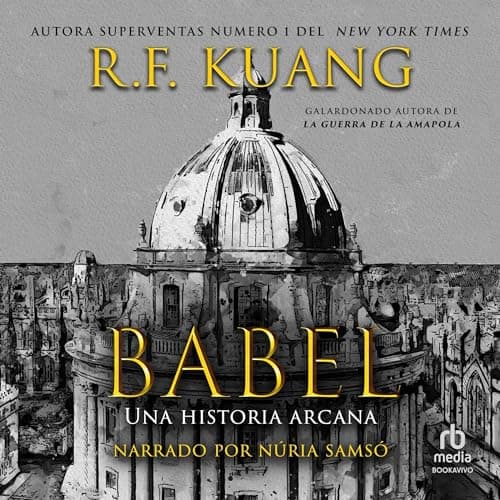
Here's the setup: Robin Swift, a Cantonese orphan, gets plucked from cholera-ravaged Canton by an Oxford professor and brought to the Royal Institute of Translation — Babel — where students learn to harness silver-bar magic powered by etymological mismatches between languages. Britain runs its empire on this stuff. Every translated word pair Robin creates makes the colonizer stronger and his homeland weaker. The first half of the book is warm and seductive — Robin finds real friendships with Ramy, Victoire, and Letty, and Kuang nails that intoxicating feeling of belonging at a prestigious institution. Late-night study sessions, arguments about grammar over cheap wine, the belief that knowing more might actually fix the world. It's the kind of academic fantasy that makes you nostalgic for a university experience you probably never had.
But the trap is already set. Robin is a colonized subject being trained to serve the colonizer, and Kuang never lets you forget it. Every silver bar he perfects extracts value from a culture Britain is actively destroying. The tension between Robin's genuine love for his work and his growing awareness of what that work enables — that's the engine of this book. When Britain moves toward war with China over opium and silver, Robin has to choose sides, and the choice costs everything.
Buy this if you can handle a twenty-four-hour listen that's more argument than action, and you genuinely enjoy stopping to think about language and empire. The magic system alone is worth the commitment — it's one of the most original I've encountered in fantasy, and it works because it's built on something real. Kuang clearly knows her linguistics and her history, and the two feed each other in ways that kept surprising me deep into the second half.
Skip it if you need sharp vocal separation in dialogue or want fantasy that moves scene to scene without long ideological detours. Nuria Samsó delivers twenty-four hours of dense material with steady control and clear diction, and her pacing suits the academic tone — measured, precise, letting Kuang's arguments land at full weight. I heard that same measured control from her in Sombra y hueso, though the material there is lighter and she gets more room to breathe between the dramatic beats. She handles the emotional escalations in the back half with restraint rather than melodrama, which is the right call for material this heavy. But character differentiation isn't her strongest suit here. Robin, Ramy, and Professor Lovell can blur together in dialogue-heavy stretches, and during a few rapid exchanges I had to rewind to figure out who was talking. Not a dealbreaker, but a real trade-off you should know about going in.
The Spanish translation creates a fascinating meta-layer that the English edition simply can't offer. This is a novel about what gets lost in translation, and you're hearing it filtered through yet another act of translation. The translation team made smart choices about when to preserve the original English-Cantonese word pairings and when to annotate. If you're bilingual, you're experiencing the book's central argument in real time — every time a match-pair example shifts meaning in Spanish, you feel the gap Kuang is talking about.
Now, the weaknesses. Kuang has a thesis and she's going to make sure you get it. In the back half especially, Robin's internal monologue can read less like a character working through a crisis and more like a postcolonial studies seminar. There are stretches — fifteen, twenty minutes at a time — where the pacing stalls because the book stops to educate instead of dramatize. The ending is polarizing: Kuang commits fully to the logical conclusion of her premise, and it's bleak. Some listeners will find it honest and earned. Others will feel like they sat through twenty-four hours to get lectured at the finish line. I admired the courage of the choice while wishing the emotional payoff had been built through character rather than ideology.
This is focused-listening material. I tried it during a workout once and lost the thread completely within ten minutes. The linguistic and philosophical arguments require your full attention — miss a key passage about why a particular silver-working matters and the next three scenes lose their weight. Long drives and quiet evenings worked best for me. At this length, plan on spending a week with it.
What Kuang pulled off here is rare: a fantasy novel where the magic system is an indictment. The silver bars aren't escapism — they're evidence. And hearing the whole thing in Spanish, watching the book's own argument about translation play out through the act of being translated, gives this edition something the original can't replicate. The book argues that language is power and translation is theft. Twenty-four hours later, I'm still not sure it's wrong.










![Sombra y hueso [Shadow and Bone] audiobook cover](/_next/image?url=https%3A%2F%2Fm.media-amazon.com%2Fimages%2FI%2F51Ew1Pe1rEL._SL1200_.jpg&w=1920&q=75)
![Asedio y tormenta [Siege and Storm] audiobook cover](/_next/image?url=https%3A%2F%2Fm.media-amazon.com%2Fimages%2FI%2F51FbopX7EiL._SL1200_.jpg&w=1920&q=75)
![Ruina y acenso [Ruin and Rising] audiobook cover](/_next/image?url=https%3A%2F%2Fm.media-amazon.com%2Fimages%2FI%2F51403xZLuTL._SL1200_.jpg&w=1920&q=75)