
What happens when the very language you study - the words you translate, the etymologies you trace like veins through living stone - becomes the weapon of the empire that stole you from your mother's arms?
I sat with that question for twenty-three hours. Twenty-three hours on my porch in Atlanta, watching the dogwoods lose their last blossoms while Robin Swift lost everything else.
The Weight of Words Made Literal
Now, I spent forty years at Howard teaching students that language carries power - that naming a thing gives you dominion over it, that translation is never neutral. R.F. Kuang took that idea and built an entire magic system around it. Silver bars inscribed with translation pairs, where the gap between what a word means in one language and what it means in another generates actual, physical force. The untranslatable becomes fuel for empire. And honey, if that isn't the most brilliant metaphor for colonialism I've encountered in fantasy fiction, I don't know what is.
But here's what separates Babel from clever concept novels: Kuang doesn't just gesture at the idea. She drags you through the academic machinery of it. You will learn about etymology. You will sit through lectures on Mandarin tone systems and Latin roots and the politics of who gets to define a word's "correct" meaning. Some listeners have called this tedious - exhausting, even. I understand that complaint. Around hour fourteen, when we're deep into another etymology lesson while the plot waits patiently outside like a dog tied to a post, I felt the weight of it too.
But I kept thinking about my husband, Gerald. He used to say the best books make you earn the payoff. And the payoff here - when Robin finally understands that his scholarship, his talent, his very presence at Oxford exists only to serve an empire that would discard him the moment he stops being useful - that lands like a fist because you've done the intellectual work alongside him.
A Note on This Italian Edition - and What Gets Lost
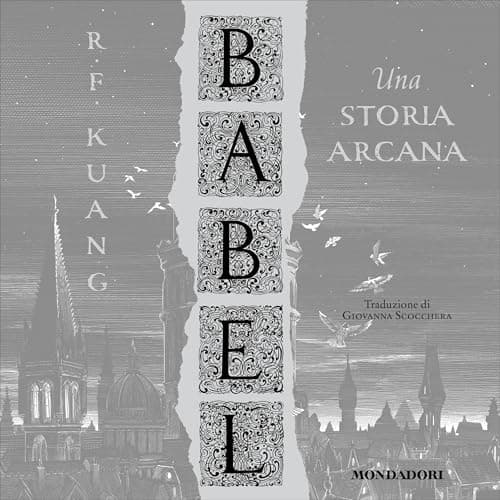
I should be honest about something. The edition I listened to is Federico Vellani narrating Giovanna Scocchera's Italian translation. The English audiobook features Chris Lew Kum Hoi with Billie Fulford-Brown handling the footnotes in this dry, almost sardonic register that listeners have praised - and I can see why that dual-narrator structure would work beautifully. Footnotes in an audiobook are a gamble. Making them feel like a second voice whispering commentary from the margins? That's smart production.
Vellani carries this Italian edition on his shoulders alone, and at twenty-three hours, that's a marathon. His pacing is deliberate - which I appreciate, because this prose deserves to be savored slowly, but I'll admit there are stretches in the third act where deliberate tips into labored. The book's academic density demands a narrator who can make a lecture on the Proto-Indo-European roots of "silver" sound like revelation rather than curriculum. He manages it most of the time. Not always.
And there's the thorny question of a book fundamentally about the politics of translation - being itself translated. Kuang's English text already grapples with Mandarin, Haitian Creole, Urdu, Latin. Some of those linguistic gaps that power the silver bars - the whole magic system depends on untranslatability - inevitably shift when filtered through Italian. I kept wondering what Scocchera had to negotiate, what she lost, what she maybe found. A book about translation, translated. My late husband would have loved arguing about that over dinner.
Who Robin Swift Really Is
Robin is not a hero in the traditional sense. He's a young man who spends most of the novel being grateful for the cage he's in because the cage has good lighting and interesting books. His radicalization is slow - painfully slow for readers who want action. But that slowness is the point. Kuang is showing how complicity works: how you can know intellectually that you're being used and still cling to the comfort of belonging. Robin doesn't storm the barricades until the empire makes it impossible for him to keep pretending the barricades aren't there.
His friendship with Ramy, Victoire, and Letty - the cohort dynamics, the way affection curdles when political reality intrudes - that's where the emotional center lives. Particularly the fracture with Letty. Without spoiling it, I'll just say: if you've ever watched a white friend choose comfort over solidarity, you'll recognize that scene in your bones. That particular ache — the slow unraveling of a friendship along fault lines neither person wanted to name — is something We Have Always Been Here handles with a similar kind of quiet devastation.
Pour Yourself Something Strong Before You Start
This is not background listening. This is not your commute book. This is the kind of audiobook that requires you to sit down, be still, and give it your full attention - the way you'd give attention to a difficult, brilliant lecture from a professor who respects you enough not to simplify. Some stories need time to breathe, and Babel breathes like a cathedral organ - slow, deep, and sometimes overwhelming.
Is it perfect? No. The pacing sags in the middle third. The exposition occasionally overwhelms the humanity. And I suspect some of the linguistic fireworks lose their spark in translation from the English original.
But when it works - and it works more often than it doesn't - it's the kind of book that changes how you think about the words in your mouth. And at my age, finding a book that still does that? That's worth every one of those twenty-three hours.