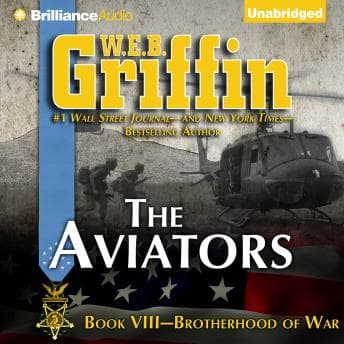

"The Army doesn't have an Air Assault Division because the Army doesn't believe in air assault." Somewhere around hour three, a general says something like this—dismissive, institutional, blind to what's coming—and I actually stopped walking along the lakefront to let it sink in. Because Griffin isn't just telling a war story here. He's documenting the birth of modern helicopter warfare, and the bureaucratic knife-fight that almost strangled it in the crib.
I came to The Aviators sideways, having worked through The New Breed first, and I'll be honest—there's overlap. Characters reappear, timelines intersect, and if you're expecting a completely fresh narrative, you might feel like you're covering familiar ground. But here's the thing: Griffin understood that Vietnam wasn't one story. It was dozens of stories happening simultaneously, viewed through different cockpits and conference rooms. The Aviators gives you the mechanics and the politics behind the machines. The New Breed gave you the operators. Together, they're complementary halves of something larger.
When the Pentagon Fights Itself
What Griffin does better than almost anyone in military fiction is capture the absurdity of inter-service rivalry during wartime. The Army wants helicopters. The Air Force insists fixed-wing is their domain. Meanwhile, young pilots are dying in aircraft that keep mysteriously failing, and the brass is more concerned with budget lines than body bags. It's infuriating in exactly the way real institutional dysfunction is infuriating—you want to reach through the speakers and shake someone.
The technical detail here is dense. Griffin was a decorated military correspondent, and it shows. He knows the difference between an OH-6 and a UH-1, and he assumes you either know too or will figure it out from context. My students would hate this. I love it. There's something deeply respectful about an author who trusts his audience to keep up.
Eric G. Dove—Excellent, With Asterisks
Let me be direct about the narration: Dove is genuinely excellent. His voice work across multiple characters—officers, enlisted men, wives, politicians—demonstrates real craft. One listener called him "fricken masterful," and I understand the enthusiasm. When he's locked in, the performance disappears and you're just there, in the helicopter, in the briefing room, in the bedroom after the telegram arrives.
But.
The mispronunciations. Place names, military jargon, the specific terminology that Griffin deployed with such precision—Dove stumbles on them, and each stumble is a jarring stop. It's like listening to a beautiful symphony where the violinist occasionally hits a wrong note. You recover, but the spell breaks. For a book this steeped in military authenticity, those moments land harder than they might in civilian fiction. I found myself wincing at least half a dozen times, which is half a dozen too many for a 13-hour commitment.
This is why we can't have nice things, apparently. A narrator this talented, material this rich, and someone in the production booth didn't catch "Da Nang" being pronounced three different ways?
The Women Who Wait (And Don't Just Wait)
Griffin gets criticized sometimes for his female characters, but The Aviators actually does something interesting with the wives and lovers orbiting these men. They're not just waiting by phones. They're navigating their own institutional battles—military spouse culture, the peculiar loneliness of loving someone who might not come home, the way war reshapes marriages even from 8,000 miles away. It's not the focus, but it's present, and it's handled with more nuance than I expected from a book published in 1988. Mad Honey explores similar territory around women navigating impossible situations, though in a completely different context.
Denise asked what I was listening to during one of our evening walks—she could tell from my face it wasn't Middlemarch. I tried to explain the helicopter politics and she gave me that look. The one that says "you're such a nerd" but fondly. Fair enough.
Who Should Strap In (And Who Should Bail)
If you're already invested in Griffin's Brotherhood of War series, this is essential. If you're coming in cold, I'd actually recommend starting with The New Breed first—it's more immediately gripping, and The Aviators will reward you more once you have that context. Military history buffs, especially those interested in the evolution of Army aviation doctrine, will find this invaluable.
Skip if: you need fast-paced action throughout (there are stretches of pure bureaucratic maneuvering), you're sensitive to period-accurate attitudes about women and race, or mispronunciations genuinely ruin audiobooks for you.
Worth Pausing the Faculty Meeting For?
Almost. The Aviators is serious military fiction from an author who knew his subject intimately, delivered by a narrator who—pronunciation issues aside—brings genuine skill to the performance. It's not Griffin's most exciting work, but it might be one of his most important. The story of how the Army learned to fly isn't glamorous, but it's essential.
I'll be thinking about those failing helicopters and the men who flew them anyway for a while. That's what good historical fiction does—it makes you feel the weight of decisions made by people who are all dead now, but whose choices echo forward into the present.