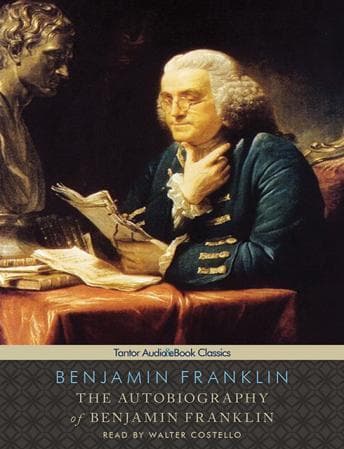

"I resolved to do an act of kindness every day, and to record it."
That line hit me somewhere around hour three, and I had to pause my work because—look, I wasn't expecting Benjamin Franklin to make me emotional. This is a founding father. A guy on money. But here's the thing: this book felt like sitting with someone's abuela, listening to them tell you exactly how they built their life from nothing. And honestly? That got me.
I know, I know. This is way outside my usual romance-and-contemporary-fiction lane. But I've been in this weird headspace lately where I want stories about people who just... figured it out. Who started with nothing and made something. My own abuela came to Texas with basically the clothes on her back, and she would've loved this book. She would've nodded along to every bit about hard work and self-improvement, even if she'd side-eye some of Franklin's more, uh, confident moments.
A Professor Who Actually Wants You to Understand
Walter Costello's narration is steady and clear—like a really good history professor who actually wants you to get it, not just impress you with what he knows. His pacing is generous, which I appreciated because Franklin's 18th-century language can get dense. There were moments where I wished for more vocal variety when Franklin quotes other people—his wife Deborah and Franklin himself sometimes blend together—but honestly, for a single narrator handling this much historical material, he does solid work.
The production quality is clean. No weird pops or background noise. Just you and Ben Franklin's life story for six and a half hours. (Frida fell asleep on my keyboard around hour four. Diego judged us both.)
When a Founding Father Gets Real
Here's what surprised me: Franklin is funny. Like, genuinely witty. He's also kind of insufferably confident sometimes? But in a way that made me laugh rather than roll my eyes. The man literally created a thirteen-point virtue system to make himself better and then tracked his progress in a little book. Narrative of the Life of Frederick Douglass has that same relentless self-improvement energy, that same "I will make myself into something better" determination. Unhinged spreadsheet energy. I respect it.
The sections about his early life in Boston and then Philadelphia hit different when you're listening while working. He's talking about teaching himself to write by copying essays and then rewriting them from memory, and I'm sitting here at my desk thinking about all the design tutorials I've watched to teach myself this career. The vibes are "you can figure it out if you just keep going." Which, some days, is exactly what I need to hear.
But I'll be honest—the middle sections about colonial politics and his time in England dragged for me. I found myself zoning out during some of the longer passages about printing contracts and political maneuvering. This is a rainy Sunday book, but maybe not all at once. I broke it up over a week of design sessions.
The Quiet Ache I Wasn't Ready For
I didn't ugly-cry. (Shocking, I know.) But there's this quiet emotional thread running through everything—Franklin writing this as a letter to his son, reflecting on his life, trying to pass down what he learned. The book was never finished. He died before he could complete it. And knowing that while listening gave everything this bittersweet weight.
The parts about his relationship with his father, about leaving home, about building himself into someone new—my heart. Noble Woman: The Life-Story of Edith Cavell gave me that same quiet ache—watching someone build a life of purpose from ordinary beginnings. Not in the romance novel way, but in the "this is a real person who lived and struggled and figured things out" way. Abuela would have loved this one. She would've said something like, "Mija, see? You work hard, you become something."
Who This Is (and Isn't) For
If you want action and drama, this isn't it. If you want to feel like you're getting life advice from a very smart, slightly smug, but ultimately kind historical figure—this is your book. Skip it if 18th-century prose makes you antsy or if you need a tight plot to stay engaged. But if you're in a "figuring things out" season of life? This one might hit you right in the chest.
I'd recommend speeding it up to maybe 1.25x during the denser political sections, but keep it at 1.0x for the personal stories. That's where the good stuff lives.
Mija, Everyone Starts Somewhere
Not my usual genre. Not my usual emotional experience. But sometimes you need a founding father to remind you that everyone starts somewhere, and figuring it out as you go is basically the American way. Or something.






![Steve Jobs [unabridged audiobook] audiobook cover](/_next/image?url=https%3A%2F%2Fcovers.audiobooks.com%2Fimages%2Fcovers%2Ffull%2F9788499923406.jpg&w=1920&q=75)