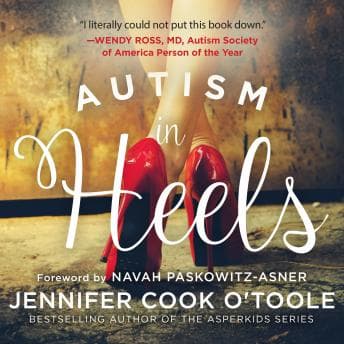

Twelve hours and forty minutes. Let me say that again. Nearly thirteen hours for a memoir that could've been a devastating, tightly wound six-hour gut punch. Instead, Jennifer Cook O'Toole wrote a book that meanders like a conversation with your most fascinating friend at 2 AM - the kind where you're captivated for stretches, then suddenly she's on a tangent about Greek mythology and you're checking the time.
I was on a red-eye to Denver, couldn't sleep, figured I'd knock this out. By hour three I was wide awake - not from turbulence, but from O'Toole describing how she'd mentally catalog every social interaction like a field researcher, building an exhaustive database of "normal" human behavior just to pass as neurotypical. That hit different. My parents did something eerily similar when they came to LA - studying American customers, memorizing small talk scripts, performing a version of themselves that would make people comfortable enough to hand over their dry cleaning. Different context, same survival mechanism.
The Red Stilettos Are Doing More Work Than You Think
Here's what makes this book worth your time: O'Toole's central argument that autism in women gets missed because the diagnostic criteria were built around how boys present. She talks about her eating disorder, her volatile relationships, her perfectionism - all things that got labeled as "just being a difficult woman" rather than indicators of something deeper. The diagnosis at thirty-five wasn't the beginning of her story. It was the decoder ring for a story that had been written in a language she couldn't read.
The red heels metaphor works because it's not just about fashion. It's about the armor women on the spectrum construct - hypervisible femininity as camouflage. O'Toole describes picking out those stilettos with the deliberateness of a general planning a campaign. Every outfit, every hair choice, every smile was strategic. And she narrates these passages with this knowing warmth that makes you feel like she's letting you in on a secret she's been keeping for decades.
When the Author IS the Narrator - For Better and For Worse
O'Toole narrates her own book, and this is where it gets complicated. The positive: nobody else could deliver lines like "I was the best fake neurotypical you ever met" with that specific mix of pride and grief. Her timing on the funny bits is genuinely good - there's a section about bad perms in the '80s that had me doing the silent airplane laugh. She's warm, she's candid, and when she hits an emotional beat about her daughters, you can hear her voice tighten in a way no hired narrator could replicate.
The negative: the non-linear structure is rough in audio format. O'Toole jumps between childhood memories, her marriage, her professional career, and broader commentary on gender and autism - sometimes within the same chapter. On paper, you can flip back. In your earbuds at 35,000 feet, you're just... lost. I rewound more than I have in months. And at 2.0x, the jumping felt almost chaotic. I dropped to 1.5x around hour five, which is the audiobook equivalent of me waving a white flag.
Some listeners have called the narration grating. I wouldn't go that far, but I'll say this: O'Toole's delivery is intense. Relentlessly intense. There aren't many quiet moments where the prose just breathes. For a nearly thirteen-hour listen, that's exhausting. Jenny would say I'm being harsh. Jenny is right. But also - this book needed an editor with a machete and a stopwatch.
Who Gets the Most ROI Here
Women who've spent their lives feeling like they're performing a version of themselves - whether or not they're on the spectrum - will find this uncomfortably clarifying. Parents of girls who seem "fine" but are quietly imploding behind their perfect grades and social scripts need this book. If you're a clinician still working from the DSM's boy-centric autism criteria, skip to the chapters on masking and female presentation. That's where the real clinical value lives.
If you want a structured, linear self-help book with bullet points and action items, this isn't it. I gave Spark Joy four stars partly because Kondo understood that constraint—illustrated, methodical, respecting the reader's time—and O'Toole's sprawl makes me appreciate that discipline even more. This is a memoir that occasionally lectures, and a lecture that occasionally memoirs. The key takeaway is worth the listen. The other 7 hours? Not so much.
I've recommended O'Toole's Asperkids series to two clients with kids on the spectrum. She knows her subject deeply because she IS her subject. But knowing something and organizing it for audio consumption are different skills. Compared to something like Temple Grandin's memoir work - which is clinical, spare, almost ruthlessly efficient - O'Toole's approach is maximalist. Every emotion explored from every angle. That's authentic. It's also a lot.
Bottom Line on the Boarding Pass
This is a 4-star book trapped in a 3-star audiobook format. The ideas are important - genuinely, urgently important for how we identify and support women on the spectrum. O'Toole's personal revelations carry weight precisely because she's not a detached observer. But the non-linear audio experience and the sheer runtime work against the message. Read the print version at your own pace, or commit to this audiobook with full attention and a willingness to rewind. This is not a commute listen. This is not a gym listen. This is a sit-down-with-a-notebook listen, which - at nearly 13 hours - is a real ask.









