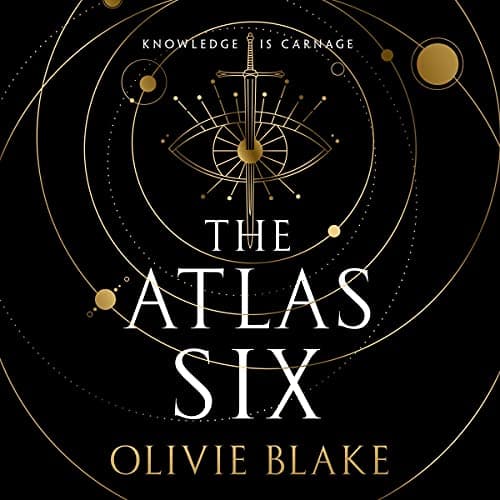

"The difference between you and me is that I know what I am."
That line hit somewhere around hour six, and I had to pause my thesis procrastination to just... sit with it. I was supposed to be debugging a procedural dungeon generator. Instead I'm having an existential crisis about a telepath's moral philosophy. Classic Thursday.
Dark Academia Meets Magic Battle Royale
Look, The Atlas Six is basically "What if the Alexandrian Library survived, but it's run by morally questionable hot people with god-tier powers?" And honestly? The magic system is *chef's kiss*. Olivie Blake doesn't just give us six mages—she gives us six completely different approaches to manipulating reality. Libby and Nico are cosmologists who can literally rearrange matter with their minds, but they do it in fundamentally opposite ways. Parisa reads thoughts like most people read text messages. Callum can make you feel whatever he wants you to feel, which is terrifying if you think about it for more than thirty seconds. (I thought about it for approximately four hours.)
This is Sanderson-level world-building, except instead of hard magic with clear rules, Blake gives us something messier and more philosophical. Court of Wings and Ruin plays in that same space where power always demands payment. The magic here isn't about what you CAN do—it's about what doing it costs you. My D&D group would absolutely steal this for a campaign. The Alexandrian Society functions like the most cutthroat wizard college imaginable, where the entrance exam involves proving you're willing to sacrifice someone.
Eight Narrators, Zero Confusion
Here's where the audiobook format genuinely elevates the source material. Each of the six candidates gets their own narrator, and the production team made inspired choices. Caitlin Kelly captures Libby's anxiety with this tight, controlled delivery that occasionally cracks under pressure. You can HEAR her overthinking. Meanwhile, whoever voices Nico (I think it's Damian Lynch?) brings this sharp wit that makes his banter with Libby land perfectly. They're supposed to be "inseparable enemies" and the narrator performances sell that complicated dynamic better than text alone could.
Steve West handles Atlas Blakely with exactly the right amount of mysterious authority—you trust him and you absolutely shouldn't. The full cast approach means you never lose track of whose head you're in, which matters because Blake switches perspectives constantly. Without distinct voices, this would be a confusing mess. With them? It's like listening to an ensemble podcast where everyone actually showed up prepared.
The Pacing Problem (And Why I Didn't Care)
Okay, real talk: the plot kind of... doesn't move? For long stretches? There's a lot of characters thinking about power, talking about power, flirting while discussing power. If you need constant action, this isn't for you. The first half is almost entirely setup—introducing six complex characters, their abilities, their baggage, their complicated attractions to each other.
I've seen people DNF this around hour eight because "nothing happens." And like... technically correct? But also missing the point. The tension isn't in external events—it's in watching these six brilliant, damaged people circle each other, forming alliances that might become betrayals. It's a slow burn in the truest sense. By the time the actual stakes become clear, you're so invested in the character dynamics that the plot almost feels secondary.
The narrators saved this for a lot of people, myself included. When the story stalled, the performances kept me engaged. Libby's narrator in particular has this way of making internal monologue feel urgent, like her anxiety is contagious.
Who Gets Sorted Into This House
This is for people who loved the academic politics of Ninth House, the competitive magic school vibes of A Deadly Education, or honestly anyone who's ever wanted to see what happens when you put six overpowered mages in a pressure cooker and wait. Babel scratches a similar itch—morally complex academics wielding dangerous knowledge in a system designed to exploit them. If you need action every chapter, skip it. If you're here for morally gray characters debating the ethics of power while being extremely hot and occasionally murderous? Welcome home.
Content warning: there's violence, some sexual content, and emotional manipulation that's genuinely unsettling because Callum's powers are DEEPLY creepy when you think about consent.
Roll for Thesis Abandonment
I finished this at 2 AM on a Tuesday when I should have been working on my procedural generation chapter. Dr. Patel would be disappointed, but Dr. Patel hasn't experienced the specific pleasure of listening to six unreliable narrators lie to themselves and each other for seventeen hours. The progression is satisfying—not in power levels, but in understanding. Each character becomes more complex, more compromised, more interesting.
Yes, it's nearly seventeen hours. Yes, it's worth it. The full cast production transforms what could be a confusing multi-POV mess into something genuinely immersive. I've already got The Atlas Paradox queued up, and my thesis can wait another week.
(It cannot actually wait another week. I'm going to listen anyway.)