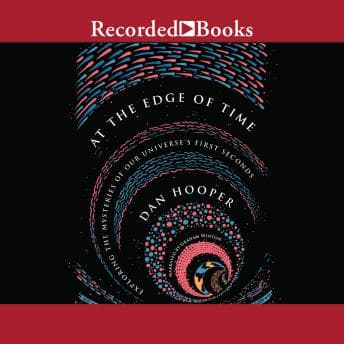

5:47 AM on a Tuesday. Wedged between a guy manspreading into my seat and someone's very aggressive breakfast burrito. Not ideal conditions for contemplating the first picoseconds after the Big Bang. But here's the thing—Dan Hooper made it work anyway.
Bottom Line: Worth your commute. This is basically a state-of-the-union address for cosmology, and the news is fascinating.
The Universe Had a Weird Childhood
Hooper works at Fermilab. Like, actually works there—theoretical astrophysics group, investigating dark matter and supersymmetry and all the stuff that makes my distributed systems problems look adorably simple. And you can tell. This isn't a pop-science writer summarizing papers they half-read; this is someone explaining their actual job.
The core premise grabbed me immediately: we've gotten pretty good at understanding the universe from about 380,000 years after the Big Bang onward (that's when the cosmic microwave background formed, for the non-nerds). But those first seconds? First microseconds? We're basically making educated guesses. Hooper is refreshingly honest about where the solid science ends and the "here's what we think might be happening" begins.
He spends significant time on the matter-antimatter asymmetry problem, which—okay, I know this sounds dry, but stick with me. The universe should have equal amounts of matter and antimatter. They should have annihilated each other. We shouldn't exist. But we do, and nobody really knows why. Hooper walks through the leading theories without pretending any of them are settled. That intellectual honesty? Chef's kiss.
When the Large Hadron Collider Becomes Your Lab Partner
The sections on using the LHC to recreate Big Bang conditions hit different when you're an engineer. He explains how particle physics experiments are essentially time machines—smash particles together hard enough and you're recreating energy densities that haven't existed since the universe was younger than my morning coffee is now. The connection between these experiments and cosmological theory is laid out clearly enough that I could follow it while half-asleep (tested and confirmed, multiple mornings).
Dark matter gets substantial coverage, and Hooper doesn't oversimplify. He explains the observational evidence, the leading candidates (WIMPs, axions), and why we haven't detected it directly yet despite decades of trying. There's this great section where he walks through the various detection experiments and why each one might or might not work. It's the kind of systematic breakdown that appeals to anyone who's ever had to debug a system where you know SOMETHING is there but can't quite prove it.
Cosmic inflation gets the treatment it deserves too. The idea that the universe expanded faster than light for a fraction of a second, and that this explains why the cosmos looks so uniform in every direction—Hooper makes the case for why physicists believe this happened even though it sounds absolutely bonkers.
Graham Winton: Clean Signal, No Noise
Look, I'll be honest—there's not much to say about the narration here. Winton reads clearly, paces well, doesn't stumble over the technical terminology. For a 7-hour science book, that's exactly what you need. He's not Ray Porter (who is?), but he doesn't get in the way of the content. No weird pronunciation choices that made me cringe, no monotone drone that put me to sleep faster than the early train already does. Professional, competent, unobtrusive.
At 7 hours 14 minutes, this is a perfect length for a science book. Long enough to actually explain things properly, short enough that it doesn't pad with repetitive summaries. I finished it in about 5 commutes at 1.5x speed—could've done 1.75x but honestly, some of the physics deserved the slower pace.
Queue It For: Train, Gym. Skip If: You Need Background Audio
This works surprisingly well for commute listening because Hooper structures his arguments clearly. You can zone out for a minute when someone's having a loud phone conversation and pick back up without being completely lost. But I wouldn't recommend it for background listening while coding—you'll miss too much.
If you loved Sean Carroll's work, this is in the same wheelhouse but more focused on that specific early-universe gap in our knowledge. If you want something more accessible, maybe start with Neil deGrasse Tyson. If you want more math, this isn't it—Hooper keeps things conceptual. Though honestly, if you're looking for conceptual frameworks that stick with you, Kybalion operates in a completely different universe—ancient philosophy instead of particle physics, but both make you rethink how reality works.
Who should listen: Anyone curious about cutting-edge cosmology who wants the real science without the math. Engineers and scientists will appreciate Hooper's systematic approach; curious generalists will appreciate that he doesn't talk down to you. Who should skip: If you need equations to feel satisfied, or if you're looking for something you can half-listen to while debugging—this one demands more attention than that.
Worth the Credit?
Yeah, it is. Hooper writes like a scientist who genuinely wants you to understand his field, not like someone trying to impress you with how smart he is. That's rarer than it should be in popular physics books. And at this length and quality, you're getting good value for an Audible credit. Just maybe wait until you're awake enough to appreciate it—this one deserves more than 6 AM zombie brain.





![Steve Jobs [unabridged audiobook] audiobook cover](/_next/image?url=https%3A%2F%2Fcovers.audiobooks.com%2Fimages%2Fcovers%2Ffull%2F9788499923406.jpg&w=1920&q=75)