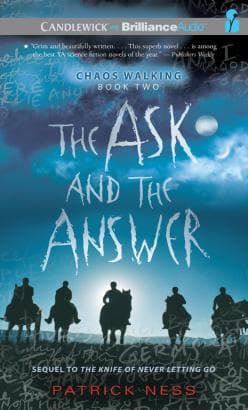

This book broke me. Like, genuinely broke me. I was supposed to be working on my procedural generation thesis (Dr. Patel, if you're reading this, I promise I'm making progress) but instead I spent three days with my headphones in, staring at my monitor pretending to code while Todd and Viola's world collapsed around them.
Patrick Ness doesn't write YA. He writes war crimes dressed up in a young adult trenchcoat.
The Moral Complexity of a Nat 1 Wisdom Save
Here's the thing about Ask and the Answer that makes it Sanderson-level world-building: the Noise. In the first book, it was this wild premise—men's thoughts broadcast constantly, no privacy, no secrets. But here? Ness weaponizes it. Mayor Prentiss uses the Noise like a psychological torture device, and watching Todd slowly compromise himself under that pressure is genuinely uncomfortable. Not "oh this is dark for a YA book" uncomfortable. Actually uncomfortable.
The alternating perspectives between Todd and Viola work brilliantly because you're watching two people you care about make increasingly questionable decisions while understanding exactly why they're making them. It's like watching your party members in a D&D campaign slowly drift toward different alignments. You want to scream at them, but you also get it. The progression is satisfying even when it's devastating.
Ness tackles colonialism, sexism, and the machinery of fascism with zero hand-holding. Babel explores similar themes of institutional violence and complicity, though it trades dystopian future for historical Oxford. The Answer (Viola's resistance group) isn't portrayed as noble freedom fighters—they're terrorists who bomb civilians. The Ask (Prentiss's regime) isn't cartoonishly evil—it's bureaucratic evil, the kind that makes you complicit through small compromises. My D&D group would love this for campaign inspiration, honestly. It's a clinic in morally gray factions.
Two Narrators, One Devastating Experience
Nick Podehl as Todd? Chef's kiss. His voice captures that confused, fierce energy of a teenage boy trying to hold onto his morality while the world demands he abandon it. There's this raw quality to his performance that makes Todd's internal struggle hit harder than it has any right to.
Angela Dawe as Viola is... complicated. Look, she's good. Her frightened-but-determined delivery works for the character. But—and this is a real issue—she whispers. A lot. Like, entire paragraphs delivered so softly I had to rewind multiple times. I was listening at 2 AM trying not to wake my roommate, and I still couldn't hear half of Viola's sections clearly. (The irony of straining to hear in a book about Noise is not lost on me.)
There's also this weird audio inconsistency when Todd calls his horse's name that pulled me out of the story every single time. It's minor, but when you're 13 hours deep in emotional devastation, small production hiccups become genuinely distracting.
The dual narrator format is perfect for this story, though. When you switch from Todd's chapters to Viola's, the tonal shift is immediate. You feel the separation between them. That's exactly what Ness wants you to feel—two people who love each other, being pulled apart by circumstances and ideology.
Who Should Queue This Up (And Who Should Run)
If you loved The Knife of Never Letting Go, you need this. Full stop. The narration is consistent with the first book, and some listeners actually think it's better. Yes, it's 13 hours. Yes, it's worth it.
But fair warning: this is not a comfort listen. If you're looking for escapist fantasy where good triumphs and everything works out, skip it (but you're wrong). This is a book about how ordinary people become complicit in atrocities. It's about how love isn't always enough. It's about the gap between who you want to be and who circumstances force you to become. That moral erosion under pressure is something I've been thinking about a lot since finishing Babel, which does similar work with academic complicity.
If you don't like info-dumps, this isn't for you either—Ness builds his dystopia through accumulated detail, not action setpieces.
Content-wise: violence, death, war themes, and some genuinely disturbing imagery. It's YA, but it's YA that respects teenagers enough to show them the real cost of fascism.
Roll for Emotional Damage
I finished this at 4 AM, thesis completely abandoned, genuinely uncertain whether I wanted to immediately start the third book or take a week to recover. (I started the third book. Obviously.) The AudioFile Earphones Award is well-deserved despite the whispering issue—this is how you adapt a complex novel for audio.
Patrick Ness wrote something that functions as both gripping YA fiction and a genuine philosophical exploration of complicity and resistance. The fact that he did it with two teenage protagonists and a telepathic horse is honestly kind of showing off.
My thesis can wait. Some stories demand to be heard.