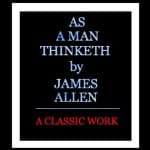

I was walking the lakefront with Denise last Sunday morning — one of those gray Chicago mornings where the lake looks like hammered pewter and nobody's out except the serious runners and the geese — and I figured, fifty-two minutes. That's barely a walk. Let me finally knock out James Allen's As a Man Thinketh.
I've been meaning to get to this one for years. Twenty years teaching English, and I'd somehow never sat with it properly. I'd seen it quoted in a hundred self-help books, seen it referenced in graduation speeches, seen it on those motivational Instagram accounts my students follow. But the actual text? Never. So here we are.
The Ghost of 1902 Speaking Directly Into Your Ear
Let me get the elephant in the room out of the way: the listing says this is narrated by James Allen. The James Allen. Who died in 1912. Now, either we've got a very old recording or — more likely — there's some creative crediting happening here. But whoever is behind the microphone, the audio quality is... rough. There are moments, particularly later in the book, where it genuinely sounds like the narrator has something in his mouth. Chapter 7 is particularly bad — the consonants get muddy, the pacing stumbles, and you can hear artifacts that suggest this recording was made with equipment that should've been retired. It's not unlistenable, but it's distracting enough that I caught myself rewinding twice, and I was walking in a straight line with nothing else to do.
Which is a shame, because the actual text is something worth hearing clearly.
Fifty-Two Minutes That My Students Would Absolutely Refuse to Finish
Here's the thing about Allen's prose — it's Victorian self-improvement writing at its most earnest, and it's structured more like a sermon than an essay. He builds his argument through repetition and variation, circling back to the same core idea — you are what you think, your circumstances are mirrors, not prisons — and layering it with increasingly vivid metaphors. The garden analogy is the one everyone knows. Your mind is a garden, you're the gardener, thoughts are seeds, etc. But the line that actually stopped me mid-stride was this: "Circumstance does not make the man, it reveals him to himself."
That's the kind of sentence I'd put on my classroom wall if I thought anyone would look up from their phones long enough to read it.
And look, I teach literature. I'm trained to be skeptical of simple ideas dressed in pretty language. Allen's philosophy has real limitations — it flirts dangerously with blaming people for their own suffering, and it doesn't account for systemic barriers in any meaningful way. If I assigned this to my juniors, I'd want them to push back on it. Hard. "People do not attract what they want, but what they are" — that's a provocative claim, and Allen never quite wrestles with its darker implications.
But there's a sincerity in the writing that I can't dismiss. This isn't a man trying to sell you a course or build a brand. This is 1902. He's writing because he believes it. The prose deserves to be savored — phrases like "cherish the music that stirs in your heart, the beauty that forms in your mind" have a cadence that feels almost hymnal. This reminds me of what Emerson did in "Self-Reliance" — that same unshakable conviction that individual thought is sovereign. Allen is Emerson's quieter, more devotional cousin.
If you want more of Allen's voice — and he never quite shook the habit of writing like a man building a cathedral out of aphorisms — I've also spent time with Above Life's Turmoil, which suffers from the same earnestness, though to less memorable effect.
The Audio Problem You Can't Ignore
I want to be fair here. The content is a 4. The audio production is a 2 on a generous day. And since this is an audiobook review, I can't pretend that doesn't matter. At 52 minutes, you're barely committing any time, but those 52 minutes should sound clean. They don't. The recording has a flatness to it — no dynamic range, no sense of space — and the narrator's diction issues in the back half genuinely undermine the elegance of Allen's language. When your prose is doing the heavy lifting (no plot, no characters, no drama — just ideas and rhythm), the narration has to be precise. A stumbled word here breaks the spell that Allen spent careful paragraphs building.
There are better-produced versions of this book out there, and at under an hour, it's worth hunting for one.
Who Should Press Play (and Who Should Find a Better Recording)
If you love the intersection of philosophy and literature — if you've read Marcus Aurelius or Epictetus and want to hear the Victorian echo of Stoic thought — Allen's text is genuinely worth your time. It's brief, it's potent, and it says more in 52 minutes than most modern self-help books say in twelve hours.
That brevity-with-weight is something Allen managed repeatedly — Man: King of Mind, Body, and Circumstance covers similar ground, mind as king and all that, though I found it hit the same few notes with less grace.But this specific recording? I'd only recommend it to completists or people who find charm in audio imperfection. If you're new to Allen, find a version with cleaner production. The words deserve better than what they got here.
The Annotation in the Margin
I finished the walk. Denise asked me what I was listening to. I told her it was a 120-year-old essay about thinking yourself into a better life. She said, "Did it work?" I said, "The ideas are beautiful. The recording needs help." She laughed and said that sounded like every faculty meeting presentation ever made. She's not wrong.