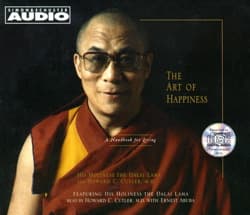

I picked this up expecting another self-help book telling me to meditate more and stress less. You know, the kind of advice that sounds great until you're staring down a 60-hour work week and three client fires. But here's the thing: The Art of Happiness actually earned some of my respect. Not all of it. But some.
Bottom line: This is what my parents did instinctively—finding contentment despite brutal circumstances—except now it's got a Nobel Prize winner explaining why it works. The Dalai Lama's core message is stupidly simple: happiness is a skill, not a circumstance. Train your mind, change your life. My dad never read Buddhist philosophy, but he understood this when he showed up to the dry cleaners at 5 AM every morning for 30 years without complaint.
When Western Psychology Meets Eastern Wisdom
The genius of this book is the setup. Howard Cutler isn't just narrating—he's the co-author, a psychiatrist who basically interviewed the Dalai Lama and then translated Buddhist concepts into language that Western therapy-goers can actually use. Like having a translator between two worlds that usually don't talk to each other.
And honestly? It works. When the Dalai Lama talks about defeating anxiety and anger, Cutler frames it in terms of cognitive patterns and mental training. No incense required. The discussion on how we create our own suffering through mental habits—that's basically CBT with a 2500-year head start. Open Book explores similar territory about how we construct our own narratives, though with less ancient wisdom and more modern memoir. I've seen executive coaches charge $500 an hour to teach worse versions of this stuff.
The key takeaway is worth the listen. The other 2 hours? Not so much. I had the opposite problem with Near View of the High Sierra—that one couldn't find a key takeaway if its life depended on it. Some sections drag into repetitive territory, and the abridged format (yeah, it's only 3 hours) means certain concepts get introduced but never fully developed. It's like getting a really good appetizer sampler but never the main course.
The Voice Problem Nobody Wants to Talk About
Okay, so here's where I have to be harsh. Jenny would say I'm being harsh. Jenny is right.
Cutler narrates his own book, which makes sense—he wrote it, he lived it. But his delivery is... therapeutic. Very therapeutic. Like, "I'm-your-psychiatrist-and-we're-in-session" therapeutic. Some people find this soothing. I found myself wishing the Dalai Lama himself was telling these stories. The man laughs constantly in real life—where's that energy?
The narration isn't bad, exactly. It's warm, it's clear, the pacing works for contemplative content. But there's a slight nasally quality that, combined with the measured delivery, can tip into monotone territory. I listened at 1.5x (couldn't do my usual 2.0x without losing the meditative vibe entirely) and even then, some sections felt like they were putting me to sleep. Which, depending on when you're listening, might be a feature, not a bug.
Production quality is clean though. No complaints there.
The ROI Calculation
Here's what I keep coming back to: this book is 25 years old and still selling. That's not an accident. The Dalai Lama's insights on relationships, work stress, and finding meaning despite suffering—they hold up. Better than most business books I've reviewed this quarter, honestly.
But let's be real. If you're expecting a direct teaching from the Dalai Lama, you're going to be disappointed. This is Cutler's interpretation of conversations with the Dalai Lama. It's filtered. Some listeners find that misleading, and I get it. You want the source, not the summary.
For me, the value is in the practical applications. The mental training exercises. The reframing techniques. Stuff I can actually use when a client is melting down or when I'm stuck in LA traffic contemplating my life choices. (Which is often.)
Who Gets Value Here (And Who Doesn't)
This works best as a bedtime or relaxation listen. Don't put this on during your commute expecting high energy—you'll zone out at a red light and miss your exit. The pacing is deliberately slow, contemplative. It wants you to sit with the ideas.
If you're already into Buddhism or meditation, this might feel basic. If you're a skeptic who thinks all spiritual books are woo-woo nonsense, Cutler's psychiatric framing might actually win you over. He's not asking you to believe anything—just to consider that your mind can be trained like any other skill. Skip it if you want the Dalai Lama unfiltered—this is Cutler's interpretation, not a direct teaching.
Three hours is tight for this much content—finally, a self-help book that respects your time. I just wish the delivery matched the efficiency. Skip to the chapters on suffering and compassion if you're short on patience. The relationship advice is solid too.
The Bottom Line on Your Three Hours
My 2.0x speed couldn't save the slower sections, but at 1.25x-1.5x, there's genuine wisdom here. My parents would probably shrug at most of it—they learned happiness through necessity, not philosophy. But for the rest of us who weren't raised with that kind of resilience built in? Worth the listen.