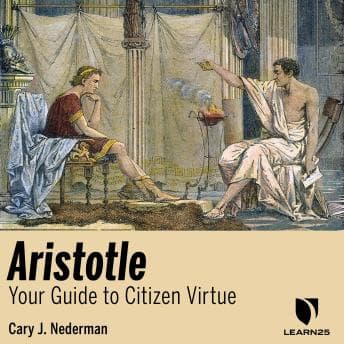

I was making chana masala at 10 PM on a Tuesday — the kind of elaborate, unnecessary cooking I do when my brain won't stop spinning — and I had Cary Nederman's Aristotle course playing through my kitchen speaker. Something about chopping onions while a political theorist explains eudaimonia felt weirdly appropriate. Aristotle believed the good life required practical engagement, not just abstract contemplation. So here I am, practically engaged with cumin seeds, contemplating virtue. He'd approve, I think.
But here's the thing that grabbed me: this isn't really an audiobook. It's a lecture series wearing an audiobook's clothing. And once I stopped expecting it to be something it wasn't, I actually got a lot out of it.
Why Your Therapist Would Want You to Read Aristotle (Mine Would)
Nederman does something I genuinely appreciate — he doesn't treat Aristotle like a marble bust in a museum. He situates him as a real person shaped by real circumstances. You get the biographical context: Aristotle as an outsider in Athens, a metic (non-citizen) who spent his career theorizing about citizenship and political belonging. I found myself asking: why does someone excluded from political participation become obsessed with defining its ideal form? That's a fascinating case study in how marginalization can fuel intellectual ambition rather than resentment.
The teleology discussion is where this course earns its keep for anyone interested in psychology. Aristotle's claim that all humans have a telos — a purpose — is basically the ancient Greek version of what we'd now call self-actualization theory. The question of whether we're even equipped to reason our way toward that purpose is something The Ethics of Belief picks apart in ways that kept me awake longer than I intended. The research actually shows that purpose-driven frameworks improve well-being outcomes across cultures, and Nederman connects Aristotle's framework to why we still instinctively feel that people should be "living up to their potential." He doesn't make that connection to modern psych explicitly (I'm doing the extra credit here), but the groundwork is solid.
What makes this course genuinely useful rather than just informative is how Nederman traces the line from Aristotle's concept of the "common good" to why we feel so frustrated with contemporary politics. The Greeks didn't separate personal ethics from political life — being a good citizen WAS being a good person. There was no opt-out. You couldn't just post your opinions online and call it participation. (My therapist would have thoughts about that observation, actually.)
The Lecture Hall Problem
Okay, but let's talk about the elephant in the room. Nederman is narrating his own material, and he sounds exactly like what he is: a professor delivering a course. His delivery is clear, well-organized, and occasionally — I'm going to be honest — flat. There's a consistent academic register that doesn't really shift whether he's discussing Aristotle's relationship with Alexander the Great or the technical structure of the Nicomachean Ethics. One listener nailed it when they said it feels more like a podcast than an audiobook, and that's exactly right.
Psychologically, this doesn't track as a problem if you know what you're getting into. But if you press play expecting the kind of vocal dynamism that makes you forget you're listening to someone talk? You'll be checking the clock by hour two. I bumped it to 1.25x speed while cooking and it actually improved the experience — gave the delivery a bit more urgency without losing comprehension.
The production is clean. No weird audio artifacts, no background noise, no jarring edits. It's professional lecture recording, full stop. At under five hours, it's the kind of thing you can knock out in a weekend of errands and cooking, which is exactly what I did.
Who This Is Actually For (And Who Should Walk Away)
If you've ever wanted to understand Aristotle but found the actual texts impenetrable — and honestly, they are, the Nichomachean Ethics reads like someone's lecture notes because that's literally what they are — Nederman is a solid guide. He's an expert who can translate without dumbing down, and that's a rarer skill than it sounds.
But if you need narrative energy, character, drama? Skip this. It's not built for that. This is a philosophy course, not a story. The protagonist here is an idea — that virtue is a practice, not a trait — and Nederman treats it with the seriousness it deserves.
Students cramming for a philosophy survey course, commuters who like their drive time educational, anyone going through a "what am I doing with my life" phase (hi, it's me) — this is your lane. People who fell asleep during their one required philosophy class in undergrad, maybe try a different on-ramp.
The Case Study I Didn't Expect to Be About Me
I went into this expecting a dry academic exercise. And parts of it are exactly that. But Aristotle's insistence that virtue isn't something you think — it's something you do, repeatedly, until it becomes habit — hit differently at 10 PM in my kitchen, alone with my chana masala and my overdue research paper. The research actually shows that behavioral repetition shapes identity more reliably than belief change does. Aristotle knew this 2,400 years ago. Pretty humbling for someone who studies human behavior for a living.
Not a must-listen. But a good listen. And sometimes that's enough.