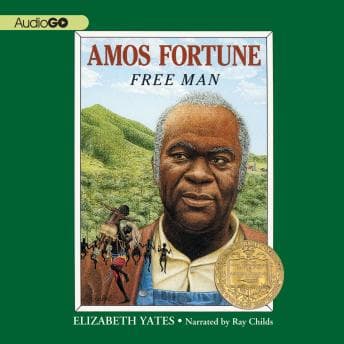

"It does a man no good to be free until he learns how to live."
I was on a Sunday morning walk - Jenny still asleep, no client calls, just me and my earbuds and Amos Fortune. And that line stopped me mid-stride on a sidewalk in Pasadena. Not because it's particularly clever. Because my dad said some version of this in Korean about 400 times while pressing shirts at 6 AM.
The 60-Year Business Plan Nobody Teaches at HBS
Here's the thing about Amos Fortune that no MBA case study would ever capture: the man spent decades - decades - building skills, saving money, and strategically buying freedom. Not just his own. His wives'. His adopted daughter's. This is a man who was kidnapped from Africa at 15, sold at auction in Boston, and spent the next 45 years executing what is essentially the longest-horizon investment strategy I've ever encountered in a biography.
Elizabeth Yates wrote this for kids. I need to be upfront about that. The prose is simple, the moral framework is straightforward, and there's no grey area about who the good guys are. But underneath the Newbery-approved packaging is a story about a man who learned the tanning trade, built a legitimate business, served his community in Jaffrey, New Hampshire, and died at 91 having purchased freedom for multiple people with money he earned with his own hands. My parents immigrated from Korea with nothing and built a business through sheer will. Amos Fortune started with literally negative equity - he was someone else's property on a balance sheet - and still found a way.
That's not a children's story. That's the hardest business case I've ever studied.
Ray Childs and the Colonial Receipts for Human Beings
At under 4 hours, this respects your time in a way I wish more biographies did. Ray Childs reads with a steady dignity that matches the subject matter. Where he really earns his keep is reading the manumission documents - the actual Colonial-era legal language that formalized Amos's freedom. There's something about hearing those stiff, formal words read aloud that makes it visceral in a way text on a page doesn't. This isn't a museum plaque you skim past. This is a receipt. For a human being. Childs reads it like he understands the weight of that.
He doesn't overperform anywhere else, either. No dramatic vocal shifts, no character voices designed to show range. For a biography about a man whose defining characteristic was quiet, relentless dignity, that restraint is exactly the right call. You won't remember Childs's voice a week later, but you'll remember Amos. And I think that's the point.
Who Needs to Hear This (And Who Doesn't)
If you have kids between 8 and 14, this is essential listening. Period. Full stop. I've run other historical kids' books through my own review process—Rush Revere and the First Patriots among them—and none of them carry anything close to this kind of moral weight. If you're an adult looking for a deep, scholarly analysis of slavery in Colonial New England, this won't satisfy - it's written with young readers in mind and the history comes in broad, clean strokes. But if you're a parent who wants your kid to understand what real hustle looks like - not the Instagram version, not the "I woke up at 4 AM and cold plunged" version, but the decades-long, soul-crushing, build-from-absolutely-nothing version - this is the book.
This is what my parents did instinctively. Now it has a TED talk. Except Amos Fortune did it 200 years earlier, starting from a position so much worse it makes every modern entrepreneurship struggle look like a rounding error.
Jenny and I don't have kids yet. But this is already on the list.
The Two-Hour Bench Sit
Bottom line: Under 4 hours for a true story about a man who treated freedom itself as a project with deliverables, milestones, and a timeline spanning most of his adult life. The children's book framing keeps it from being the definitive Amos Fortune biography that adults might crave - I wanted more about the tanning business operations, more about the economics of self-purchase, more about Jaffrey's community dynamics. But at this length, you're risking nothing. My 2.0x speed brought it in at just under two hours on that Sunday walk, and I sat on a park bench for the last twenty minutes because I didn't want to walk into the house looking like I'd been crying over a Newbery book written for fifth graders.
Jenny would say I'm being harsh calling this a kids' book. Jenny is right.




![Steve Jobs [unabridged audiobook] audiobook cover](/_next/image?url=https%3A%2F%2Fcovers.audiobooks.com%2Fimages%2Fcovers%2Ffull%2F9788499923406.jpg&w=1920&q=75)