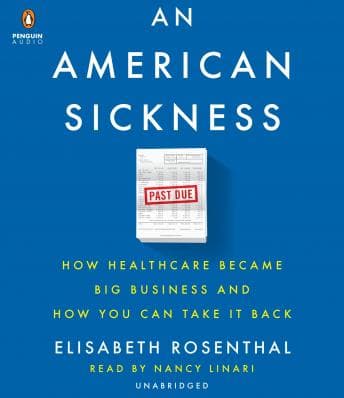

So everyone told me this book would make me angry. They were wrong. It made me angry AND it made me want to build a spreadsheet.
I started this one on a Monday morning, 6:07 AM Caltrain, half-alive, and by the time we pulled into Mountain View I was fully awake and texting Kevin screenshots of my insurance EOB like "DO YOU SEE THIS. THIS IS WHAT SHE'S TALKING ABOUT." He did not appreciate this at 7:15 AM. But honestly? An American Sickness is the kind of book that rewires how you read every medical bill, every pharmacy receipt, every "out-of-network" surprise for the rest of your life.
The Healthcare Stack Is Broken at Every Layer
Rosenthal does something really smart here - she doesn't just wave her hands at "the system" like every op-ed you've ever skimmed. She breaks American healthcare into its component services the way you'd decompose a distributed system. Hospitals. Insurance companies. Pharma. Device manufacturers. Each gets its own deep dive, and each chapter traces how that specific industry evolved from something vaguely mission-driven into a pure profit extraction machine.
The hospital chapter wrecked me. She walks through how nonprofit hospitals - the ones with "community" in their names - started behaving like predatory lenders, placing liens on patients' homes over unpaid bills. There's a section on chargemasters (the secret internal price lists hospitals use) that reads like documentation for the world's worst API - totally opaque, internally inconsistent, and designed so nobody outside the system can parse it. As someone who debugs systems for a living, the parallels to intentionally obfuscated codebases are... uncomfortable.
She also has this framework she calls the "Economic Rules of the Dysfunctional Medical Market" that she lays out early and references throughout. Things like "A medical condition without a procedure code doesn't exist" and "Prices will rise to whatever the market will bear." It's basically design patterns, but for a system optimized to extract maximum revenue from sick people.
13 Hours of Density - Pace Accordingly
Here's where I have to be honest: this is NOT an easy commute listen. At 13+ hours, the middle chapters on pharmaceutical pricing and insurance consolidation get genuinely dense. I bumped it up to 1.75x for the business-heavy sections - my standard speed for books that are really well-researched reports in audiobook clothing - and that helped. But there were mornings where I'd zone out during a particularly granular explanation of PBM (pharmacy benefit manager) kickback structures and have to rewind 5 minutes.
Nancy Linari narrates with a clear, steady delivery that works well for this kind of investigative journalism. She's not doing anything flashy - no character voices needed here - but she handles the technical terminology and the shift between data-heavy passages and patient stories without stumbling. It's professional, clean narration. The narration reminded me of the audiobook for Too Much and Never Enough, another investigative non-fiction listen where the narrator's steady, no-theatrics delivery is exactly what the material demands - you don't want drama when the facts are already doing the heavy lifting. Not Ray Porter levels of "I'd listen to this person read a phone book," but solid and reliable for the genre.
The last third of the book pivots to actionable advice - how to negotiate bills, how to read an EOB, how to fight surprise charges - and that section is genuinely useful. I actually paused during one commute and emailed myself three specific tactics for dealing with out-of-network billing disputes. (One of which I've already used. It worked. The ROI on this audiobook is literally measurable in dollars saved.)
Could've Been Two Books, Honestly
My one real criticism: Rosenthal tries to be both a comprehensive history AND a practical guide, and at 13 hours, you feel the seams. The historical deep dives are excellent journalism. The practical advice chapters are genuinely useful. But they're almost two different books stitched together, and the tonal shift between "here's how hospitals consolidated into monopolies over 30 years" and "here's how to dispute your ER bill" is a little jarring.
That said - and this is important - the history IS the practical advice. You can't effectively fight a $47,000 surprise bill if you don't understand why chargemasters exist, why balance billing is legal, and how insurance company mergers reduced your negotiating power to zero. So even the dense chapters earn their runtime.
Who Needs This in Their Ears
Perfect for: anyone with American health insurance, which means anyone who's ever stared at a bill and thought "this can't be right." Also perfect for the engineer/analyst brain that wants to understand the SYSTEM, not just complain about symptoms.
Skip for: bedtime. You will either fall asleep during the PBM chapter or you'll get so angry about hospital pricing that you can't sleep at all. Neither is great.
I finished this in about 5 commutes at 1.75x, and I genuinely think it should be required listening for every American adult. Not because it's fun - it's frequently infuriating - but because it gives you the mental model to stop being a passive participant in a system designed to confuse you.
Debug Your Medical Bills
TL;DR: Worth your commute. This is basically a systems architecture review of American healthcare, and the audit results are damning. Dense in places, but the practical sections alone will save you money. Bump the speed, keep a notes app handy, and prepare to be angry in a productive way.