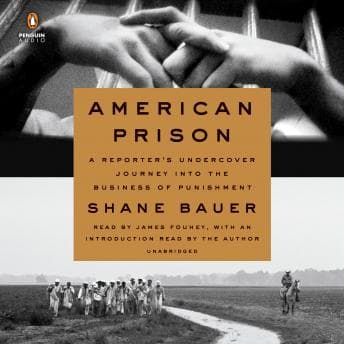

Four AM, walking Ranger through the neighborhood because sleep wasn't happening. I'd been listening to this one during a drive out to a client site in San Antonio and made the mistake of not stopping when I pulled into the driveway. Sat in my truck for another forty minutes. Then couldn't sleep. So there I am, dog on leash, earbuds in, listening to Shane Bauer describe how a for-profit prison in Louisiana operates on a $9-an-hour workforce with virtually no training, and my blood pressure is doing things my doctor wouldn't approve of.
Let me cut to the chase: American Prison is one of the most important audiobooks I've listened to this year, and one of the most infuriating.
$9 An Hour, A Uniform, and A Prayer
Here's what got me. Bauer walks into CCA's Winn Correctional Center in Winnfield, Louisiana - using his real name, his actual background as a journalist for Mother Jones - and nobody catches it. No meaningful background check. No real screening. They hand him a uniform and put him on the floor with inmates after what amounts to a joke of a training program.
In the military, we spend months preparing people before they're anywhere near a combat zone. Here you've got undertrained, underpaid guards responsible for hundreds of inmates, and the company's primary concern is keeping costs low enough to turn a profit. The predictable result? Chaos. Violence. Medical neglect. Guards who stop caring because the institution never cared about them.
What Bauer captures - and what Fouhey's narration makes viscerally clear - is the slow rot of working inside a broken system. Bauer documents his own psychological transformation. He starts empathetic, curious. Months in, he's barking orders, losing patience, starting to see inmates as problems rather than people. I've seen this scenario play out in real life. Put decent people in a dysfunctional institution with no leadership, no resources, and no accountability, and the institution wins every time. It eats them.
The History Nobody Taught You In School
This is where the book earns its weight. Bauer doesn't just give you four months of undercover reporting - he threads in the full ugly history of for-profit incarceration in America, going back to convict leasing after the Civil War. The 13th Amendment abolished slavery "except as punishment for crime," and Southern states exploited that loophole with devastating efficiency. Bauer traces a direct line from those convict lease camps - where mortality rates were staggering - to the modern private prison industry.
The author clearly did their homework. These aren't throwaway historical asides. They're the backbone of the argument, and they hit hard because you're hearing them alongside Bauer's firsthand account of the same patterns still operating in 2014. Underfed inmates. Untreated medical conditions. A workforce kept deliberately disposable. The parallels aren't subtle, and they shouldn't be.
Fouhey Carries the Weight Without Breaking
James Fouhey handles narration duties - Bauer reads his own intro - and the man does serious work. He's voicing guards, inmates, corporate executives, historical figures. People across races, education levels, emotional states. And he does it without a single moment that made me wince. I've heard him bring the same chameleon-like adaptability to Imagine Me, a dystopian YA novel that couldn't be further from this material, and he was just as compelling. The guards sound like guys I've known in my line of work. Tired, underpaid, some trying to do right, some long past caring. The inmates sound like individuals, not a monolith. That matters in a book like this, where it would be easy to flatten everyone into types.
Fouhey also nails the tonal shifts between Bauer's present-day reporting and the historical chapters. The prison sections carry an urgent, ground-level tension - you feel the fluorescent lights and the understaffing. The history chapters are more measured but no less disturbing. He moves between both without losing you, which is harder than it sounds over ten-plus hours.
Who Needs This In Their Ears
If you care about criminal justice, this is mandatory. If you work in security, law enforcement, corrections - mandatory. If you think private prisons are just a political talking point people argue about on cable news, Bauer will fix that in about two hours.
But fair warning: it's not an easy listen. There's violence, abuse, and moments that'll make you angry in ways that don't resolve cleanly. Bauer doesn't offer tidy answers. He shows you the machine and lets you sit with it.
One thing I particularly respected - when Bauer's cover is eventually blown and he goes back to interview former colleagues, he doesn't dodge the ethical mess of what he did. These were people who trusted him. Some of them were decent folks stuck in a terrible job. He sits with that tension, and Fouhey reads those sections with exactly the right weight. Not preachy. Not apologetic. Just honest.
Mission Debrief
Worth your time? Here's the debrief: this book made me angry, and it should make you angry too. At ten and a half hours it's focused, well-structured, and never wastes your time. Shane Bauer went somewhere most journalists wouldn't, stayed longer than anyone should've asked him to, and came back with receipts. The narration matches the material blow for blow. Ranger sat through the whole thing without complaint, which is more than I can say for myself.







![Steve Jobs [unabridged audiobook] audiobook cover](/_next/image?url=https%3A%2F%2Fcovers.audiobooks.com%2Fimages%2Fcovers%2Ffull%2F9788499923406.jpg&w=1920&q=75)