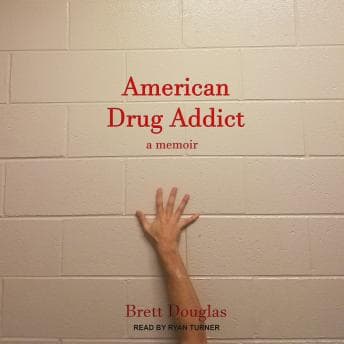

What do you do when someone hands you a list that includes Barry Manilow, used tampons, armed robbery, and murder — and tells you it's all one life?
I'll tell you what I did. I stopped mid-design on a branding project for a yoga studio (the irony), pushed my laptop back, and just... sat there. Diego was asleep on my keyboard. Frida was staring at me from her perch on the bookshelf like she knew. It was around hour six, somewhere deep in the wreckage of Brett Douglas's life, and I had mascara tracks down my face even though I'd been alone in my apartment all day.
The White Picket Fence Is Always a Setup
Brett Douglas opens this memoir with the most deceptively boring American résumé you've ever heard — college degree, twenty-six-year marriage, three businesses, kids, the literal white picket fence. And then he just... dismantles it. Piece by piece. Not with self-pity, which is what I was bracing for, but with this almost clinical honesty that somehow hits harder than any dramatic monologue. He catalogs his descent into addiction the way you'd read off a grocery list, and the contrast between the mundane delivery and the absolute chaos of his experiences — crack, heroin, prostitution, arson, identity theft — creates this dissonance that sits in your chest like a rock.
What got me wasn't the shock value. It's that Brett doesn't let you look away from the small moments. There's this section where he talks about cinnamon toothpicks — yes, cinnamon toothpicks — as part of his story, and it's such a weirdly specific, human detail that it grounds you. You're not listening to a cautionary tale. You're listening to a real person who remembers the taste of cinnamon while his life was falling apart. That specificity is what separates this from the hundred other addiction memoirs out there. Carry On, Warrior has that same quality — the kind of specificity that makes you feel like someone cracked a window open in a room you thought was sealed.
And when he gets to the part about recovery not being abstinence but "a process of growing up" — my heart. MY HEART. Because that's the thing nobody says. Everyone wants the dramatic rock bottom, the single moment of clarity, the triumphant ending. Brett's saying: no, it's slower than that, and messier, and more boring, and that's okay.
Ryan Turner Carries the Weight (Mostly)
Ryan Turner narrates with a steady, grounded tone that works for this material. He doesn't oversell the dark moments or go soft on the funny ones, and for a nearly ten-hour memoir, that restraint matters. The pacing is deliberate — this isn't a sprint, and Turner seems to understand that. His voice has this quality where you can hear him holding back, which mirrors Brett's own matter-of-fact delivery style.
But — and this is where I have to be honest — the character differentiation is pretty thin. When Brett's quoting conversations with dealers, family members, therapists, they all kind of sound like the same guy with slightly different energy levels. For a memoir, this bothers me less than it would in fiction, because the focus is really on Brett's internal world. But there were stretches, especially in the middle hours, where I lost track of who was speaking in dialogue-heavy scenes. Not a dealbreaker. Just something I noticed.
The audio quality itself is clean and consistent. No weird volume shifts, no background noise. At 1.0x — the only speed I recognize — Turner's cadence felt natural, like someone telling you this story across a kitchen table at 2 AM.
Who This Book Punches in the Gut (And Who Should Brace Themselves)
Look. I need to say this clearly: this book contains basically every trigger warning that exists. Addiction, sexual content, violence, suicide, abuse — it's all here, and it's not sanitized. If you're in early recovery or dealing with active trauma around any of these topics, please check in with yourself before pressing play.
But if you're someone who connects with raw, unfiltered honesty — if you've ever loved someone who couldn't stop destroying themselves, or if you've been that person — this book felt like sitting in a room with someone who finally stopped lying. My abuela lost a nephew to addiction before I was born. She never talked about it except once, late at night, when she said "mijo no podía parar." He couldn't stop. Listening to Brett describe that same inability to stop, that same bewildered helplessness inside the compulsion, I thought about her face when she said it.
Abuela would have cried through this one. Then she would've lit a candle.
The Candle I'm Lighting for This One
This is not a pretty book. It's not a rainy Sunday book. It's a 2 AM book, lights off, cats pressed against your legs because animals know when you need them. It's messy and sometimes the writing gets a little scattered — the sheer volume of experiences Brett crams in can feel disjointed, like he's afraid you'll stop listening if he slows down. But the emotional core holds. The landing holds. And I cried twice, which for a memoir outside my usual lane is saying something.
If you want polished prose, this isn't it. If you want someone's actual life cracked open on the table — bone and marrow and all — press play.