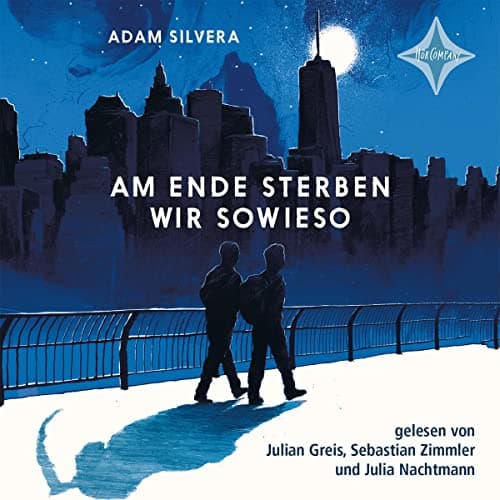

I was grading a stack of sophomore essays on The Great Gatsby — it was maybe 11:30 PM, Denise had already gone to bed, and I had this playing through my headphones as a kind of emotional counterweight to seventeen-year-olds writing "Gatsby was a simp" in their thesis statements. And then the opening of this book hit me: two teenagers get a phone call telling them they're going to die today. Not someday. Today. I set the red pen down.
Let's talk about what Adam Silvera is really doing here, because the premise sounds like it could go sideways fast. A company called Death Cast phones you before midnight to let you know your last day has begun. It's speculative, sure, but Silvera isn't interested in the sci-fi mechanics — he's interested in what you'd actually do. And the answer, for Mateo and Rufus, is startlingly ordinary. They don't rob banks or jump out of planes. They find each other through an app called Last Friend, and they try to live a whole life in the hours they have left. It's the kind of setup my students would roll their eyes at on paper and then get absolutely wrecked by in execution.
Silvera pulls off the same trick in History Is All You Left Me — a premise that sounds like a greeting card and lands like a gut punch.The Clock That Won't Stop Ticking
The German title — Am Ende sterben wir sowieso ("In the end we all die anyway") — is actually more honest than the English They Both Die at the End. It strips the premise down to its philosophical core: mortality isn't the twist, it's the premise. And the audiobook leans into that with its three-narrator structure. Julian Greis handles Mateo with this careful, almost fragile quality — the kid is terrified, paralyzed by his own caution, and Greis lets you hear the tremor underneath the words without overplaying it. Sebastian Zimmler's Rufus is rougher, more impulsive, carrying grief like a weapon. The contrast between the two voices does something the printed page can't: it makes the growing closeness between these characters feel physical, like watching two orbits slowly converge.
Julia Nachtmann takes the interstitial chapters — the side characters whose lives brush against Mateo and Rufus throughout the day — and this is where the production gets interesting. Silvera structured the book so that minor characters get their own brief viewpoint chapters, and Nachtmann's sections create this mosaic effect. You hear a death notification from the perspective of the caller. You hear a stranger at a party. Each one is a small reminder that the world doesn't stop because two people are dying. It's the literary equivalent of that thing where you're sitting in traffic and you realize every single car contains an entire life.
When the Author Tells You the Ending on Page One
This reminds me of what Hemingway said about writing — the dignity of movement of an iceberg is due to only one-eighth of it being above water. Silvera tells you the ending in the title. Both boys will die. So the tension isn't whether — it's how they spend the hours before. And that shifts the entire listening experience. You're not racing to a plot twist. You're savoring. Every small decision — Mateo finally leaving his apartment, Rufus choosing forgiveness over anger, both of them deciding to ride bikes through the city — carries this impossible weight because you know the clock is running out.
At 8 hours and 26 minutes, the pacing mirrors a real day. It doesn't rush. There are stretches that feel deliberately slow, and I think that's intentional — Silvera wants you to sit with the discomfort of time passing. My students would probably call parts of it "boring." I'd call it prose that deserves to be sat with. The German narration adds a layer of distance that, paradoxically, made me feel more — maybe because hearing it in a different language forced me to listen harder, to pay attention to inflection and rhythm rather than just processing words.
Who Gets the Phone Call (And Who Should Hang Up)
If you loved The Fault in Our Stars but wanted something that spends less time being clever and more time being honest, this is its spiritual successor. If you're the kind of listener who needs constant plot momentum or action beats, you'll struggle here — this is a character study wearing a speculative premise like a coat. The emotional weight is real, and the three-narrator setup keeps it from becoming monotonous, but you need to be willing to sit with two scared kids trying to figure out what matters.
Skip it if you need your sci-fi concepts fully explained. Death Cast is a given, not a puzzle. Skip it if you only listen while distracted — this one demands your attention, or the emotional architecture collapses.
The closest thing I've heard to a book that earns the same focused listening is A Good Girl's Guide to Murder — totally different in tone, but the same deal where half-attention means you lose the thread entirely.The Red Pen Can Wait
I finished this at 1 AM. The Gatsby essays were half-graded. I sat there in the kitchen for a long time thinking about what I'd do with a day — a real, confirmed last day. Not the dramatic version. The real one. And I think that's the highest compliment I can pay a YA novel: it made a 47-year-old English teacher forget he was supposed to be working. Worth pausing the faculty meeting for. Worth pausing everything for, actually.









