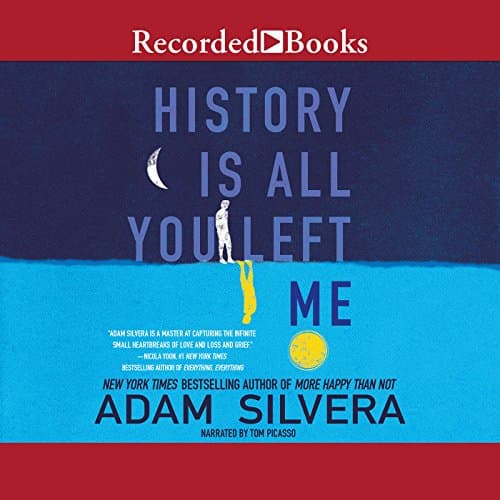

Adam Silvera's History Is All You Left Me is one of the most emotionally precise YA novels about grief I've encountered in audio form, and it nearly wrecked me on a Tuesday afternoon when I should have been working.
Griffin, our narrator, has just lost Theo — his first love — to a drowning accident. But this isn't just a story about a dead boyfriend. It's about what happens when you can't stop picking at the edges of someone's absence. Griffin reaches out to Jackson, the guy Theo was dating when he died, and the two form this uneasy bond built on shared loss and a growing suspicion that Jackson might be hiding something about Theo's death. It sounds like it could spiral into teen soap opera territory, but Silvera keeps the emotional register honest enough that it never does.
What surprised me as I got deeper into the listen was how much the structure does for this story. The novel toggles between past and present — Griffin's memories of falling in love with Theo intercut with the wreckage of Theo's death. In audio, this hits differently than it would on the page. You're hearing Griffin build something tender in one chapter and then watching him unravel in the next, and the whiplash is the point. Grief doesn't move forward in a straight line, and the book's architecture mirrors that disorientation. I found myself rewinding a few times early on to orient myself in the timeline, which is worth flagging if you tend to listen while juggling other tasks.
Griffin's OCD is handled with real care here. It's not a quirk or a plot device — it's the lens through which he processes everything. His fixation on the left side of things, his counting, his rituals — they're threaded into how he grieves, how he loves, how he tells this story. And that's where Silvera does something genuinely sneaky: he makes you realize, gradually, that Griffin might not be the most reliable narrator. The imagined conversations he has, the details he emphasizes or skips over, the version of events he constructs — it all starts to feel like a puzzle where some pieces have been deliberately turned face-down. By the final stretch, the story quietly rearranges itself beneath you, and the landing is the kind that makes you sit with your headphones on in silence for a minute after it ends.
Now, Tom Picasso's narration. This is where my feelings get complicated. When Picasso is dialed in, he's the right voice for this book. His delivery captures teenage grief with a restraint that feels true — Griffin isn't performing his pain, he's trying to hold it together, and Picasso's tone mirrors that. The mournful weight in his voice during the harder passages lands without tipping into melodrama. His pacing is measured in a way that lets the emotional beats breathe.
But the character differentiation problem is real, and in a book like this, it matters more than usual. Picasso gives Theo a noticeably deeper register, which helps. Jackson, though? He blends into Griffin's voice in a way that creates genuine confusion during the imagined conversations — scenes that are critical to understanding Griffin's psychological state. If you can't tell who's supposedly talking during those sequences, you lose a layer of meaning. A few mispronunciations crop up too (the "unites" for "unties" error being the most distracting), and in a narrative this emotionally calibrated, those small stumbles land harder than they would in a less intimate story.
The tonal consistency is a double-edged thing. Picasso commits fully to the grief register, which works beautifully for about 70% of the book. But when the story shifts toward suspicion around Jackson, or when lighter memories of early romance surface, the narration doesn't really shift with it. It's like a singer who has a gorgeous lower range but never opens up into the higher notes.
What carries this audiobook across the finish line is Silvera's writing. He writes queer grief without making the story about being queer — the specificity of Griffin and Theo's relationship feels lived-in and real, but the loss would hit just as hard regardless of who's involved. Compared to They Both Die at the End, this is a smaller, more interior novel. No high-concept hook, just the raw mechanics of losing someone and trying to figure out what was real. Silvera does something similarly quiet and devastating in Here's To Us, where the emotional architecture is just as carefully constructed around absence. That intimacy is the book's best quality, even when the audio production doesn't fully serve it.
At just under ten hours, the pacing is deliberate. Some listeners will call it slow, and I get it — this book sits in discomfort rather than rushing toward its reveals. That's what grief does. But if you give it your focused attention on a long solo drive or a rainy afternoon with nothing else pulling at you, the payoff in the final chapters earns the slow burn. Listen if you want a grief story that trusts you to sit in the mess without flinching — and one that'll probably make you cry. Skip if you need strong voice differentiation from your narrators or if a deliberately paced, interior listen sounds more frustrating than immersive. Just know going in that you're trading voice variety for emotional authenticity, and that trade-off won't work for everyone.