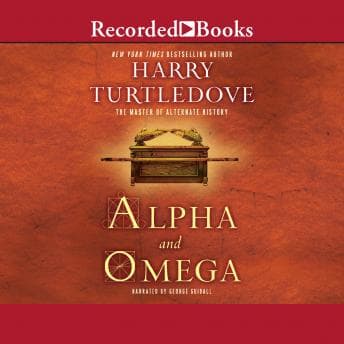

What happens when the guy who wrote the book on alternate history stops asking "what if" about the past and starts asking it about the end of everything?
I was walking the lakefront with Denise last Saturday — one of those gray Chicago mornings where the lake looks like hammered steel and you can smell winter thinking about showing up early. She was on a phone call with her sister, so I had a solid ninety minutes with Harry Turtledove's Alpha and Omega pumping through my earbuds, and I'll be honest: I spent half that walk arguing with a fictional archaeologist in my head.
When the Master of "What If" Digs Under Jerusalem
Here's the thing about Turtledove. I've taught alongside his work for years — not formally, but I've slipped The Guns of the South into my "recommended reading" handouts more than once. The man understands how ordinary people react to extraordinary pressure. That's his superpower. It's what separates him from writers who just want to play dress-up with history. So when he pivots from alternate pasts to a potential apocalyptic present — a secular Jewish archaeologist named Eric Katz stumbling onto evidence of divine intervention beneath the Temple Mount — you'd expect that same groundedness.
And you get it. Mostly. Eric Katz is a beautifully realized skeptic, the kind of guy who'd sit in the back of my classroom and challenge every reading assignment with "but how do we know that?" His internal resistance to what he's witnessing feels earned rather than contrived. Turtledove drops him into a world where a dirty bomb goes off in Tel Aviv, where signs of the Third Temple start appearing in America of all places, and where the tunnels under one of the most contested pieces of real estate on Earth yield something that makes every argument about faith versus reason feel suddenly, terrifyingly academic.
But — and this is a significant "but" — the first four or five hours move at the pace of an actual archaeological dig. Which is to say: slowly, methodically, with a lot of brushing dust off small objects. Turtledove is building his geopolitical chessboard with care, introducing characters across multiple countries and faiths, and I respect the ambition. I do. But there were stretches during my evening grading sessions where I realized I'd been half-listening through three pages of Middle Eastern political maneuvering that felt more like a briefing document than a novel. My students would call this "mid." I'd call it a slow burn that doesn't quite justify its own patience.
George Guidall Does the Heavy Lifting (As Usual)
Let's talk about what George Guidall brings to this. The man has narrated something like 1,300 audiobooks, and at this point he reads with the quiet authority of someone who's forgotten more characters than most narrators will ever voice. His Eric Katz has this dry, slightly exhausted quality — like a guy who's spent too many years in the sun sifting through rubble and isn't about to get excited just because the rubble might be divine. It's the right choice. Where a lesser narrator might have gone big with the revelatory moments, Guidall keeps Eric's wonder grounded in disbelief, and that restraint makes the supernatural elements land harder.
His pacing is deliberate — this is a 1.0x listen, no question — and his diction is clean enough that you catch every loaded phrase Turtledove embeds in the dialogue. Where he struggles slightly is in differentiating the supporting cast. There are a lot of characters here spanning Israeli, Palestinian, American, and various religious perspectives, and while Guidall signals shifts clearly enough that you won't get lost, the vocal distinctions between, say, two different Israeli officials can blur during longer stretches. It's not a dealbreaker. But in a book where geopolitics and theology are colliding from a dozen angles, I wanted sharper edges between voices.
The Real Question Turtledove Is Asking
This reminds me of what Hemingway said about writing — that the dignity of movement of an iceberg is due to only one-eighth of it being above water. Turtledove's iceberg here isn't really "what if God is real." It's "what would proof do to us?" And that question is where the book earns its keep. The political fallout, the religious panic, the way different factions immediately try to weaponize or suppress the discovery — that's Turtledove at his best. He's not interested in the theology as much as the sociology. What happens to a secular archaeologist when his secularism becomes untenable? What happens to extremists when their certainty gets confirmed but in the wrong way? That same tension — belief systems cracking under the weight of what they've summoned — is something Laini Taylor builds into every corner of Days of Blood & Starlight, though she comes at it through myth and war rather than archaeology and scripture.
If you loved Turtledove's The Guns of the South, this is its spiritual successor in ambition if not in genre. Where that book asked "what if the Confederacy got AK-47s," this one asks "what if the ground beneath your feet proved everything you'd dismissed." It's messier, less propulsive, and occasionally too in love with its own setup. But the final third delivers. The scenes in the tunnels under the Temple Mount have a claustrophobic intensity that Guidall narrates with perfect restraint — quiet voice, careful pauses. The narrator understands that pause is punctuation.
The prose deserves to be savored, even when the plot doesn't always cooperate. At 14 hours and 40 minutes, it's a commitment, and I won't pretend every hour earns its place. But the ideas here are big enough to justify the patience.
Worth Pausing the Faculty Meeting For — With Caveats
This is for readers who want their speculative fiction grounded in real-world complexity rather than spectacle. If you're expecting Left Behind-style apocalyptic fireworks, you'll be disappointed. If you want a smart, slow-building examination of what happens when faith and evidence collide in the most politically charged location on Earth, and you have the patience for Turtledove's methodical worldbuilding, this delivers. Skip it if pacing is non-negotiable for you. Pick it up if you've ever stared at a headline about Jerusalem and thought, "What would it actually take to change everything?"