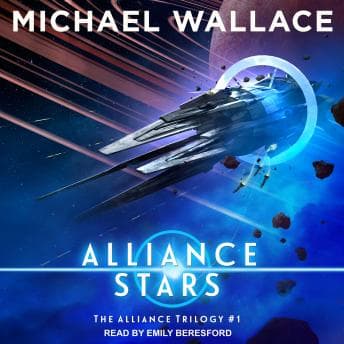

"Shields are failing!" — or something to that effect. Look, I was deep in a nested loop of spaghetti code when Emily Beresford started shouting about space battles, and honestly? It woke me up.
I didn't catch the exact timestamp because I was trying to figure out why my terrain generation algorithm was creating floating mountains again (cool for fantasy, bad for physics), but the energy was undeniable. This is Alliance Stars, and while it might not be rewriting the laws of science fiction, it definitely kept me from throwing my laptop out the window.
Emily Beresford Didn't Come to Play
I read some reviews before diving into this one. A few people were complaining online that Beresford "attempts" character voices. Attempts? No, my friends. She commits.
(Side note: If you prefer monotone reading, go listen to the text-to-speech on my unfinished dissertation. It's thrilling. Dr. Patel loves it.)
Beresford brings the drama. She does accents. She does distinct tones. Is it subtle? Not really. But this is a space opera about alliances and wars—subtlety is overrated. She has this Earphones Award pedigree, and you can tell. She treats every dialogue tag like it's the most important thing in the galaxy. That same commitment to character work is what makes Dark Tower II: The Drawing of the Three so memorable—when a narrator actually inhabits the voices, the whole story clicks. For a guy who spends his life listening to Steven Pacey turn grunt-work into high art, I appreciate the effort. She makes the characters feel distinct, which is crucial because—let's be real—sometimes the writing blends them together a bit.
When the Loop Gets Repetitive
Okay, let's talk about the elephant in the airlock. The reviews aren't wrong—the story gets a little... familiar. Michael Wallace has written a ton of books (Void Queen, Red Sword), and he definitely has a formula.
There were moments where I felt like I was grinding XP in an RPG. Another battle, another desperate situation, another description that sounded suspiciously like the last one. It's the literary equivalent of a fetch quest. You know exactly what you're doing, you know how it's going to end, but the loop is satisfying enough that you keep playing. Wizard's First Rule has that same comfortable rhythm—familiar fantasy beats executed well enough that you're happy to go along for the ride.
But here's the thing: I didn't mind.
Sometimes you don't want a complex, 40-hour political treatise where you have to keep a wiki open just to remember who betrayed whom. Sometimes you just want the audiobook equivalent of a popcorn movie. It's accessible. It's fast. It's nearly 8 hours of "pew pew" and high stakes.
Who's Rolling Initiative on This One?
If you're looking for deep, philosophical sci-fi that challenges the nature of existence? Keep scrolling. But if you want a fun, action-heavy romp with a narrator who acts her heart out—and you've got code to debug or a commute to survive—this is your jam. Skip it if you need intricate world-building or hate when narrators go full theater kid.
Back to My Floating Mountains
I listened to this entire thing in two sittings while pretending to work. It's perfect for that. Engaging enough to keep you awake, but not so dense that you crash your car (or your code) if you zone out for ten seconds.
(Just don't tell Dr. Patel I finished a whole audiobook this week. I'm supposed to be reading papers on Perlin noise.)