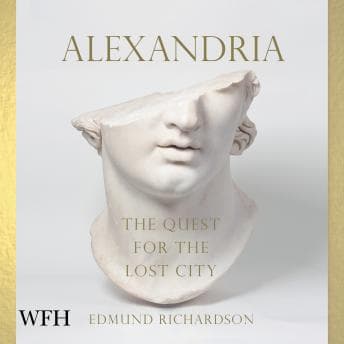

"I am become a ghost." That line hit me around hour three, somewhere on I-35 between Austin and Dallas, and I had to pull over at a rest stop just to sit with it. Charles Masson—born James Lewis, working-class London kid turned East India Company deserter—actually wrote those words about himself. A man who erased his identity so completely that he became invisible, and then used that invisibility to walk into places no European had any business surviving.
Let me cut to the chase: this book is exceptional. Edmund Richardson has done something I rarely see in historical nonfiction—he's made a 19th-century archaeological obsession feel like a spy thriller without sacrificing an ounce of academic rigor.
The Ghost Who Found Alexandria
Masson's story reads like fiction because it shouldn't have been possible. A private soldier deserts the East India Company in 1827—a capital offense—and instead of getting caught and executed, he reinvents himself as a wandering scholar. He learns languages, adopts local dress, travels with Sufi pilgrims, and somehow talks his way into the confidence of Afghan kings. Then he discovers tens of thousands of ancient artifacts, including the Bimaran casket with the earliest known depiction of the Buddha.
Richardson—a classics professor at Durham—spent years tracking down Masson's scattered papers across archives in London, Calcutta, and Kabul. You can feel the weight of primary sources here, but it never becomes a slog. He structures the narrative like a mystery, revealing Masson's real identity gradually, the way Masson himself constructed and deconstructed his various personas.
What got me was the Great Game context. I've read plenty about British-Russian imperial maneuvering in Central Asia, but Richardson shows how a single man could become a pawn in that chess match without ever fully understanding the game. Masson fed intelligence to the East India Company while being suspected of working for the Russians. Both sides used him. Neither trusted him. And the tragedy is that his archaeological discoveries—genuinely world-changing work—got buried under the political chaos of the First Anglo-Afghan War.
When the Author Reads His Own Work
Richardson narrates this himself, and I had mixed feelings going in. Academics reading their own books can go either way—sometimes you get passion, sometimes you get a monotone lecture. Richardson lands somewhere in the middle, closer to the good side. His British accent works well for the material, and you can hear genuine enthusiasm when he's describing Masson's discoveries or quoting from his journals.
This isn't a performance, though. There's no dramatic range when he's voicing different historical figures. Masson's letters, official Company correspondence, Afghan court documents—it all sounds like Edmund Richardson. For a 10-and-a-half-hour listen, I occasionally wished for a professional narrator who could've given the various voices more distinction. But Richardson's knowledge of the material—the way he emphasizes certain phrases, the slight pauses before significant revelations—partially compensates. You're hearing the book from the person who knows it best.
Same Mountains, Different Century
Here's where this book hit different for me. I spent time in Afghanistan. Different century, same mountains, same fundamental problem: outsiders thinking they understand a place they've barely glimpsed. Richardson doesn't beat you over the head with contemporary parallels, but they're unavoidable. Masson watched the British march into Kabul in 1839, confident and superior. He knew it was a disaster before the first shot was fired. He'd lived there. He understood the terrain, the politics, the impossibility of holding that ground.
The British didn't listen. Sixteen thousand people died in the retreat from Kabul in 1842. Masson survived, barely, and spent his remaining years trying to get someone—anyone—to care about his archaeological work. They didn't. He died broke and forgotten in 1853.
(Ranger perked up during the battle descriptions. Good boy knows combat when he hears it.)
Who Should Gear Up—And Who Should Stand Down
If you want car chases and explosions every chapter, this isn't your mission. The pacing is deliberate. Richardson takes time to establish historical context, explain archaeological significance, and trace the bureaucratic paper trails that eventually revealed Masson's secrets. Worth it, but you need patience.
This is for anyone who loves history that reads like adventure. Fans of William Dalrymple's work on British India will feel right at home. If you've ever wondered what the Great Game actually looked like on the ground—not from London or St. Petersburg, but from the mountain passes of Afghanistan—Masson's story delivers. For a different kind of ground-level view of power and chaos, Fire and Fury: Inside the Trump White House offers that same sense of watching history from the inside while the people in charge ignore every warning sign.
End of Mission
Charles Masson deserved better from history. He found a lost city, recovered treasures that belong in any conversation about ancient Buddhist art, and got crushed by the same imperial machinery he'd tried to escape. Richardson has finally given him his due—meticulously researched, compellingly told, and narrated with genuine care.
Worth your time? Absolutely. This is the kind of book that makes you pull over at rest stops just to think. Ranger approved.






![Steve Jobs [unabridged audiobook] audiobook cover](/_next/image?url=https%3A%2F%2Fcovers.audiobooks.com%2Fimages%2Fcovers%2Ffull%2F9788499923406.jpg&w=1920&q=75)