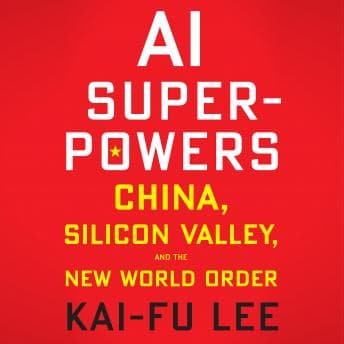

Can we talk about how exhausting it is when every tech book published after 2015 wants to convince you that the robots are coming for your job? I get it, I really do. But I was about three chapters into AI Superpowers before I realized Kai-Fu Lee wasn't just serving up another doom-and-gloom AI apocalypse narrative. He's actually doing something far more interesting—and occasionally frustrating—with his nine hours of your time.
Lee brings credentials that most AI commentators can only dream about. The man ran Google China, worked at Apple and Microsoft, and now invests in AI startups across both superpowers. When he talks about the AI race between the US and China, he's not speculating from the sidelines. He's been in the room where decisions get made, and that insider perspective makes this audiobook genuinely valuable.
The core argument here is provocative: China isn't just catching up in AI—they've already arrived, and in some ways, they're pulling ahead. Lee breaks down why this happened, and it's not the story you might expect. It's not about stolen intellectual property or government subsidies (though those come up). It's about entrepreneurial culture, data access, and what Lee calls the "gladiatorial" nature of Chinese tech competition. Listening to him describe how Chinese startups will copy each other's features within weeks, forcing constant innovation just to survive, made my morning commute feel weirdly intense.
Mikael Naramore's No-Drama Delivery
Naramore handles the narration with the kind of steady professionalism that business audiobooks desperately need. His voice is clear and measured, never getting in the way of the material. He doesn't try to dramatize Lee's predictions about job displacement or add artificial urgency to discussions of machine learning algorithms. For a book packed with technical concepts and cultural analysis, his straightforward delivery is exactly right. You can listen at 1.25x without losing anything—a blessing for a nine-hour commitment.
The Cultural Analysis That Actually Earns Its Claims
This is where the audiobook really shines. Lee grew up in Taiwan, was educated in the US, and has spent decades working in both Silicon Valley and Beijing. His comparisons between American and Chinese tech culture feel genuinely earned rather than superficial. The section on how Chinese companies approach user data—with far fewer privacy concerns than their Western counterparts—is eye-opening and more than a little unsettling.
Lee also does excellent work categorizing which jobs AI will actually threaten. He creates a framework based on social interaction and creativity that's more useful than the usual hand-waving about automation. Truck drivers? Probably in trouble. Therapists? Probably safe. It's practical, specific analysis that actually helps you think about the future rather than just fear it.
The Pivot You Won't See Coming
Now, here's where I have to be honest about the book's strange structural choice. The final portion takes a sharp personal turn. Lee was diagnosed with stage IV lymphoma, and he uses that experience to pivot toward a discussion of meaning, purpose, and what he calls a "human-AI coexistence." It's heartfelt and clearly genuine, but it also feels like you've wandered into a different book entirely. After hours of rigorous analysis, suddenly you're getting life advice about spending more time with family and finding work that machines can't replicate.
The shift reminded me of Essentialism, which also pivots from productivity frameworks to deeper questions about what actually matters—though Greg McKeown at least commits to that philosophical lane from page one.
Is this a flaw? I'm genuinely unsure. Some listeners will find it moving—a reminder that all this technological change ultimately matters because of how it affects real human lives. Others will feel like Lee abandoned his analytical framework right when they wanted concrete policy solutions. He dismisses universal basic income fairly quickly without offering equally detailed alternatives. The idealism is sincere, but it doesn't quite satisfy after such a thorough diagnosis of the problem.
Who Gets Value Here (And Who Won't)
If you want to understand the AI landscape—especially the China dimension that most American coverage either ignores or sensationalizes—this is essential listening. Lee's insider perspective and cultural fluency give him insights that pure technologists or pure economists simply can't match. The book was published in 2018, and while some specific predictions have aged (as all tech predictions do), the fundamental analysis of why China became an AI powerhouse remains relevant.
Queue this up if: you want strategic analysis of the US-China AI competition from someone who's actually been in both ecosystems. Skip it if: you need concrete policy prescriptions or can't handle a philosophical detour after hours of business analysis.
The Debug Report
Just be prepared for that tonal shift at the end. Lee clearly wanted to write something more than a business book, and whether that ambition elevates or undermines the final product depends entirely on what you're looking for. If you want pure strategic analysis, you might find the ending frustrating. If you're open to a more philosophical conclusion, it might be exactly what you need to hear after nine hours contemplating the displacement of human labor.