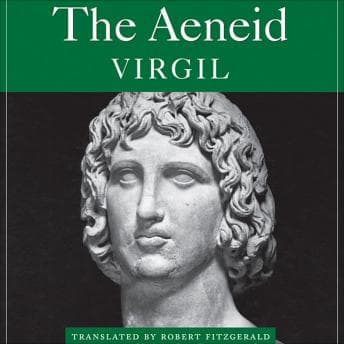

Two thousand years. That's how long the Aeneid has been shaping how we think about duty, destiny, and the terrible cost of empire. I finished this one during a late-night grading session—papers stacked like miniature Troy walls around me—and found myself staring at the ceiling for a solid ten minutes after Ravenscroft delivered those final lines. My red pen sat untouched. The sophomores' essays on symbolism could wait.
Robert Fitzgerald's translation has been the gold standard since 1983 for good reason. He understood something crucial: Virgil wrote poetry, not prose dressed up in fancy clothes. The lines breathe. They have rhythm. They demand to be heard aloud, which makes this audiobook feel less like an adaptation and more like a restoration—returning the epic to its original oral tradition.
That Breathy, Intimate Mic Presence
Christopher Ravenscroft makes an interesting choice here. His delivery is close to the microphone, almost conspiratorial, like he's telling you secrets about gods and men in a darkened library. It works beautifully for the intimate moments—Dido's grief practically crawls into your chest—but creates this fascinating tension during battle sequences. You're getting war filtered through whispered urgency rather than booming theatrics.
The Trojan Horse sequence alone justifies the Earphones Award. Ravenscroft becomes Sinon, the crafty Greek who convinces the Trojans to drag their doom inside their own walls, and his voice shifts into something slippery and persuasive. Then minutes later, when Troy burns, that same voice carries genuine horror. Not performed horror. The kind that catches in the throat.
What impressed me most was how he handles the gods. Jupiter sounds like inevitability itself. Juno's rage feels personal, petty, divine. He gives each character—mortal or immortal—what the AudioFile review called "an indelible impression." I'd go further: he makes you understand why ancient Romans genuinely believed these beings controlled their fates.
The Weight of Pietas
My students always struggle with Aeneas. "He's so boring," they complain. "Why doesn't he just stay with Dido? Why does he always do what the gods tell him?" And I get it. We're raised on heroes who rebel, who choose love over duty, who punch destiny in the face. That tension between personal desire and larger obligation shows up in It Ends With Us too, though in a completely different context—sometimes the hardest choice is the one that protects something bigger than yourself.
But listening to Ravenscroft's Aeneas, I finally heard what I've been trying to teach for two decades. This isn't a man without passion—it's a man who carries the future of an entire civilization on his shoulders and knows that his personal happiness is irrelevant to that burden. When he leaves Carthage, when Dido's funeral pyre lights the horizon behind his ships, Ravenscroft doesn't play it as cold duty. He plays it as a man who has chosen to break his own heart because Rome matters more than Aeneas.
That's the thing about the classics. They're not artifacts. They're arguments. Virgil is making a case for what civilization costs, and Ravenscroft understands that case needs to be felt, not just heard.
Who This Is (and Isn't) For
This is not background listening. Don't put this on while cooking or pretending to pay attention in faculty meetings. (Principal Martinez, I'm kidding. Mostly.) Fitzgerald's translation is dense with imagery, and Ravenscroft's intensity demands your focus. I'd recommend dedicated listening sessions—maybe an hour at a time—with space afterward to let the poetry settle.
If you loved the Iliad but found it chaotic, the Aeneid offers something more structured, more Roman in its discipline. If you're coming from modern fantasy epics and want to understand where Tolkien got his sense of doom-laden destiny, this is required listening. If you're a teacher looking for a way to make this accessible to students who think anything written before 1950 is automatically boring—hand them this audiobook.
Skip it if you need action every five minutes. The Aeneid has spectacular set pieces, but it also has long passages of prophecy, divine council, and catalog of Italian tribes. Ravenscroft makes these compelling, but they require patience.
Class Dismissed
Here's what I keep thinking about: Virgil died before finishing the Aeneid. He wanted it burned. Augustus refused. And now, two millennia later, I'm listening to an English actor interpret a translation of a poem that its author considered incomplete, and it still hits like nothing else in Western literature.
The final battle between Aeneas and Turnus ends abruptly, violently, without the resolution we expect from modern storytelling. Ravenscroft delivers that ending with a kind of shocked finality that left me genuinely unsettled. Which is exactly right. Virgil wasn't writing comfort. He was writing truth about what power requires.
My students would absolutely hate this. I loved every minute.