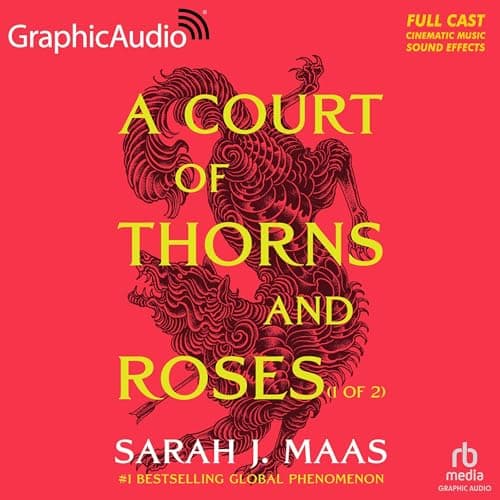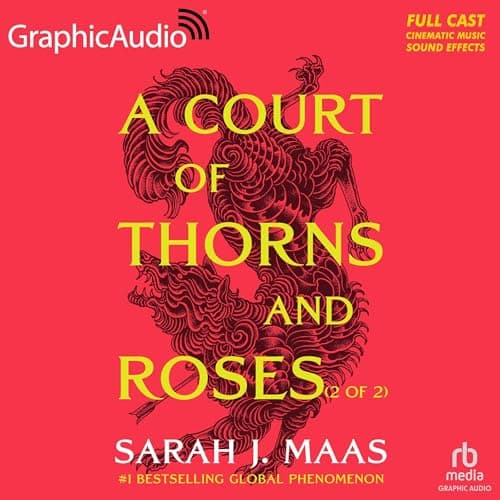

I was halfway through a solo road trip when Part 2 kicked in, and I genuinely forgot to stop for gas. That's either a ringing endorsement or a safety hazard, depending on your perspective.
Here's what you need to know up front: if you listened to Part 1 of this dramatized ACOTAR adaptation and thought it was fine but a little slow, Part 2 is where the format actually earns its keep. The first half of Maas's novel is romance and worldbuilding—pleasant enough in a full-cast production, but not exactly demanding the bells and whistles. I noted the same slow burn in Court of Thorns and Roses (1 of 2) [Dramatized Adaptation], which I gave a four—solid, but always feeling like it was building toward something bigger. Part 2 is Under the Mountain. It's Amarantha. It's the trials, the political maneuvering between courts, and that ending. And the dramatized format turns all of it up to eleven.
Let me get specific about what works. The Under the Mountain sequences benefit enormously from the layered sound design. When Feyre is trapped in that oppressive, claustrophobic court, you can hear it—the echo of stone chambers, the ambient tension underneath dialogue. It's not subtle, but it doesn't need to be. The climactic sequence at the end, which I won't spoil for the three people who haven't read this yet, gains genuine visceral impact from the production. Multiple listeners who've read the book five or six times report being gripped all over again during that final stretch, and having experienced it myself, I get it. The combination of overlapping voices, rising score, and sound effects creates something a single narrator simply cannot replicate.
Rhysand's arrival in the story is where the full-cast format pays its biggest dividend. Hearing a distinct actor embody his unsettling charm—separate from Tamlin's voice, separate from the narrator—makes the political tension between courts feel immediate rather than described. You're not being told Rhysand is dangerous and magnetic; you're hearing it in real time, and the contrast with Tamlin lands harder because of it. Think of it like finally hearing a D&D party where every character has their own distinct voice instead of your DM doing slightly different accents. Lucien similarly benefits from having his own dedicated voice. His loyalty, his frustration, his humor—these come through in ways that even a skilled single narrator would struggle to differentiate at this pace.
Now, the trade-offs. They're real, and whether they bother you depends entirely on what kind of listener you are.
The background music is a persistent issue. During action scenes, the cinematic score works beautifully—it drives momentum and raises the emotional stakes. But during quieter emotional beats, it sometimes feels like it wandered in from a different scene. A tender moment between Feyre and Tamlin shouldn't sound like a boss fight is about to start. The volume mixing is inconsistent enough that you'll occasionally strain to hear dialogue over the score, which is exactly the wrong priority for an adaptation that lives or dies on its performances.
The dialogue flow problem from Part 1 carries over here too. Because this is adapted from prose, not written as a script, you get narrated scene descriptions wedged between lines of conversation. It's like watching a play where someone walks onstage between every exchange to describe the set. If you're locked in and paying attention, your brain smooths over these interruptions. If you're doing dishes or only half-listening, they'll make the whole thing feel choppy and unnatural. One listener compared it to a video game cutscene, and that's honestly not unfair.
A few mispronunciations surface—'win-ded' instead of 'wind-ed' being the most cited. In a production with this level of polish, those moments are jarring. And the fake-sounding laughter from certain group scenes remains an irritant. Individual performances are strong across the board, but some of the reactive ensemble moments—gasps, laughs, crowd murmurs—have a stagey quality that breaks the immersion the rest of the production works so hard to build.
Who Should Listen (And Who Should Skip)
Buy this if you enjoy full-cast audio drama, you want the ACOTAR story to feel like an event rather than a narration, and you're willing to give it your full attention. The Under the Mountain material and the ending genuinely benefit from this format in ways that surprised me. Skip this if interrupted dialogue flow will drive you crazy, if background music competing with voices is a dealbreaker, or if you'd rather have a clean, unadorned prose narration where the words do the work. The standard audiobook exists for a reason.
At just under six hours, Part 2 moves fast. The action-heavy back half of the novel suits this format better than the slower romance of Part 1, and you'll likely finish it in one or two sittings. It's not a flawless production—the music mixing and adapted-prose awkwardness keep it from that—but when it connects, it connects hard. That ending alone justifies the listen for anyone who already loves this story and wants to experience it from a completely different angle.










![Court of Thorns and Roses (1 of 2) [Dramatized Adaptation]: A Court of Thorns and Roses 1 audiobook cover](/_next/image?url=%2Fimages%2Fcovers%2F3bcc2829-f877-4390-9481-cbc4af7c28aa.jpg&w=1920&q=75)