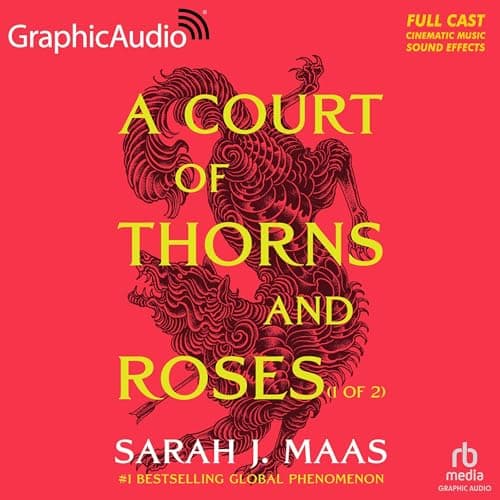

Look, I have a bone to pick with dramatized adaptations that treat background music like it's the main character. I was sitting in my audiologist's waiting room - hearing aid recalibration day, the irony isn't lost on me - when the Spring Court scenes kicked in and this swelling orchestral score nearly drowned out Feyre's dialogue. As a hard-of-hearing listener, this hit different. And not in the good way.
But let me back up. Because when this production works, it genuinely works.
The Cast Does What a Single Narrator Can't
Twenty-plus actors. That's not an audiobook - that's practically a radio play. And the thing is, having distinct voices for Feyre, Tamlin, Lucien, and the rest of the Spring Court crew eliminates the mental gymnastics you normally do when one narrator switches between characters. Melody Muze carries Feyre with this raw, stubborn edge that fits the huntress-turned-prisoner arc. Henry W. Kramer's Tamlin has weight to him - not just "brooding love interest" weight but actual tension, like he's holding something back even when he's being kind. When Tamlin laughs in that scene where Feyre's guard finally starts cracking, you can hear the relief in it. That's not just reading lines. That's performing.
Gabriel Michael as Lucien? Probably the standout for me. There's a sharpness there, a sardonic bite that makes every scene with him feel like the most interesting conversation in the room. That kind of ensemble chemistry—where every voice adds friction and texture—showed up in a completely different register in Tears of the Moon, which also leans hard on cast dynamics to do the emotional heavy lifting. The full cast creates instant social dynamics you'd otherwise have to imagine.
Where the Production Gets in Its Own Way
Here's where I got frustrated. The dramatized format adds scene-setting narration between dialogue beats, and sometimes it kills the momentum dead. Two characters are building tension, voices layering emotion - and then a narrator cuts in to describe what the room looks like. It felt like someone pausing a movie to read stage directions out loud. For a story that's already on the slower side in Part 1 (Feyre's adjustment to the Spring Court takes its time), these interruptions made certain stretches drag.
And the mispronunciations. "Win-ded" instead of "winded" pulled me right out of an otherwise solid scene. I sync text with audio constantly for my accessibility work, and pronunciation inconsistencies are the kind of thing that compounds - once you catch one, you're listening for the next one instead of following the story.
The sound effects mostly land. Feyre's hunting scenes in the woods have this crunchy, cold atmosphere - snow underfoot, bowstring tension, wind through bare branches. Cinematic, yeah. But some of the background music choices felt mismatched to the emotional temperature of scenes. A quiet, vulnerable moment between Feyre and Tamlin doesn't need what sounds like a fantasy trailer score underneath it. Clarity over spectacle - always. And clarity over volume, too.
Accessibility - Almost There, Not Quite
This is the part where I put on my consultant hat. A full-cast dramatized production should be an accessibility win. Multiple distinct voices means less cognitive load for listeners who struggle with single-narrator character differentiation. The sound design adds spatial cues. In theory, this format is gold for listeners like me.
But the music mixing undermines it. When score and dialogue compete for the same frequency range, my hearing aids have to choose. And they don't always choose the dialogue. I found myself rewinding more than I should've, especially during the louder action sequences. If the production team had pulled the music back about 30% during dialogue-heavy scenes, this would've been a much cleaner listen. Accessibility done right means thinking about the mix, not just the performance.
Should You Spend a Credit on Half a Book?
This is Part 1 of 2. Six hours gets you through the slower setup - Feyre's family, the wolf kill, arriving at the Spring Court, the gradual thaw with Tamlin. The ending reportedly picks up significantly in Part 2, and multiple re-readers say the second half is where the payoff lives. So you're committing to two credits for the full story.
If you've already read the book and want to re-experience it with spatial audio and a full cast, this format delivers something the standard audiobook can't. If this is your first time with the story, be ready for a slow build in Part 1 - the romance and action both simmer more than boil here. Skip this version if you're hard-of-hearing and sensitive to music-heavy mixes without dialogue isolation options - the mixing will fight you in the louder scenes.
The Caption-Sync Verdict
The performance is layered enough to feel, even when the production stumbles over its own ambition. The cast earns it. The sound design mostly earns it. The music mixing and pacing interruptions hold it back from being the definitive way to experience this story. I wanted to love this without reservations - a full-cast fantasy adaptation with sound design is exactly what accessibility-forward audio should look like. But "almost there" is still "not there yet." Part 2 apparently tightens everything up, so I'm cautiously in for the second half.










![Court of Thorns and Roses (1 of 2) [Dramatized Adaptation]: A Court of Thorns and Roses 1 audiobook cover](/_next/image?url=%2Fimages%2Fcovers%2F3bcc2829-f877-4390-9481-cbc4af7c28aa.jpg&w=1920&q=75)