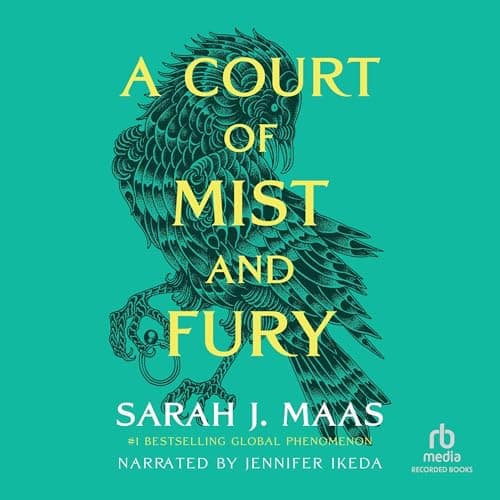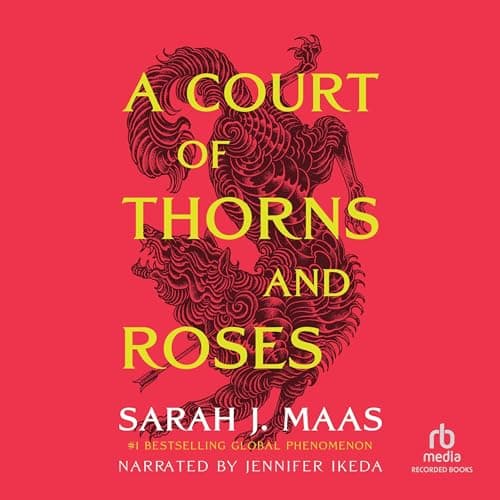

I started this one after closing the library on a rainy Thursday, shelving returns in that weird after-hours silence where every cart squeak sounds haunted. Not exactly the Night Court, but close enough for Oregon. By the time Feyre killed the wolf in the woods and that impossible, terrifying creature came to collect the debt, I was in. Not gently. Fully.
This audiobook works because it understands the assignment: hunger first, glamour second. Sarah J. Maas is building a romantasy machine here, yes, but the early engine is fear. Survival. Bargains made under pressure. A girl who has spent so long keeping everyone alive that she barely knows what desire even feels like until it arrives wearing claws and a temper.
Where the beast-story gets its teeth
The obvious frame is Beauty and the Beast with fae politics draped over it, but the reason people get hooked is that Maas keeps tilting the fairy-tale furniture until it feels dangerous again. Feyre isn't wandering into a whimsical magical realm. She's dragged into one because she killed something she didn't understand. That's a much better starting point. Meaner. More folkloric. Something about that folkloric meanness reminded me of the disorienting dread I felt reading Alice's Adventures in Wonderland — another story where being dragged somewhere you don't understand is the whole horror.
And the audiobook helps sell that shift from human desperation to faerie unease. Jennifer Ikeda gives Feyre a grounded, warm urgency that matters because Feyre can be prickly, stubborn, occasionally self-defeating — and if the voice leaned too petulant, the whole thing would collapse. Instead, Ikeda makes her sound tired in a real way. Not theatrical exhaustion. Survival exhaustion. You hear the guardedness when she's thrown into Tamlin's estate, and you hear it soften by degrees rather than all at once.
Tamlin is where listeners are either going to melt a little or roll their eyes, and honestly? Ikeda does a lot of heavy lifting there. His voice shifts from hostile to tender, and that's exactly right. Early on, there's a hard, almost clipped edge to him — enough to preserve the threat. Later, that edge eases into something gentler without turning him into mush. Important distinction. This series lives or dies on whether the attraction feels earned through proximity, suspicion, and weird little moments of vulnerability. In audio, it mostly does.
I also have to mention the atmosphere around the blight spreading through Prythian. That's the part I found most interesting this time around. Beneath the romance, there is genuine rot in this world — old magic going wrong, courts under strain, rules everybody is pretending still function. This understands that horror isn't about gore — it's about dread. The sense that the beautiful house is already cursed, everybody knows it, and they keep setting the table anyway.
Jennifer Ikeda commits — after a slight adjustment period
Let's talk about the thing some listeners complain about: the voice can sound a little artificial for the first couple of chapters. I get why people say that. There's a controlled crispness to Ikeda's delivery at the start that can read as overly measured if you're expecting immediate warmth. I needed a little time with it too. Not long. But enough to notice.
Then the performance settles into itself.
And once it does, the character work becomes the reason to stay. Ikeda's Amarantha has that spiteful, mocking tone listeners keep bringing up, and yes — it lands. She doesn't play Amarantha as loud evil. She plays her as someone enjoying the game a little too much, which is worse. Way worse. It's the kind of choice that gives those later scenes a poisoned-candy quality.
The narrator commits. That's rare.
Rhysand's entrance is another smartly handled moment. You can hear the tonal change immediately: charisma sharpened into threat, amusement used like a blade. He sounds like trouble before the text fully confirms it, which is exactly what that character needs. Not because he's simply "mysterious" — every fantasy man with cheekbones gets called mysterious — but because his energy disrupts the entire emotional balance of the book.
Production-wise, this is clean. Single narrator, no music, no sound effects, no gimmicks. Good. This series doesn't need a bunch of atmospheric padding to tell you something ominous is happening. The tension is in the performance and in the gradual tightening of the plot. If you want something to half-listen to while answering emails, though, this probably isn't it. The first stretch especially asks for attention because the world-building is laying track while the romance is still deciding what shape it's going to take.
For the readers who want claws with their courtship
I think the divide on ACOTAR usually comes down to what you came for. If you want dense political fantasy from page one, this may feel slow until the book shows its sharper edges. Sixteen hours is a real commitment, and the middle stretch does linger in that simmering mode where glances, rituals, and withheld information are doing most of the work. If you're impatient, you'll feel that.
But if you like a slow-burn structure where attraction develops alongside dread — where the pretty estate, the masks, the curses, and the don't-go-into-the-woods energy all matter — this absolutely hits. And once the story pivots into its darker final movement, it becomes much harder to pause. That's when Maas stops flirting with menace and starts using it.
Who should skip? Anyone allergic to romantasy tropes, anyone wanting horror-horror instead of dark fairy-tale tension, and anyone who needs a narrator to feel instantly natural in the first ten minutes. Who should listen? Anyone who wants their courtship served with teeth — just know the fear here is secondary to the romance, not the other way around.
As audiobooks go, this is worth the credit because Ikeda gives the book shape. Not flashy shape. No big stunt performance. Just smart vocal choices, steady escalation, and an understanding that Feyre's emotional evolution has to sound believable or none of the faerie glamour means anything.
I didn't listen to this one in the dark for once. Rain against the library windows was creepy enough. Shirley (my cat) was unimpressed. I was, annoyingly, fully invested.