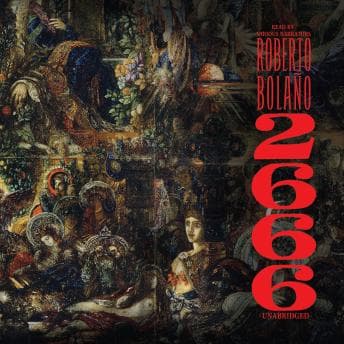

I started 2666 during spring break. Denise and I drove down to visit her sister in St. Louis, and somewhere on I-57, about two hours south of Chicago, Armando Durán began telling me about four European literary critics obsessed with a reclusive German novelist named Archimboldi. I didn't finish the book until three weeks later, walking the lakefront at dawn before school, grading at midnight, sneaking in chapters during lunch duty. Thirty-nine hours. That's longer than most TV series. And I'm not sure I've fully recovered.
Let me be honest with you: this is not a book that makes itself easy to love. But it is a book that makes itself impossible to forget.
Five Narrators for Five Books — And It Actually Works
Bolaño wrote 2666 as five interconnected novels, and the audiobook production assigns each one its own narrator. This could've been a disaster. Instead, it becomes the book's secret weapon.
Armando Durán handles "The Part About the Critics" — the opening section where four academics from different European countries circle each other intellectually and romantically while chasing the ghost of Archimboldi. Durán's Spanish-inflected English is perfect here. These are cosmopolitan Europeans moving through conferences and hotel rooms and affairs, and his voice carries that slightly formal, slightly passionate energy that makes you believe these people would fly across continents because of a sentence in a novel. I believed it. I've been that person. (Not with the flying. Teacher salary. But with the obsession over a sentence — absolutely.)
G. Valmont Thomas picks up "The Part About Amalfitano" and brings this dry, deadpan humor that sneaks up on you. Amalfitano is a philosophy professor whose mind is fraying at the edges — he hangs a geometry textbook on a clothesline to see what the elements will do to it — and Thomas reads him with this kind of exhausted lucidity that feels exactly right. You're laughing, but it's the laugh of recognition. The man is losing his grip and he knows it.
Grover Gardner narrates the Oscar Fate section — the African American journalist sent to cover a boxing match in Santa Teresa (Bolaño's fictional Juárez) after his mother dies. Gardner's pacing is the best of the five. Deliberate. Controlled. He understands that Bolaño is building dread here, not action, and he lets the silences between sentences do their work. The narrator understands that pause is punctuation.
Then comes Scott Brick with "The Part About the Crimes." And here's where listeners split hard. This section is — there's no gentle way to say this — a catalog. Body after body. Young women murdered in Santa Teresa, each death reported in clinical, almost bureaucratic prose. Some listeners think Brick's slightly melodic, character-forward style is wrong for this material, that it needed someone flatter, more monotone, to match the numbing horror Bolaño intended. I go back and forth. Brick's character voices are genuinely outstanding — his cops and detectives feel distinct and lived-in. But in those long forensic passages, the singsong quality occasionally fights against the text's devastating flatness. It's the one section where I wished I could swap narrators mid-stream.
John Lee closes with "The Part About Archimboldi," and he's the quietest, most subtle of the five. Which is exactly what that final section needs — it's a life story told with enormous patience, moving from World War II through decades of literary obscurity, and Lee reads it like a man sitting across from you in a dim room, telling you something important but refusing to raise his voice.
The Book That Swallows Other Books
This reminds me of what Hemingway said about prose being like icebergs — most of the meaning sits below the surface. Except Bolaño inverts it. He gives you everything. Every digression, every character's cousin's neighbor's dream. And somehow the accumulation IS the meaning. You're 25 hours in, reading about the 87th unsolved murder in Santa Teresa, and it hits you: the repetition isn't laziness. It's rage. It's Bolaño refusing to let you look away, refusing to let any single death become just another statistic.
My students would hate this. I love it. But I also understand the hate. I reviewed Brimstone: Booktrack Edition a while back and got a handful of emails from listeners saying it was too dense — which, honestly, made me realize how differently we all draw the line between challenging and punishing. Some listeners find the meta-literary digressions — the novels within novels, the academic arguments about obscure European writers — self-indulgent. And at 39 hours, your patience will be tested. There are stretches in the Amalfitano section where I was grading sophomore essays simultaneously and genuinely couldn't tell you which was more disorienting, the homework or the novel. (The novel. By a wide margin.)
But here's what Bolaño is really saying, underneath all of it: we build elaborate structures of meaning — criticism, philosophy, journalism, literature — and none of them can contain the brute fact of violence against the powerless. The critics search for Archimboldi. Fate searches for a story. The cops search for a killer. Nobody finds what they're looking for. And those women are still dead.
If you loved The Savage Detectives, this is its spiritual successor — bigger, darker, more willing to stare into the void without blinking.
Who This Is For (and Who Should Run)
This is for people who treat reading as a commitment, not entertainment. If you want plot resolution, clean arcs, or anything resembling closure — skip this entirely. If you've ever read Pynchon or Sebald and thought "yes, more of this," then clear your calendar. You'll need three to four weeks at a reasonable pace.
Do NOT listen to this as background audio. You'll lose the thread within minutes and spend the rest wondering who these people are and why someone is hanging a book on a clothesline.
The prose deserves to be savored. 1.0x speed. No exceptions. Natasha Wimmer's translation won the National Book Award for a reason — every sentence has weight, and speeding through it would be like fast-forwarding through a funeral.
Worth Pausing the Faculty Meeting For
2666 is the kind of book that changes what you think books can do. It's unwieldy, sometimes maddening, occasionally transcendent. The five-narrator approach mostly works beautifully — Durán and Gardner and Thomas and Lee each bring something distinct and essential. Brick is the wild card, brilliant with character work but occasionally at odds with his material. Thirty-nine hours is a staggering commitment, and I won't pretend every one of them earns its keep.
But I finished it three days ago, and I'm still thinking about it during faculty meetings. (Sorry, Principal Martinez. Again.)
This is why we still read the classics. Even the ones that haven't had time to become classics yet.